
| story by | |
| photos | Kansas Historical Society, KansasMemory.org (Copy and reuse restrictions apply.) |
| OPEN A PDF OF THE ARTICLE |
The 19th century in Lawrence consisted of much turmoil but also progress toward a new way of life for the town.
19th Century Lawrence
In the 1870s, Lawrence, Kansas, was a prosperous community with a diverse economy. It was founded during the Kansas territorial conflict, but after the Civil War, it went through the processes of becoming a thriving town.
The city of Lawrence was established in 1855, but its early years were turbulent, with two attacks on the young community. In the years preceding the Civil War, the United States was engaged in a controversy over the expansion of slavery. The Kansas-Nebraska Act of 1854, enacted on May 30, 1854, created the territories of Kansas and Nebraska. It was assumed that Nebraska would be a free state, but the conflict about whether Kansas would be proslave or free commenced immediately. The Act also repealed the Missouri Compromise by allowing slavery to be decided by popular sovereignty. Lawrence was at the center of the territorial conflict (also known as Bleeding Kansas) preceding the Civil War. The city was established in 1855 by the New England Emigrant Aid Company, which helped Free State settlers travel to Kansas Territory.
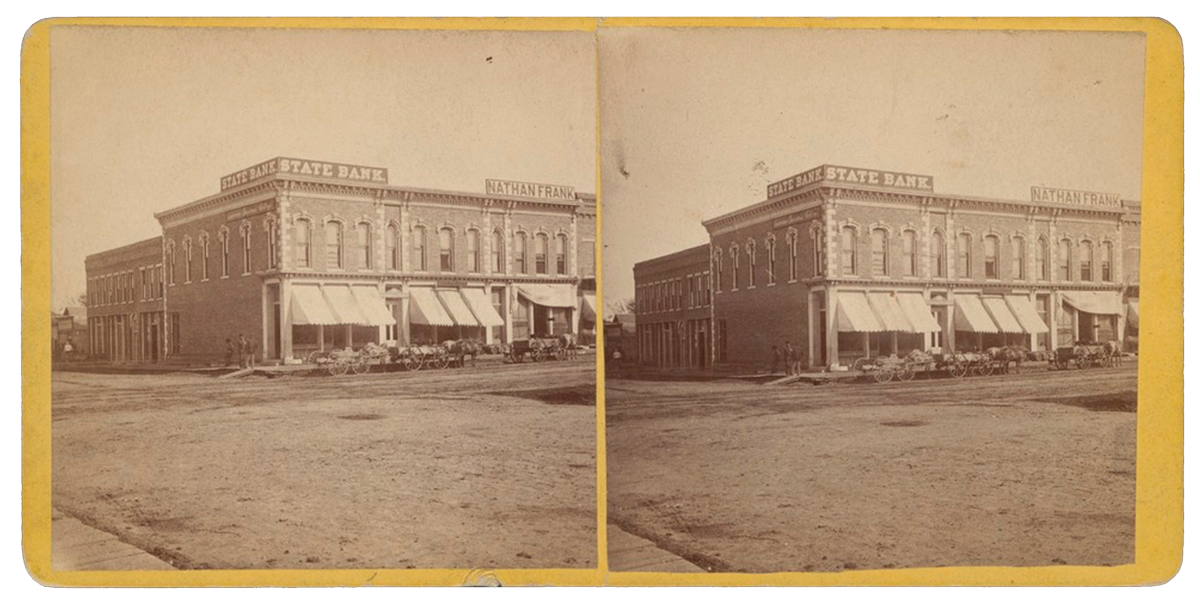
Business buildings on Massachusetts Street in Lawrence, Kansas. Signs for the State Bank and Nathan Frank, a wholesale grocer, are visible. Photo courtesy Kansas Historical Society, KansasMemory.org. Copy and reuse restrictions apply.
The first confrontation between Free State supporters and proslavery proponents occurred on May 21, 1856. It was called the sacking of Lawrence, when pro-slavery supporters shut down Lawrence’s newspapers—the Kansas Free State and the Herald of Freedom. The offices and the presses were destroyed, and although the Herald of Freedom resumed publication, it was several months before that occurred. The Free State Hotel was destroyed, as was Charles Robinson’s home. Robinson served as the New England Emigrant Aid Company’s official financial agent, and his efforts eventually led to the founding of Lawrence.
LOCAL MATTERS
Our Local Advertisers – Making a Positive Impact
The second turbulent event was a raid by William Quantrill, a Confederate guerilla. His band of about 300- to 400-plus men arrived in Lawrence at daybreak on Aug. 21, 1863. By noon, the raiders had destroyed more than 200 homes and businesses, and left 150 men dead or dying. On Quantrill’s orders, his guerillas killed around 150 men and boys who could carry a rifle. When Quantrill’s men rode out of the city, most of Lawrence’s buildings were burning, including all but two businesses.
In spite of these devasting events for Lawrence, by the mid-1870s, Lawrence was experiencing the typical existence of a new town on the Kansas prairie. The population in 1875 was 7,268, and the surrounding Douglas County had 18,505 residents. This included 9,334 males and 9,171 females, with 5, 805 born in Kansas. Other settlers immigrated from Denmark, France, Germany, Great Britain, Ireland, Norway and Sweden. Lesser numbers came from other parts of Europe and British America. One of the usual questions census takers asked was, “Where from to Kansas?” The largest number of settlers came from Missouri, followed by Illinois, Indiana and Ohio. Others came from a variety of other states. Douglas County waterways included the Kansas and Wakarusa rivers. It also had a number of small streams and springs. Well water could be accessed at a depth of 25 feet. While there was some coal in the county, it was of poor quality. The area around Lawrence had a large quantity of good-quality building stone, with many limestone structures being constructed. Though not plentiful, the varieties of timber included walnut, ash, hackberry, oak, elm and cottonwood.
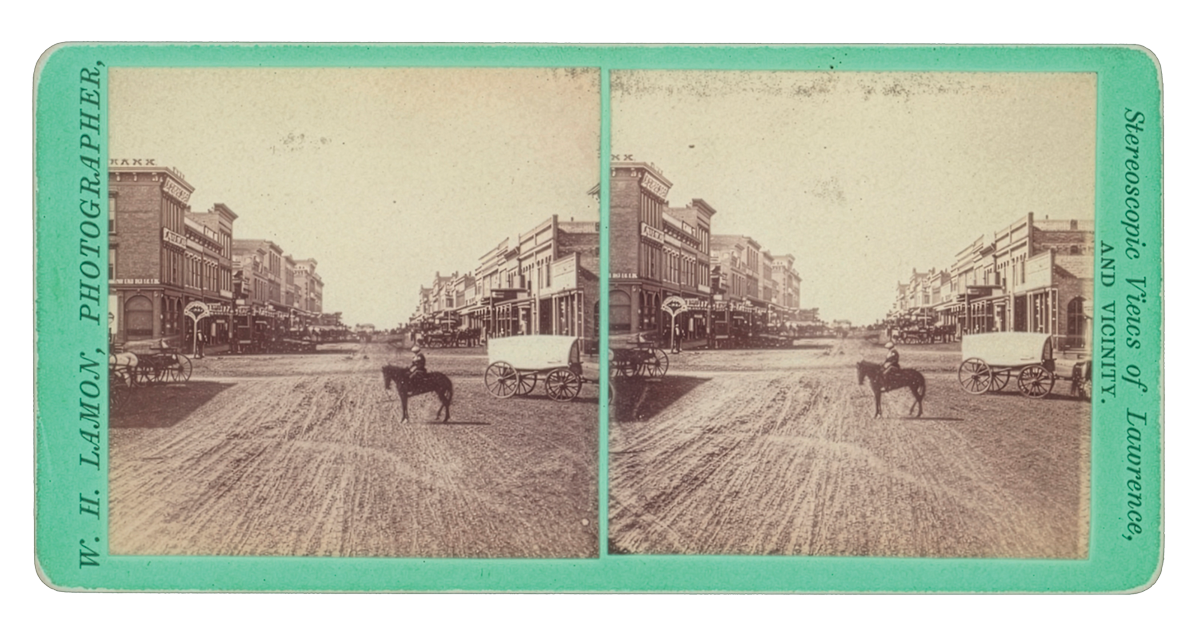
Massachusetts Street looking north from Henry Street (now Eighth Street). Photo courtesy Kansas Historical Society, KansasMemory.org. Copy and reuse restrictions apply.
A number of railroads had portions of routes in Douglas County. The Kansas Pacific Railway had a principal station in Lawrence. The Lawrence and Southwestern Railroad connected with the Atchison, Topeka and Santa Fe Railroad in Carbondale, in Osage County. The Leavenworth, Lawrence and Galveston Railway had stations in Lawrence, Baldwin and Prairie City. Several other railroads operated in the county.
Occupations of residents included 47.9% engaged in agriculture, 23.9% in professional and personal services, 13.9% in trade and transportation, and 14.1% in manufactures and mining. A listing of business in an 1873 county atlas contained 20 lawyers, two architects, five banks, 10 contractors and builders, three druggists, 15 grocers and markets, and six realtors. Other business listed included two agricultural implement dealers, boots and shoes, blacksmithing, baker, dry goods, hotels and boarding houses, lumber dealers, liveries, four physicians and a number of other businesses. The 1875 Kansas State Board of Agriculture report listed manufacturers as a planning mill, machine shop, seven wagon and carriage factories, four grist mills, two breweries, four packing houses, three furniture factories and a brick manufactory, among others. As for income, farm laborers earned $8 to $20 per month with room and board;, city laborers, 75 cents to $1.50 per day; bricklayers and stone masons $2 to 3.50 per day. Clerks made $25 to $100 per month. Other workers were paid a variety of wages.
Other community amenities in Douglas County included 84 organized school districts with 93 schoolhouses. The State University (Kansas University) was located in Lawrence. A number of denominations had organized churches. This included five Presbyterian, six Congregational, five Baptist, four Methodist, six Catholic and a number of other churches with one building.
This profile of Lawrence in the 1870s provides a great glimpse into life in the town. But as is very unusual for this period, a photographer named W.H. Lamon took several stereopticon views of downtown Lawrence.