| story by | |
| photo by | Steven Hertzog |
| OPEN A PDF OF THE ARTICLE |
Lawrence’s large artist population not only contributes to the creative side of the local community but also connects it to the wider world through its artistic and business pursuits.
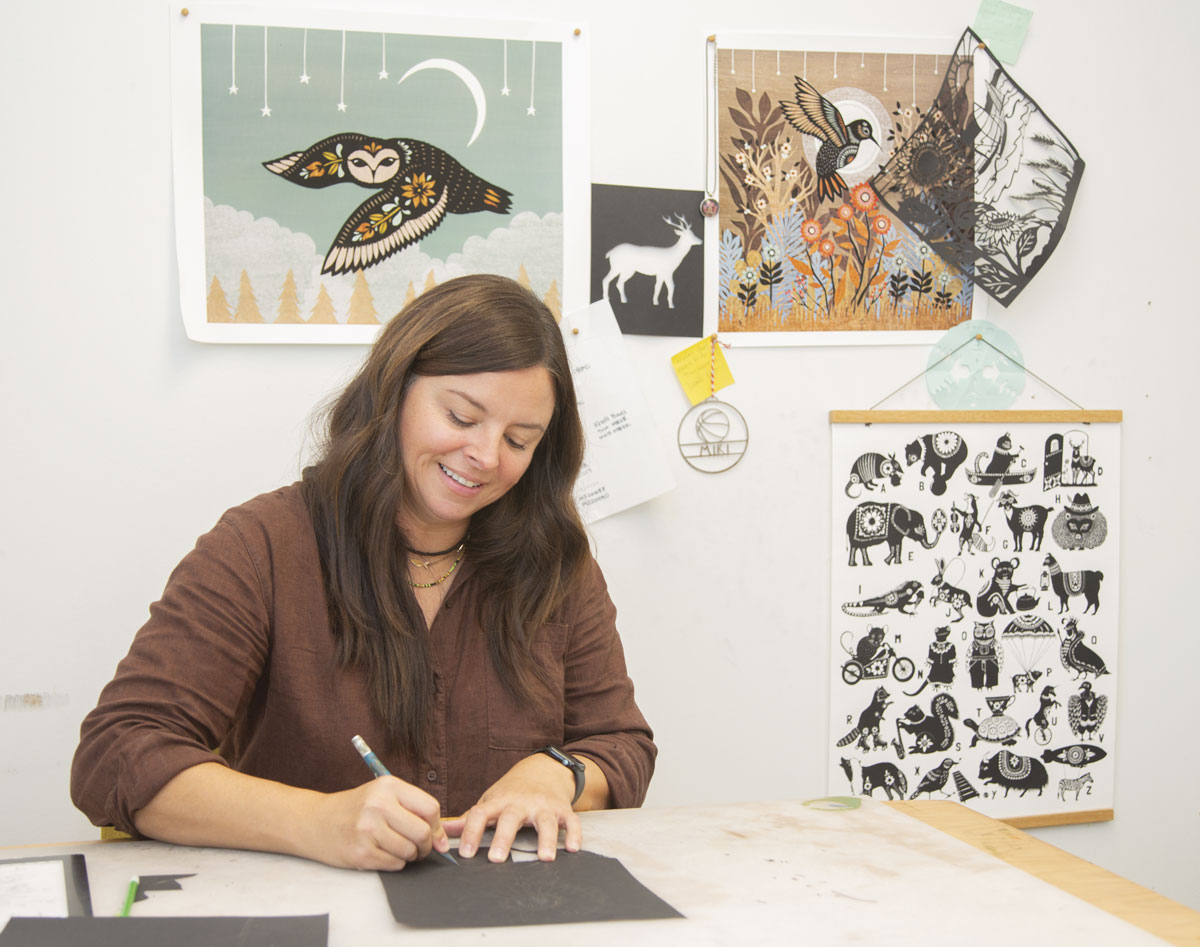
Angie Pickman works in her East Lawrence studio.
Depending on the culture in which you live, an artist’s response to “What do you do for a living?” may vary drastically. In cultures of the world that believe artwork has an intrinsic value, the response may be one of awe or reverence. For example, in Europe for thousands of years, art and artists have been highly valued. It is truly an eye-opening experience to walk through Florence or Rome, or other countries and cities in Europe and see murals lining the ceilings, the paintings one after another hung on walls and the sculptures becoming part of landscapes, in addition to being displayed on the inside and outside of buildings. These works were usually commissioned by the church, families or businesses.
There are many other areas around the globe where art and artists are highly valued both culturally and monetarily, who champion expression, cultural worth, truth-seeking, beauty, challenge, pain and healing, and many other aspects of art. In our society, the response may be more mixed, as monetary denominations sometimes squeeze out the reasons artists create and the benefits creatives can bring. Through challenges, artists have been and will continue to be the canary in the coal mine for any culture.
There is a small group of artists, a treasure trove that has broken the norms. These artists are not only able to make art because they are pulled with an internal drive that demands action for creation, obeying and cultivating the expression of their inner voice, they also have the uncanny ability to find a way to monetize this desire. We have a unique situation in Lawrence, as we have a larger percentage of professional artists living and working here than in a majority of cities in the U.S.
Adapt and Adjust
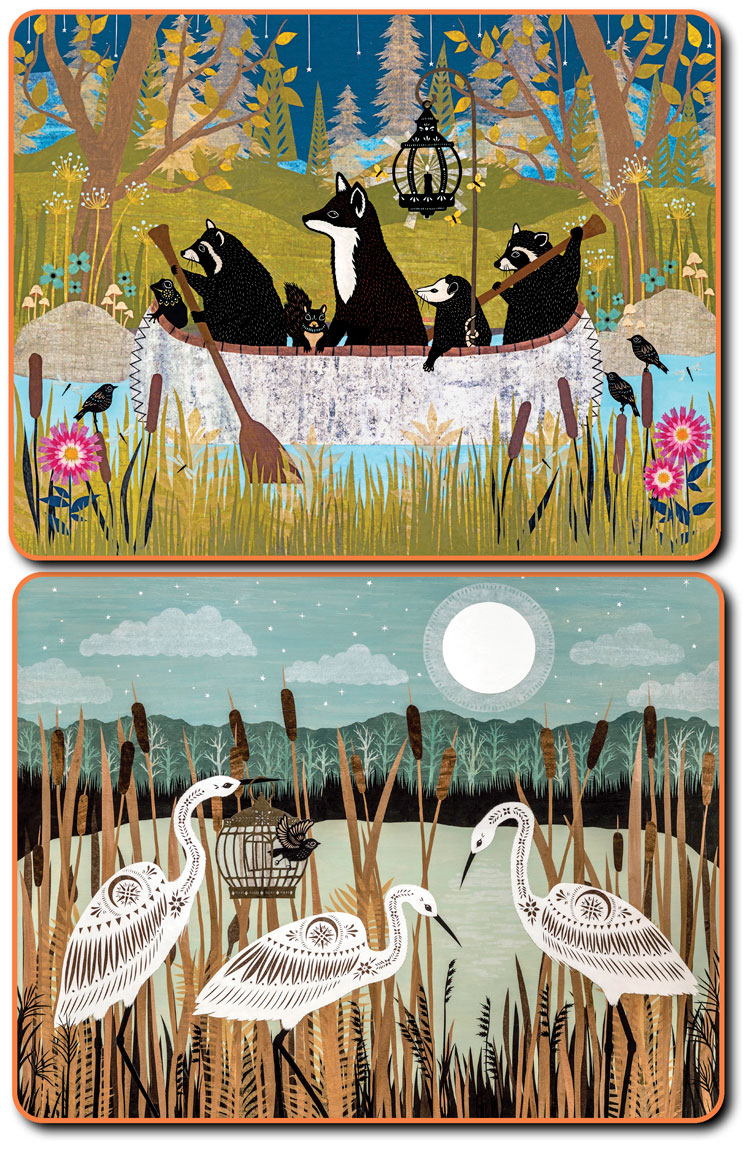
Angie Pickman’s Hand-cut paper collages, 48 in x 60 in.
Where The Lantern Light Leads, 2025.
Beyond The Rushes Tall, 2024.
Working professionally for around 17 years, Lawrence artist Angie Pickman is known nationally for her striking and well-designed cut paper images. Now, after her work was also involved in the Lawrence/Algerian connection during the 2026 FIFA World Cup, it is also known internationally. Her work titled “Within Your Grasp” is a cut paper piece that includes a fox in the foreground and crescent moon peeking out from tree branches, with flowers radiating around the fox. It was chosen as an official diplomatic offering by the City of Lawrence to be gifted to the Algerian Ambassador Sabri Boukadoum. The fox in Angie’s gifted artwork correlates to the Algerian team’s fennec fox mascot, and the crescent moon corresponds to the symbol on their national flag.
Pickman’s work was inspired originally by animation artist Lotte Reiniger, “whose shadow puppet films inspired me to start doing what I do.” She says she “has been fortunate to have had a great response to my artwork since I started showing it … so part of that I think is just luck. Part of it is writing down my artistic and business goals, and always doing something that stays on the path of achieving those.”
She explains that part of the positive response to her work is also listening to her audience and observing how it reacts to her work and adapting. And part of it is just following her own intuition and doing what feels right to her.
For Pickman, a certain level of success in art is the ability to make a living off her work, but she doesn’t think that is the only marker of success as an artist or person. “Ultimately, I think the biggest success is finding joy in what you are doing.”
She takes a very businesslike approach to her work, focusing on a few specific avenues, some seasonal. In the spring and summer, Pickman attends art festivals. “I also wholesale my printed reproductions to retailers around the country, do custom work, license my work to various companies for different products and have my studio and online store where people can visit and purchase art. If one avenue is in a lull, there is usually something else keeping me busy.”
She also pays attention to the business, and if she finds that something needs to change, she adapts and makes adjustments.
Pickman sells her original work but also sells prints, which is one way that she can keep her art accessible and always have something available to those who enjoy her work. “Over the last few years, I have significantly expanded my wholesale reach, now selling to several hundred stores across the country. Most of my retail sales are generally in person at art shows and online. I’ve been fortunate to have had strong sales in the last year, up from the previous year, both at art shows and through wholesale.”
Because she stays quite busy, other than the art shows to which she applies, any exhibition or other opportunity most likely came about because she was invited. Pickman says, “I am proud to have my work represented in a number of public and private collections. Some of the most meaningful collections I’ve become part of in recent years are those of children’s hospitals and medical clinics.”
She says creating and providing work for these environments has influenced her to think more intentionally about the emotional experience her art can provide. “I want the pieces to create a sense of peace and wonder, and hopefully transport the viewer away from any worry and uncertainty of being in a medical setting,” Pickman explains.
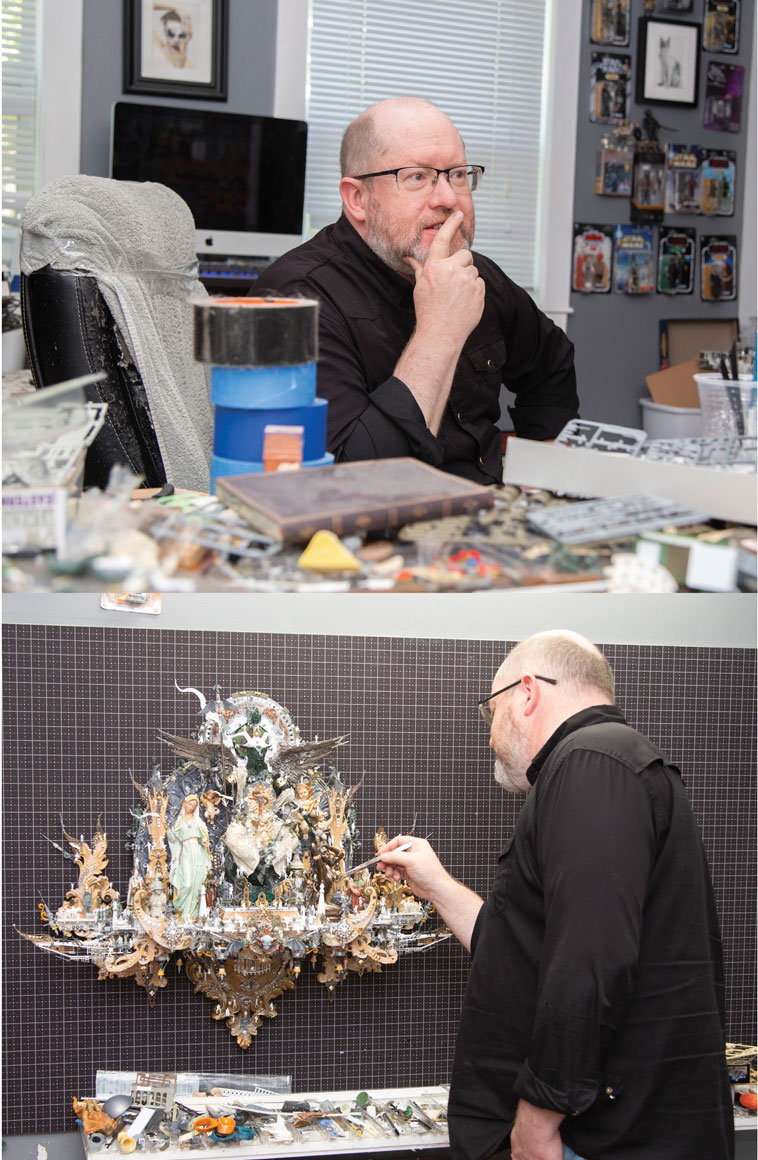
Kris Kuksi, working at his desk and putting the final touches on his new creation.
A Tricky Path
I first saw Kuksi’s work at the PULSE Contemporary Art Fair during Art Basel Miami Beach and was drawn to the beauty, maximalism, references to baroque or Gothic architecture, surrealism and the sheer overwhelming number of objects highlighting allegories. Kuksi isn’t a fan of limiting his work to a specific categorization or characterization. Topics that heavily influence his art? “Human psychology, history, architecture. I’m not particularly inspired by other art, as that is the result of someone else’s inspirations,” he explains. “I prefer the direct sources that lead to that for myself.”
LOCAL MATTERS
Our Local Advertisers – Making a Positive Impact
He says he loves patterns, design, the macabre, very old things, ruins. Airplanes that no longer fly are one of his favorite concepts. “An object that was alive, burned fuel, flew long distances but now rusting in a museum on display as a form of its former glory. I like movement in stillness. Light with dark, chaos and order.”
Kuksi didn’t begin as a sculptor but was focused on drawing and painting naturalistic pieces. He says, “Building things, sculpture, this thing I do is my calling. I wanted to be a painter for my career, but it’s not about ego. Drive is important, but art is a tricky path one can’t force to fit your comfort levels.
“Sculpture chose me because that is what the world wanted,” he continues. “I wanted it, too, so here I am 20 years deep. I’ve always liked ‘composer’ more than ‘artist’ or ‘sculptor.’ I just love to make arrangements according to the relationships of forms in unity and balance.”
The phrase “art is a tricky path” is one that is very true for any artist who would like to marry vocation with passion. Kuksi found that one of the biggest changes he had to make recently was stepping away from the necessity of working with galleries. He has moved on to the “realm of self-promotion, and just old-fashioned word of mouth still works in the tech boom fuzz of shortened attention spans.”
When it comes to selling his work, “Communication is key,” he says. “I’ve found that it’s not about selling a product. Serious art collectors don’t buy stuff, they buy experience. Art is the experience, so as an artist, you have to embrace that and allow yourself to be open and receptive.
“Success arrives when other people copy you. Especially when big corporations do,” Kuksi explains. He says the U.S. copyright law and the legal system have helped him defend his work in these cases. “ … There’s going to be folks (who) tell you you can’t do that or this, or that nothing can be done for certain situations or events. There’s always a way; success has many different definitions.”
When it comes to what’s most important to artists: “Have your boundaries. Don’t worry about being famous or wealthy; none of that stays with you when you reach the end of life. Purpose and servitude to your community, collectors, anyone else who believes in you is most important,” he says.
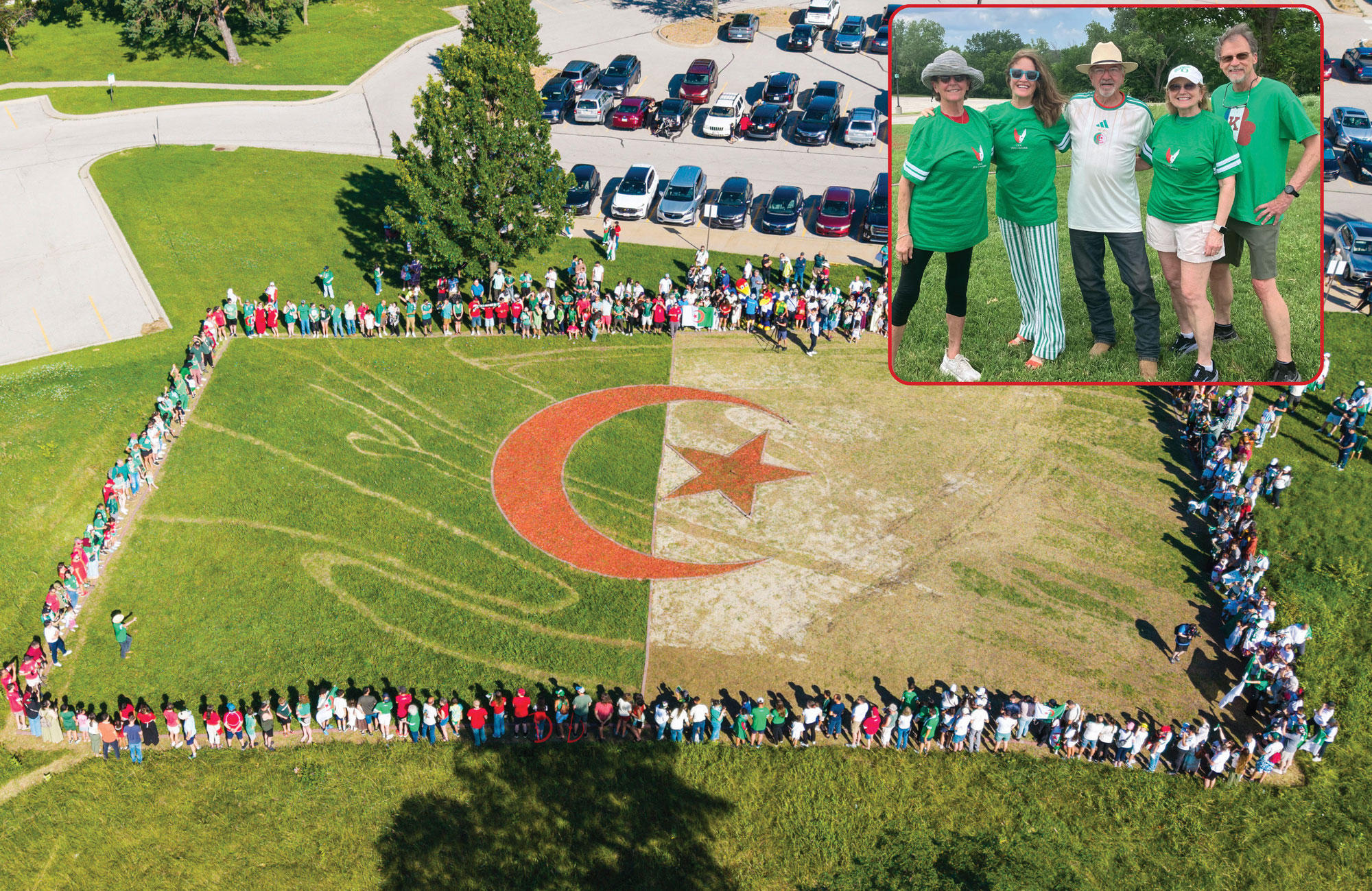
The now universally famous Algerian Flag designed and created by Stan Herd; Stan with Susan Tate and others at the Algerian Flag celebration.
Moving With the Times
Artist Stan Herd, most known for his large dramatic Earthworks, or Crop Art works, made mostly out of natural objects and land, has been a fixture in the Lawrence community for many years. Recently, Herd’s public art utilized humans in the large reproduction of the Algerian flag at the Lied Center of Kansas, which was part of the 2026 FIFA World Cup. Herd firmly believes that “most successful artists, musicians, singer/songwriters, filmmakers and creative people … have to embrace the new, move with the times and embrace the reality of the ‘present.’ ” He believes humanity has never experienced anything remotely as “evolved” as the times we are living in at this moment—an era of the Anthropocene, wherein mankind has altered the planet in such a way that anyone who is not aware is just not paying attention. “It’s important to me to mirror this ‘zeitgeist,’ ” he explains.
Despite the challenges of the current human condition, Herd defines success as an artist: “It sometimes comes down to my ability to overcome cynicism about whether art really has much value in these modern times. Often enough, I seem to convince myself that it does, so I keep on creating. But studying the history of art over my lifetime leaves me intellectually cautious about assuming that ‘art made today’ makes much of a difference in the big picture. I try not to become addicted to my fears and buy into a ‘psychosis of doom and gloom,’ he says.
So his process to make art and to embrace a ‘life worth living’ is to spend a little time daily or weekly lamenting the failure of responsible stewardship of the planet then bust loose for a good glass of wine and a KU football game—or paint just because it makes him feel good.
The recent success of Herd’s Algerian flag installation at the Lied Center in Lawrence created a substantial amount of positive press regionally, nationally and internationally. This notability came out of a year of frustration, trying to work with other organizations before the World Cup. The news from other countries that were planning to attend the World Cup also were not looking favorably on the situation, with challenges of international travel, including getting visas, high prices and a general sour feeling about how the U.S. was treating its visitors.
“At a time when most of the visiting FIFA countries were viewing America as an unfriendly destination, the citizens of Lawrence, Kansas, showed the world a level of hospitality and love that changed the perception globally,” he says.
The Forbes article “The Top 5 Pop Culture Moments From The FIFA World Cup So Far,” by Olivia Shalhoup, named “Algeria and Lawrence, Kansas, Fall in Love With Each Other” as No. 3. “Nobody saw this one coming, and that’s exactly what makes it the most wholesome subplot of the tournament,” Shalhoup wrote. “In a matter of days, the Algerian national soccer team captivated the city of Lawrence, Kansas, with World Cup fever, a whirlwind romance that blossomed before they even played their first match in Kansas City. Lawrence, home to The University of Kansas (KU) Jayhawks, became an unexpected international darling as the college town made headlines around the world for its mutual love affair with the Algerian men’s national soccer team, known as Les Fennecs.”
LOCAL MATTERS
Our Local Advertisers – Making a Positive Impact
What a great example of the intrinsic value that art has to challenge biases and perceived notions, giving way to the opportunity for better relationships. What is life but for its quality defined by relationships within the community and throughout the world?
“Making art is a ‘passion of the mind’ that infects the heart and settles the stomach, soothes the soul and embellishes the dream state,” Herd says. “In the end, it is really just a ‘state of mind’ … and I believe … a ‘health’ state of mind. So forget about all the cynicism espoused earlier and just follow the urge to create as ‘catharsis.’
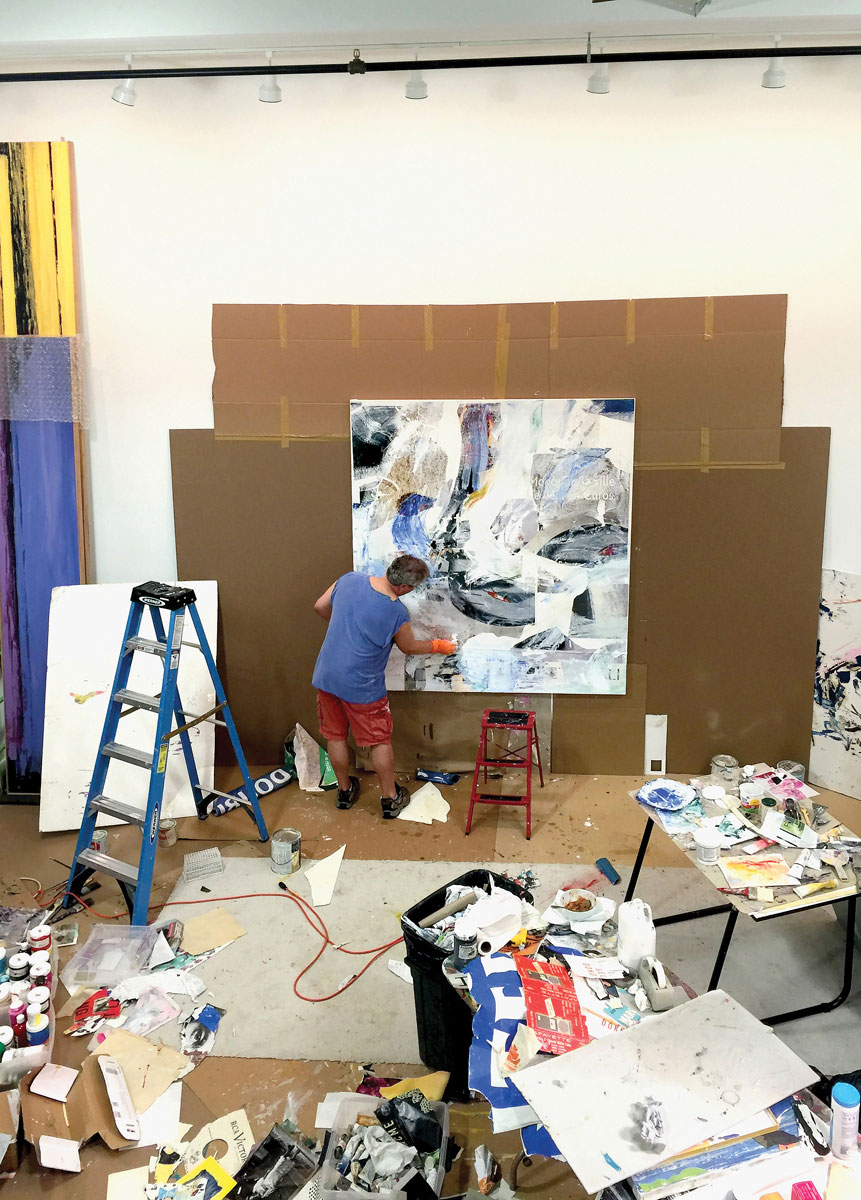
Stephen Johnson in his studio painting a large abstract .
Curiosity Is Key
Stephen T. Johnson has been in Lawrence (and his family before him) for many years. He is comfortable communicating in not only foreign languages but also in many artistic mediums and processes. “My artistic practice, whether painting, illustrating or creating public art, revolves around joy and wonder. Whether I am illustrating a children’s book, designing a mosaic for a public space or making an abstract painting, I am searching for relationships between perception and imagination, structure and spontaneity,” Johnson says.
The joy and wonder are clear in Johnson’s artwork, but this does not downplay the fact that it is hard work and also a business. There are many challenges that any artist starting out should be aware of, he explains. “One must have a thick skin being an artist, for there are just as many disappointments as there are successes. As someone who has spent many years applying for public art commissions, I know this well. They are extremely competitive, often requiring weeks of research, design and writing simply to become a finalist.”
Johnson says the ups and downs of a freelance lifestyle can create an emotional roller coaster where past successes and current work can be overshadowed at any moment by a rejection or a project that never comes to fruition.
Johnson grew up in a home with “international flavor” here in Lawrence. Both of his parents were French professors at The University of Kansas. “The wonderful mix of talented people living and working in Lawrence has long inspired me through interactions at my family home, countless dinners, parties and friendships,” he says. He attended both Lawrence High School and KU. He played French horn in high school and lead guitar in rock bands, as well as doing various jobs growing up. “Those experiences continue to shape me today,” he says. “I also rely on many talented local people to help bring the work to life. I like to say that it takes a village to make an art show, and in my case, that village has long been Lawrence, Kansas—rich with talent, generosity and creativity.”
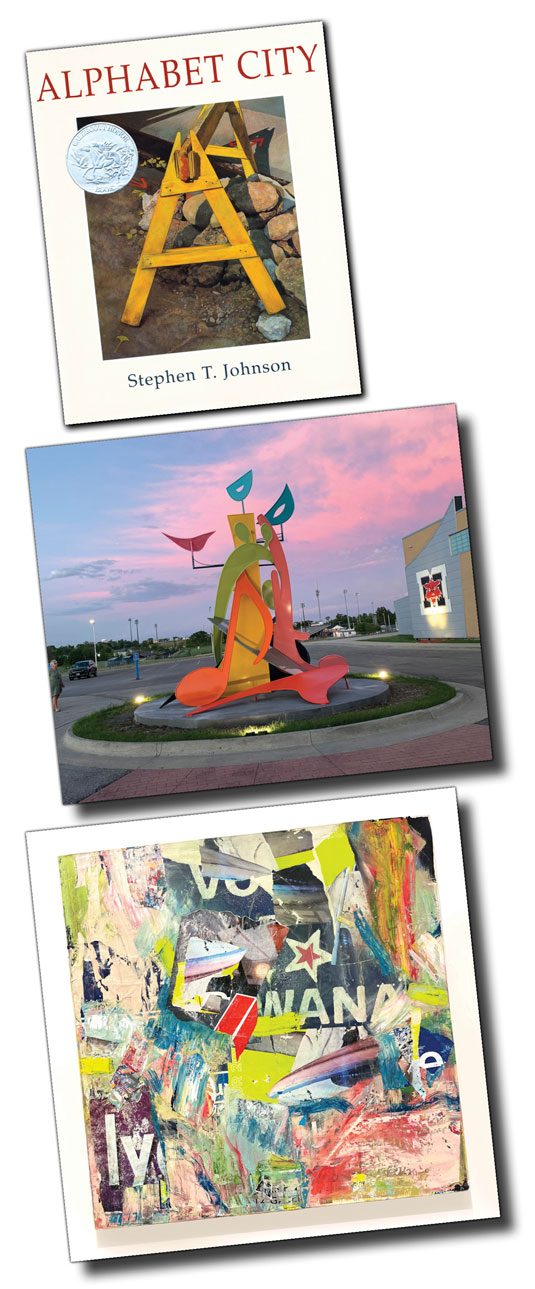
Top to bottom: Alphabet City by Stephen Johnson is a Caldecott Honor Book, and a NY Times Best Illustrated Book of the Year winner
Scherzo, Colorful abstract forms based on musical notations and celebrate the rhythms, sounds, and ideas generated within this outstanding Marshalltown Performing Arts Center
Xmas in Paris. Oil and Paris Métro posters on canvas, 48 × 48 inches, 2023.
Johnson spent a number of years outside of Lawrence studying and living in New York City and France. One of his favorite projects was his Caldecott Honor-winning book “Alphabet City,” which remains one of his most significant bodies of work, exploring the letter shapes hidden within urban environments from A through Z. “I had never painted such photorealistic imagery before, and the project challenged my skills anew,” he says.
Johnson continues to challenge himself and look forward: “I’m most excited about ideas for projects I have yet to discover. I’m exploring new and unusual materials while developing several themes for a larger body of work that has been on the back burner for many years.” He says he’s also completing several private commissions and working on a children’s book for his publisher, Simon & Schuster. “Each new project fills me with joy, gratitude and the excitement of discovering something I didn’t know was there before.”
Johnson, like his parents before him, also teaches at KU, although he is teaching classes in illustration. He believes curiosity, more than any skill, has always been his greatest teacher, whether picking up a new material or learning to work with fabricators. “Every new project asks something different of me, whether collaborating with architects and fabricators, or embracing new technologies. I see art as both a creative pursuit and a professional practice. Each project teaches me something that informs the next, allowing me to continue growing while remaining true to the core ideas that have guided me throughout my career.”
Johnson also has his own definition of success. He says, “Success, for me, is less about awards and honors than my connection to a project and the people involved. If my work has made a positive impact on a place, a community or a client, I consider that success.”
As a town, Lawrence is extremely lucky to have so many professional visual artists living and working here. They are creating, making, pushing boundaries, passionately challenging themselves and others, as well as interacting with our city, our state, our nation and internationally, all of which has brought the world to us.