
| story by |  |
| photo by | Steven Hertzog |
| OPEN A PDF OF THE ARTICLE |
These local companies may ship their products worldwide, but they are perfectly happy being based right here in the middle.
Made in Douglass Co
From aerospace components to innovative health-care products to acoustic automobile features, products made or developed by Lawrence-based companies reach millions of people every day, giving this college town an outsized role in industries that span science, health care, manufacturing and beyond.
As a CEO of one of the city’s wide-reaching businesses put it, Lawrence isn’t just perhaps a surprising hub of national and international business reach, it’s a home well-suited to research, development and manufacturing of products that impact and benefit millions nationally and worldwide.
“Lawrence isn’t just home to companies that can design and manufacture valuable products for people across the globe,” says Dr. Nick Love, cofounder and CEO of Love Lifesciences, “it is a place where students are educated, trained and can subsequently be employed to utilize and hone those valuable skill sets.
“Lawrence is a place where ideas become prototypes, prototypes become clinical-trials-ready products, and products can be manufactured and scaled—all in one location,” he adds. “And that is just on the physical product side.”
Love knows this from personal experience. His company, Love Lifesciences, started in 2021 and, cofounded by Chief Technology Officer Bradley Hopper, is part of KU Innovation Park (KUIP). It invented, manufactures and distributes the UNIPEN, a pharmaceutical injection device designed to optimize efficiency, safety and precision across a diverse range of therapies.
Love Lifesciences isn’t alone among area businesses whose products are consumed far and wide.
DARcorporation (DAR stands for Design, Analysis and Research) is an aeronautical engineering company on the northern edge of the city that provides aircraft design and analysis, wind energy, engineering and prototyping, and software and books not only for companies nationally and internationally, but for the U.S. government and NASA.
Adler Pelzer Group is a German company with one of its nine U.S. manufacturing locations on the eastern edge of Eudora. It operates under its subsidiary brand name, HP Pelzer Automotive Systems, and is a worldwide leader in the design, engineering and manufacturing of acoustical and thermal components and systems for the automotive sector.
While these three companies operate in completely different business sectors, all can agree on one thing: Lawrence and the Douglas County area provide an environment ripe for innovation, creation and productivity.
“I know Lawrence, (The University of Kansas), KU Innovation Park and the community as a whole have been integral to Love Lifesciences’ success and the success of many other businesses in the medtech and pharmaceutical spaces,” Love says. “Lawrence really is a place that has many of the key components necessary to build a thriving business, from talent development to product development.”
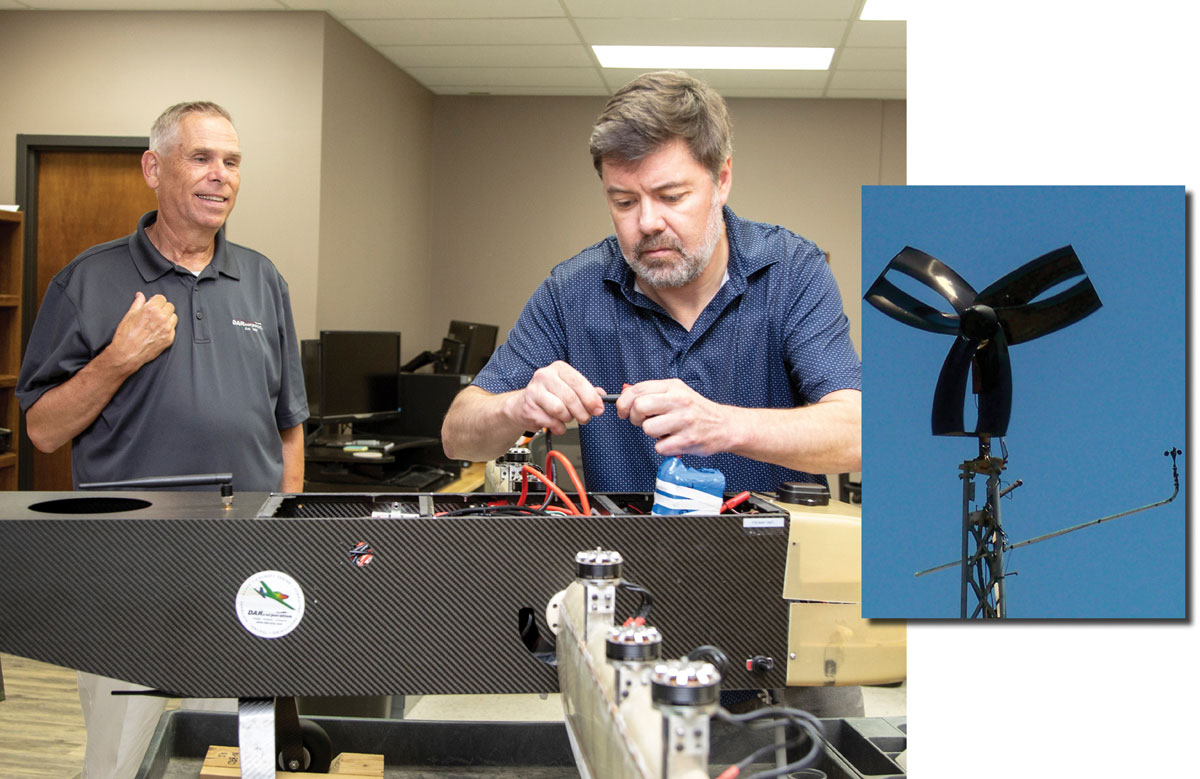
Top: Dr. Willem Anemaat, President, and Rob Zernickow, Flight Test Engineer, with the NASA MAVRIK Research UAS
Bottom: Hi-Q 61 Full Scale Wind Turbine Designed and Built by DAR corporation
A Lifetime Love of Flight
Willem Anemaat gets visibly animated when showing a visitor around DARcorporation’s new office and shop facilities, especially when it comes to presenting some of the current projects on which his team of engineers are working. On one table is a small aircraft the team is designing for NASA, to be used for research and scouting. A small side room houses several 3D printers busily carving out creations and components. There is another small aircraft Anemaat’s team is designing to compete in an upcoming aeronautics competition. To win the DARPA Lift Challenge and its $6.5-million prize money, the team must design and engineer a drone that can vertically lift at least four times its own weight.
“We’re in the process now of building a fuel-powered engine for it,” Anemaat says. “We started with an electric engine, but the batteries weighed too much.”
DARcorporation emerged as a company in 1991 and was founded by Jan Roskam, a distinguished professor in aerospace engineering at The University of Kansas (KU). But the company’s conceptualization occurred a couple years earlier when he and one of his graduate students, Anemaat, began throwing around ideas.
“Jan wrote eight books on aircraft design,” says Anemaat, who attained a Ph.D. in aerospace engineering from KU in 2007. “We automated that into educational software for aircraft design. It sold in over 60 countries.”
When Roskam retired in 2004, Anemaat and his wife, Mary Jo, bought him out, and Willem became DARcorp’s president. Mary Jo is vice president.
The business has been headquartered at several locations throughout Lawrence—First on Ninth streets, out on Wakarusa for 16 years and then out near Haskell Indian Nations University before moving to its current location on Lakeview Road, just north of Interstate 70, last year.
“We moved here Feb. 1, 2025,” Anemaat says. “It’s one level, which worked out better layoutwise for us.”
While he says 90 percent of his company’s revenue (which was around $2.5 million last year) comes from software and consulting services, DARcorporation’s team of 12 full-time employees, along with help from a handful of KU interns, is involved in a dizzying array of projects that include, but are not limited to, single-engine propeller aircraft, multiengine propeller, jet-powered kit aircraft, light-sport aircraft, experimental hybrid air/ground vehicles and wind turbines.
If it flies, DARcorporation most likely can create it.
“We had 24 people and were doing $5 million a year before COVID,” Anemaat says. “Now, we’re being a little conservative. We’re starting to do more in hardware, making things.”
He says DARcorporation has an ongoing partnership with Auburn University dealing with innovative research and small-business technology transfer.
“We do a lot of subcontracting for other companies on design work,” Anemaat adds. “Reverse engineering.”
While much of the company’s work is now military and for the U.S. government and NASA, he says DARcorporation has done some military consulting with Turkey and provided some work for China on a skydiving simulator.
“When I go to other Chamber of Commerces, people say, ‘Lawrence?’ ” he says. “I like being in the middle of the country. You don’t have to travel far to get anywhere. It’s low cost. We can do flight testing without prying eyes. There’s plenty of space. It’s worked perfectly for us.”
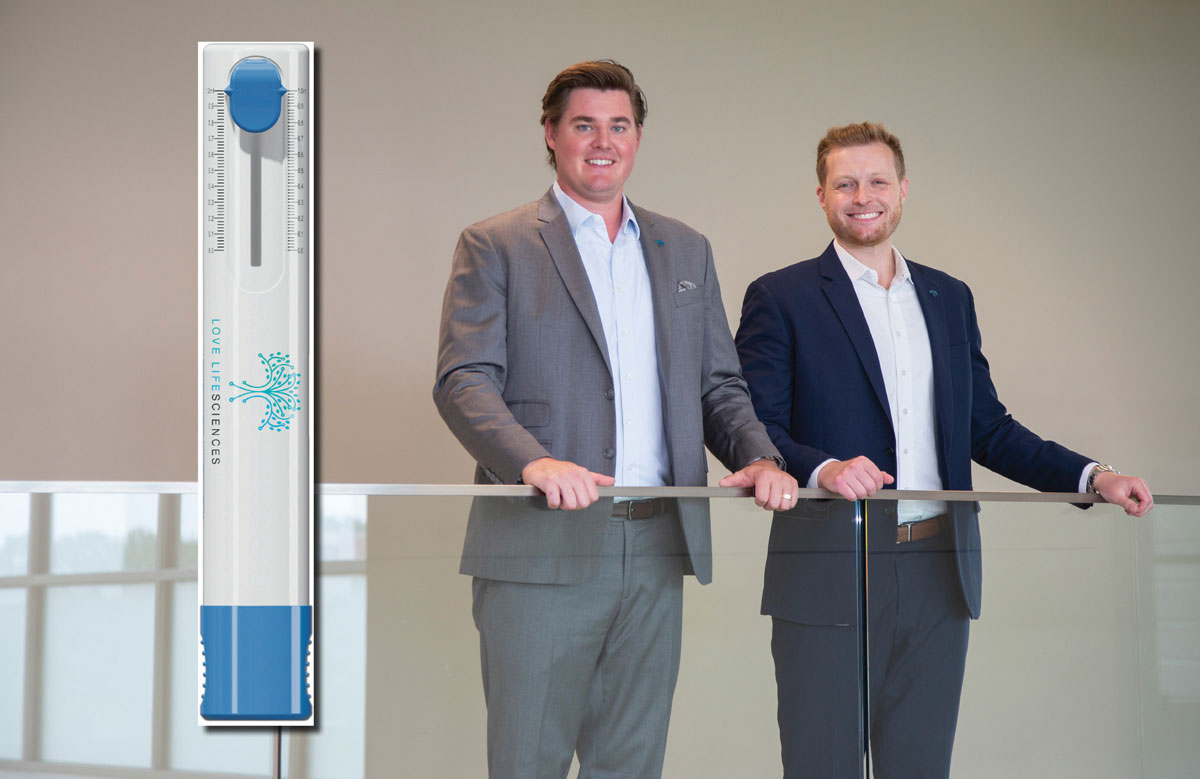
Bradley Hopper, CTO & Co-Founder and Nick Love, CEO & Co-Founder of Love LifeSciences. Inset: Love Lifesciences UNIPEN
Transforming Health Care
Love Lifesciences was formally founded in May 2021, but Nick Love says he had a concept for a different device, MultiPen, a couple of years earlier. The trouble was, while Love had the science and medical background needed to pursue this venture—he holds an undergraduate degree in molecular, cellular and developmental biology, a doctor of medicine degree and a master’s degree, all from KU—he lacked the engineering and design skills needed to put ideas into action. The dilemma was quickly solved when he met Bradley Hopper, who joined Love as cofounder and chief technology officer after their wives, who were KU sorority sisters, introduced the two of them.
“Bradley was in Topeka, I was in the Kansas City area … and with today’s technology of 3D printers, computer-generated modeling and Zoom, we were able to be remote for the first years of Love Lifesciences,” Love says. “A year ago, our team began growing, and we realized we needed a physical office and space for research and development. KUIP is a sweet spot in the middle of America. I knew of it, knew the staff there. It was perfect for us.”
LOCAL MATTERS
Our Local Advertisers – Making a Positive Impact
Love says he started thinking about self-administered injections from seeing his patients at KU Medical Center. He came up with a multidose device concept, MultiPen, and after meeting Hopper sent a collection of drawings to him. Being the good partner, Hopper candidly responded that the device was “too complex, the applicable market was too niche and that we should think about scaling back to a single-use device.” Love agreed that he had seen patient problems with these single-use devices, too. Together, the team produced a 400-patient study to discover what problems patients faced with self-administered injections. The study showed patients had difficulty with pain and anxiety, were often overdosing or underdosing on medications, and ultimately would discontinue life-altering therapies because of these problems.
Behold the UNIPEN.
“We designed UNIPEN to be patient-controlled,” Love says. “Patients reported having anxiety about injecting and having bruising at the injection site. We wanted patients to control the process of how slowly or quickly medications are administered, provide comfort by hiding and protecting the needle, and remove the inconveniences of the traditional syringe and vial.
“People want control,” he says.
Love says UNIPEN can administer most injectable drugs and, in fact, combinations of drugs, which allows the device to employ into the rapidly developing personalized medicines and compounding pharmacy marketplace. Love Lifesciences, which has four full-time employees and works with more than 100 individuals across dozens of (primarily Kansas-based) contractors, distributes UNIPEN to 45 states; Love says that is on track to increase to 48 states by the end of the year. The company has launched UNIPEN with more than six injectable formulations to date.
He added that 100 percent of the product is made at GemTech, out of Spring Hill, Kansas.
“(UNIPEN is a) bridge from the pharmacy world to the major pharmaceutical products world,” Love says. “We have a pipeline lined up to sell more than a million units in 2027.”
To support UNIPEN, Love Lifesciences has recently developed and deployed both semiautomated and fully automated fill-finish systems capable of producing millions of injectable units a year with a single operator in a small, 4-foot-wide space. These technologies not only enable compounding pharmacies to produce injection devices within their limited space but further allow them to increase production capacities while driving toward reductions in labor and cost requirements. In fact, its fully automated system—a robotic arm producing roughly four million units annually—has significant implications in the pharmaceuticals space.
“What we have done is create the UNIPEN Platform,” Love says, “which provides the core infrastructure needed to launch an injectable drug product from the device, labeling, supply chain, packaging and the final product fulfillment. This has substantial applications for pharmacies, yes, but also for new drug development and generic pharmaceuticals.”
This past month, Love Lifesciences installed its fully automated robotic arm system into pharmaceutical manufacturer Excite Pharma Services for validation testing and subsequent UNIPEN-based drug fulfillment.
As time passes, Love expects Love Lifesciences to continue rolling out innovative new products in pharmaceutical delivery and manufacturing.
“We’re always seeing valuable solutions to deploy,” Love says, “but we have to be mindful of how we do that.
“We definitely have some cool stuff in the pipeline,” he adds.
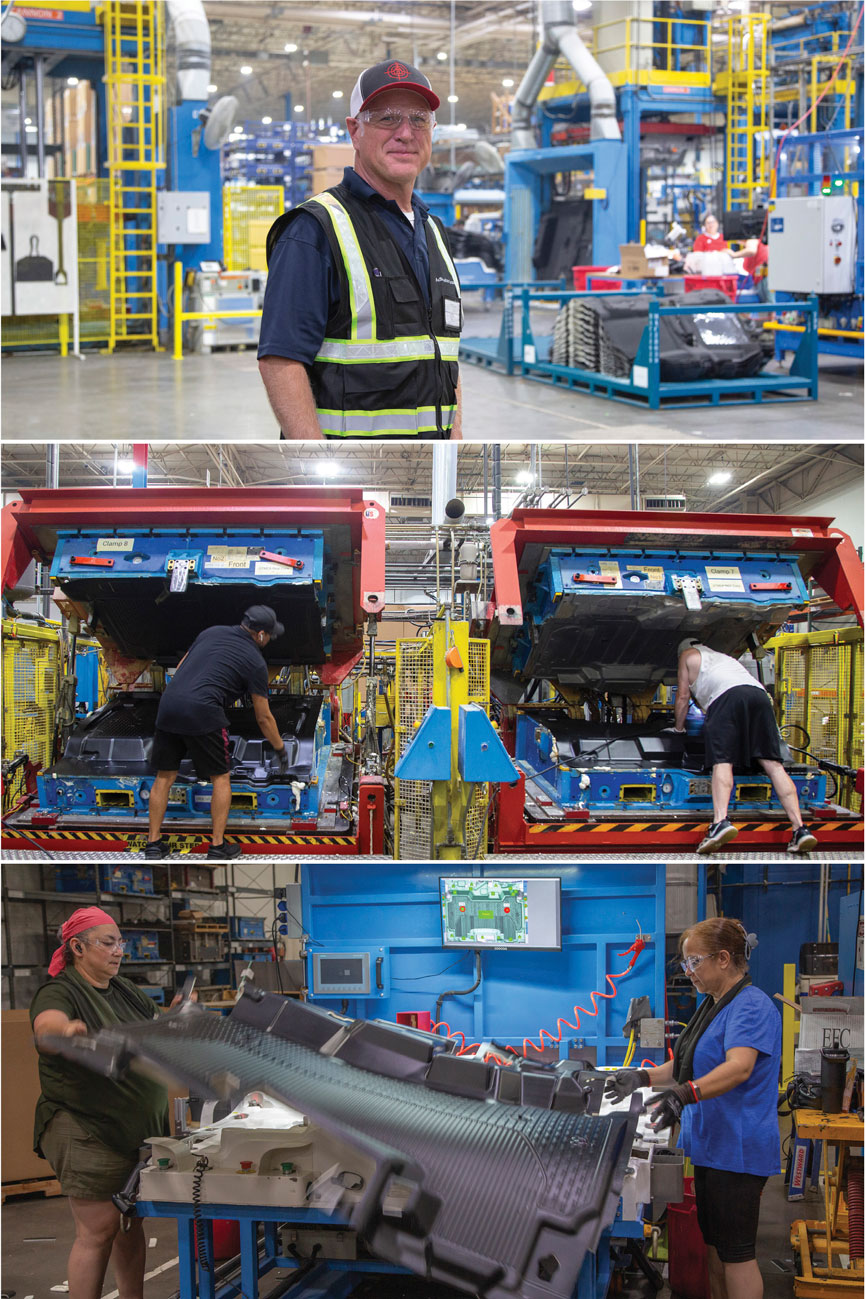
Top to Bottom: Chris Lewis, Human Resources manager – “It’s a great place to work”; Foaming process of the Ram Truck TPO interior.; Ram Truck interior going through final assembly.
Driving in Quiet, Climate-Controlled Comfort
The Adler Pelzer Group is one of those companies that, if it’s doing its job properly, consumers never give a second thought. Even on its own website is a banner which, tongue-in-cheek, states, “Never heard of us? Good.” That’s what the company is all about really. When you get in your car, crank the stereo and hear pure acoustical notes and minimal engine or road noise, you have Adler Pelzer to thank, not that anyone ever would.
“We keep your car quiet,” says Chris Lewis, human resources manager at HP Pelzer Automotive Systems Inc., in Eudora. “Our carpets keep road noise out of the car cabin. That’s important, because today’s four-cylinder engines are loud.”
Adler Pelzer, founded in Witten, Germany, in 1969 and headquartered currently in Hagen, Germany, is a worldwide leader in the design, engineering and manufacturing of acoustical and thermal components and systems for the automotive sector. Acoustic performance and thermal efficiency, in order to achieve the best in comfort for the vehicles of customers, is what the company is all about.
LOCAL MATTERS
Our Local Advertisers – Making a Positive Impact
Worldwide, Pelzer employs 15,000 people in 23 countries. Its Eudora facility employs 91 but is expecting that number to double over the next two years.
“This location services Ford, (General Motors), Tesla, Rivian, Mercedes and Stellantis,” says Lewis, who adds this location has been in place about 30 years. “We just won two 10-year contracts—GM Equinox/Buick Enclave and, in 2028, Ford F150, which is a big one.”
Pelzer, which has its U.S. headquarters located in Troy, Michigan, designs, engineers and manufactures everything from hood insulation, acoustic heat shields, engine under shields, wheel liners, trunk insulation—there even is insulation for electric-motored vehicles that make little sound.
“We do a lot of work with the Chevy Equinox,” Lewis says. “A lot of floor carpets and wheel liners. We just brought on the Ford Transit last year and brought on several new employees.”
Just as these other companies—DARcorporation, Love Lifesciences and many others making impacts far and wide with innovative new products—Adler Pelzer Group loves making its products, at least some of them, in the heart of America in Lawrence and Douglas County.
“We have a lot of employees that have been here 15 to 20 years,” Lewis says. “When we moved out here, I had no idea this industrial park stretched back as far as it does; and there’s no space available.
“I just think it’s the coolest thing working out here,” he says.