

| story by | |
| photo by | Steven Hertzog |
| OPEN A PDF OF THE ARTICLE |
As is evident in these local companies, when used well, AI has the ability to help solve difficult real-world problems and assist people in ways that can be good for all of humanity.
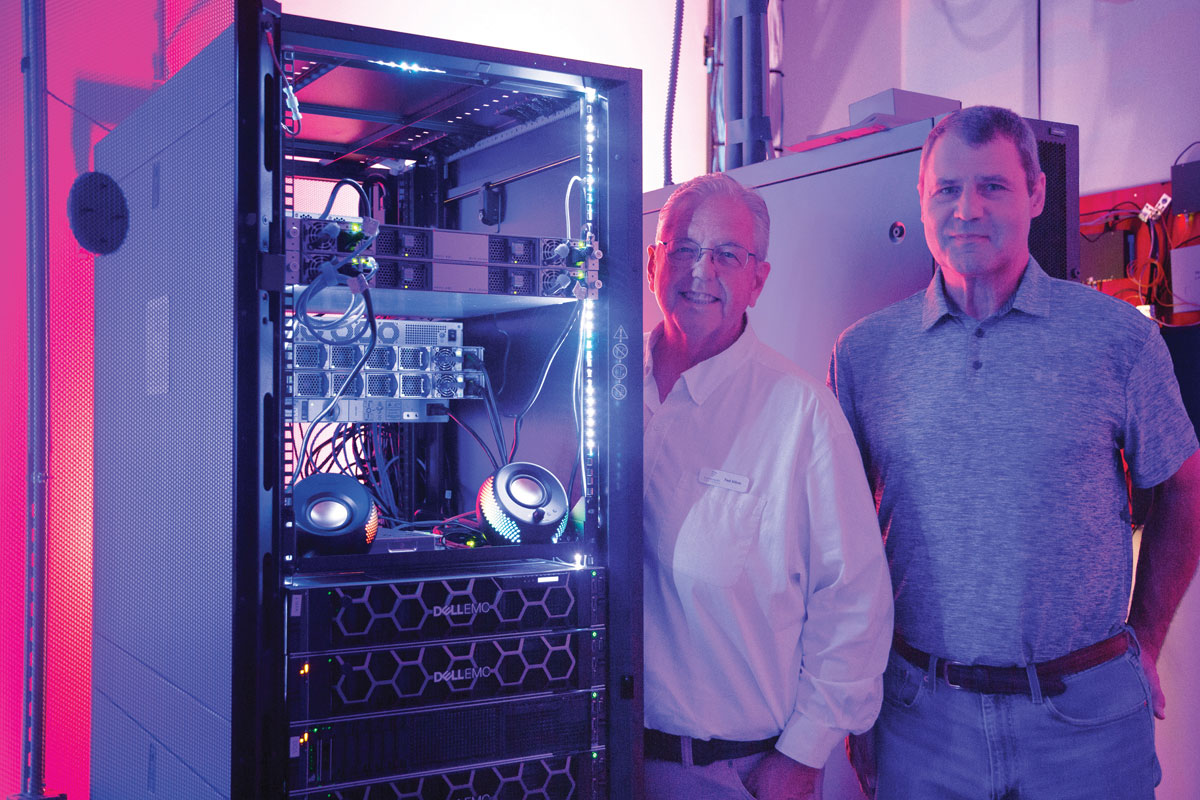
Euphemystic Ventures founder & CEO Ted Kihm with Chief Revenue Officer Craig Stoppel
Artificial intelligence (AI) has vast potential and is designed to solve real problems in real time through innovation and automation. Some experts believe it is poised to be the most transformative technology of the century. But how did it get to where it is today?
Some argue it all started in 1950 with one question: “Can machines think?” Mathematician Alan Turing explored this idea in his paper “Computing Machinery and Intelligence,” now published in the journal Mind. A central concept in AI, the “Turing Test” measures machine intelligence by assessing a machine’s ability to mimic human conversation and behavior.
Through the years, AI has advanced from simply a concept being tested in myriad ways by scientists across the globe to a technology like no other. What started as scientific analyses being shared amongst academics transitioned into neural networks, early computers, talking robot pets, robots interacting with humans—even a chess-playing program that beat a world champion chess player. From CPUs to GPUs to interfaces like Siri, YouTube, chatbots and OpenAI, today’s artificial intelligence can understand and respond to humans in ways few believed possible.
As AI continues to advance, innovation in 2026 “will be less theatrical and more technically pluralistic,” according to the Forbes article “Predicting AI In 2026: A Year of Consequence,” by Paulo Carvão. He says for artificial general intelligence or superintelligence to be achievable, the path will not be linear but will require conceptual breakthroughs.
“Performance gains from ever-larger models are becoming incremental, costly and environmentally intensive,” he explains. “This reality is forcing researchers and founders to explore alternatives that emphasize efficiency, specialization and integration rather than raw size.”
Companies that treat AI as plug-and-play software are hitting walls, Carvão continues. Those that succeed recognize that technology represents only 30 percent of AI success; people and processes account for the remaining 70 percent.
And the ecosystem of local startups is already reflecting this belief.

Inside Euphemystic Ventures
Thinking Outside the Box
These days, many businesses don’t need more data, they need their current data to be organized, easily accessible and understandable so they can deliver useful, quality results.
That’s exactly what Euphemystic Ventures (EV) offers. The company, founded in 2025 by Ted Kihm after 27 years with T-Mobile, solves difficult business problems with technology. “We’re particularly good at identifying what I think of as the ‘stubborn workflow’—a process that is expensive, slow or frustrating, but has existed for so long that everyone has developed workarounds and stopped noticing how broken it is.”
He says every organization has expensive, frustrating work that it has learned to live with because fixing it was too difficult, too expensive or simply not practical. “AI is changing that boundary very quickly. Our job is to help organizations identify the problems that have become newly solvable, figure out which ones are actually worth solving then prove it with a small, real-world implementation before anyone makes a major investment.”
EV’s approach? “Start with the business pain instead of the AI, combine deep technical capability with human judgment and be willing to build something specifically around the problem rather than simply selling a product we already have,” Kihm explains.
The company works with AI, large language models, search technology such as OpenSearch, automation, software engineering and high-performance computing. It also operates its own AI lab at KU Innovation Park, where the company is located.
During Kihm’s time at T-Mobile, the company took a massive, complicated and expensive system, and improved it dramatically through open-source technology, automation and AI.
LOCAL MATTERS
Our Local Advertisers – Making a Positive Impact
However, the financial impact was substantial, he says. “That made me realize these kinds of capabilities shouldn’t exist only inside enormous companies with enormous technology organizations. There are smaller businesses, researchers and organizations with equally interesting problems.”
Kihm says EV comes in with fresh eyes, determines the actual business problem then decides whether AI, search, automation or better software can remove that friction. “The important distinction is that we don’t begin by asking, ‘Where can we put AI?’ We begin by asking, ‘What hurts?’ ”
EV does both custom problem-solving and product development. One of the products currently being developed is CiteTerra, which grew out of their work with large collections of project information. It is designed to help organizations preserve and understand institutional knowledge—not simply find a document but reconstruct how information, decisions, terminology and relationships developed over time. “That becomes valuable anywhere important knowledge is spread across thousands of documents and years of decisions, including architecture, engineering, construction and other complex organizations,” Kihm explains.
He says AI is fundamental within EV’s products, but he doesn’t think it should be the point. The business problem is the point. “AI gives us an extraordinary ability to interpret information, automate work and help people operate at a higher level. But our philosophy is that AI should assist humans, not replace humans.”
Technical capability is important, but it isn’t enough, he adds. “Human judgment, experience, relationships and taste still matter enormously.”
The main obstacle EV faces is getting past the hype and fear of AI. “On one side, you have people behaving as though simply adding AI to something automatically makes it better. On the other, you have understandable anxiety that AI simply means replacing people,” Kihm explains.
But neither is particularly useful, he adds. “If our solution tomorrow is, ‘Don’t go talk to that person—go ask the screen,’ we may have made the workflow more efficient while making the profession worse. That is why we keep returning to the principle that AI should assist humans, not replace the human relationships through which judgment develops.”
Kihm says the goal of EV is to give people better tools, better access to knowledge and more time to do the things humans are actually good at. And he’s optimistic about what is possible for the future.
“I think AI can help us move toward a more abundant future—one where we spend less human effort on mechanical work and have more capacity for creativity, discovery, relationships and stewardship. That ambition is obviously much larger than anything one company can accomplish. But I would like Euphemystic Ventures to be one small part of moving us in that direction.”
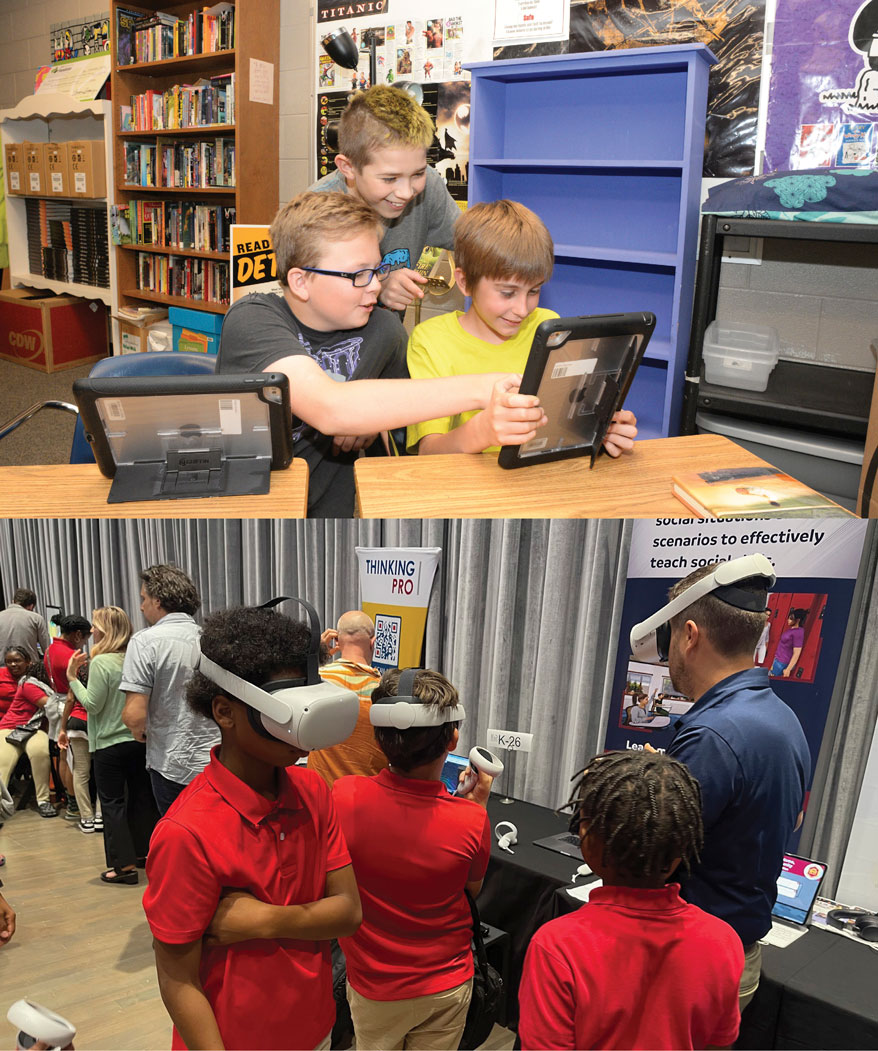
Top: Middle school students from the Olathe Unified School District participated in the iterative development process the team went through to test and scale VOISS. Here, one student is playing VOISS on an iPad and his peers are suggesting ways to further gamify it. Bottom: National visibility for a local innovation: Students from Washington D.C. public schools playing VOISS at the mEducation Alliance Symposium, Arlington, Virginia.
Giving Youth a Hand
Designed to help students develop essential social skills for use in the real world, The University of Kansas (KU) spinout company VOISS got a license from the KU Center for Technology Commercialization in fall 2025 for its intellectual property so it could commercialize, co-founder and CEO Paul Epp explains. The original research team that has been developing VOISS for the last 15 years is all KU faculty, and the research lab at KU’s Life Span Institute continues to drive the development of AI integrations into VOISS to create a more customized and personalized learning experience for youth.
“The interactive, extended-reality platform helps youth learn and develop crucial social skills with and without a practitioner,” Epp explains. “Developed over more than a decade of research with students and practitioners in real-world settings, the platform has been used by more than 3,000 students and 300 teachers, and is backed by research out of KU’s No. 1-ranked special education program.”
VOISS is a completely new way of approaching social skill development that uses technology to help youth build skills for real life rather than replacing real-life interactions, he says.
Amber Rowland, inventor, VOISS cofounder and chief science officer, says VOISS gives students a safe place to learn and practice social skills in a simulated environment. Having served in many capacities in education throughout her long career, including with KU as a researcher for the last 24 years, she says it’s typically adolescents between the ages of 11 and 18 who struggle the most with social skills.
VOISS’s research focuses on students with disabilities, specifically those with autism or learning disabilities, Rowland explains. “We work closely with our users to ensure that our content is culturally responsive. We wanted to create a safe place for students to learn and practice social skills, and extended reality was the best platform to engage students and incorporate evidence-based practices that we know work for teaching social skills.”
LOCAL MATTERS
Our Local Advertisers – Making a Positive Impact
Using VOISS, students can practice 180 social skills through 140 three- to five-minute simulation scenarios, she adds. “The scenarios were written by educators and tested by adolescents. For the last three years, we have been working toward commercialization because we did not want the product to disappear after the grant funding ends.”
Social skills learning is delivered in a variety of different formats and software platforms throughout the country, but no other solution combines the accessibility and scalability across different types of devices with the library of content created by its research team for both instructional delivery and for helping youth to extend these skills into real life, Epp says.
VOISS works with educators, school districts, schools, parents and mental-health practitioners across the United States, he continues, and is constantly exploring partnerships with other platforms and other educational software companies to make it easier for its audience to learn about and/or implement the program at their institutions.
“There are two separate environments that are directly connected so that youth can use the app to learn social skills, and the educators, practitioners and parents can use their own app to help guide learning and monitor progress for the youth,” Epp explains. The interactive app is accessible across many different types of devices, including the Apple, Google Play and Meta Horizon app stores. Youth can play VOISS on an iPad, Chromebook or Meta headset, for example.
“Just about every kind of software technology you can imagine” is used by VOISS. “AI and other types of machine learning, VR and XR graphics processing, audio recording and processing, and the latest technologies for web development,” he says.
AI isn’t being used in the student application right now, Epp adds, but AI integrations are being developed in the research lab at KU to provide a more customized learning experience for students. “We use AI tools to help educators and parents make use of the tools that help them monitor student progress and guide their learning paths through the system, and in helping them generalize the skills they learn in the app into real life.”
Across the board, the explosion of AI tools has sped up a lot of software and business processes, he explains. “Traditional audio recording, for example, is no longer needed to create realistic character voices, and AI agents can be used both for creating underlying code and analyzing processes, and figuring out how to deliver our product more efficiently.”
The one hurdle, Epp says, is differentiating VOISS from other “edtech” products that may be developed quickly to capture a market but lack the rich history and investment of time and effort that has gone into VOISS for more than 15 years.
In the meantime, VOISS will continue to innovate in the educational space. “We will build a number of different social skill learning experiences that offer customization for our users in order to maximize learning effectiveness for youth of all skill levels so we can really put the technology to work for them,” he says.
The company hopes to help youth build the foundation of skills they need to eventually enter the workforce so they know how to interact with others and become self-confident adults. “We are building on the years of work of our researchers so that we can use VOISS to establish a process for learning social communication skills that will eventually help youth of all skill levels,” Epp says.
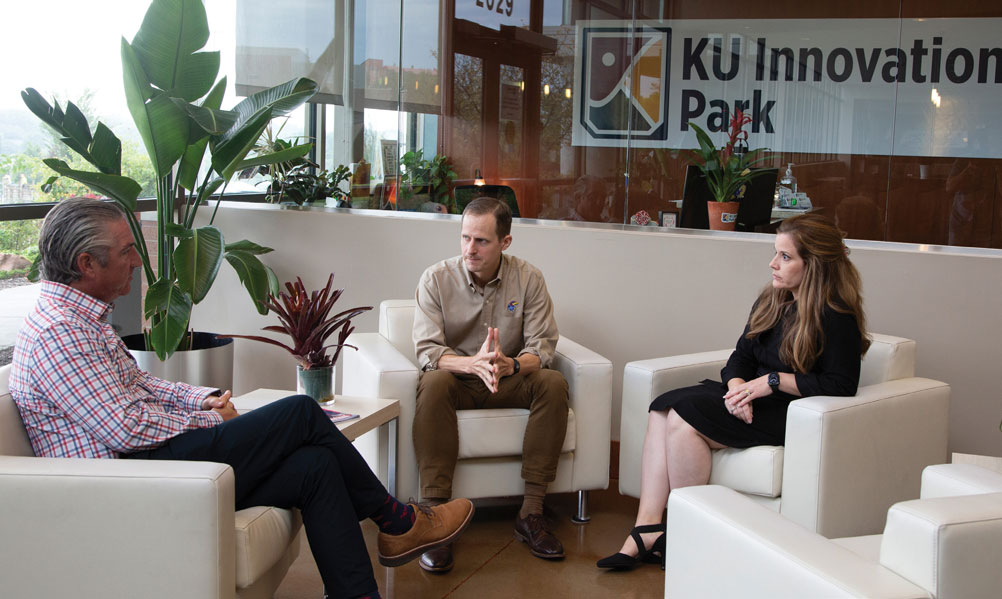
Paul Epp, (center) co-founder & CEO of VOISS with partner (right) Amber Rowland co-founder and Chief Science Office chat with KUIP Chief Executive Officer Adam Courtney (left).
Keeping It Local
Luckily, these startup companies didn’t have to go far to be successful. They can build a high level of technical capability right here in Lawrence while solving problems wherever they happen to be, EV’s Kihm says. “World-class technical work doesn’t have to come exclusively from the traditional technology centers.”
That’s where KU Innovation Park (KUIP) comes in. KUIP is a growing community of innovation, entrepreneurship and commercialization, according to its website. It offers a variety of enterprise services for technology and bioscience businesses at any level, from concept to industry. Both EV and VOISS reside there.
Relationships at KUIP cross boundaries very quickly, Kihm explains. “Entrepreneurs interact with researchers. Technology people encounter civic and economic-development leaders. Companies run into one another at the Innovation Park. It’s possible to become part of an ecosystem rather than simply occupy an office somewhere. That kind of interaction can happen because we’re physically in the same ecosystem. It isn’t a networking event six months from now. Sometimes it really is a conversation in the hallway.”
LOCAL MATTERS
Our Local Advertisers – Making a Positive Impact
Epp agrees. He met the research team behind VOISS through the KUIP and says it made sense to base the company there since it provided so much support. “The KUIP is an amazing institution that helped make this company possible. They have been essential to our progress so far. Lawrence is inseparable from KU and KUIP, and also has an attractive set of economic and livability characteristics that make it a good place for attracting talent.”
“The deeper we get into AI, the more I believe the hardest questions aren’t purely technical,” Kihm says. “They’re questions about trust, institutional knowledge, human judgment and how technology changes the way people work together.”
He believes AI is going to become extraordinarily capable, but more interesting is what we decide humans are for. Do we use these tools simply to replace people and optimize the numbers we already measure, he asks? Or do we use them to remove drudgery, preserve knowledge, expand human capability and give people more opportunity to exercise judgment, creativity and care?
“I don’t want our community’s relationship with AI to be dictated entirely from somewhere else. I’d like us to participate in deciding what that future looks like,” Kihm says.