

| story by |  |
| photo by | Steven Hertzog |
| OPEN A PDF OF THE ARTICLE |
Though the music industry is very much about artistry and creativity, it can also be about making a good living.
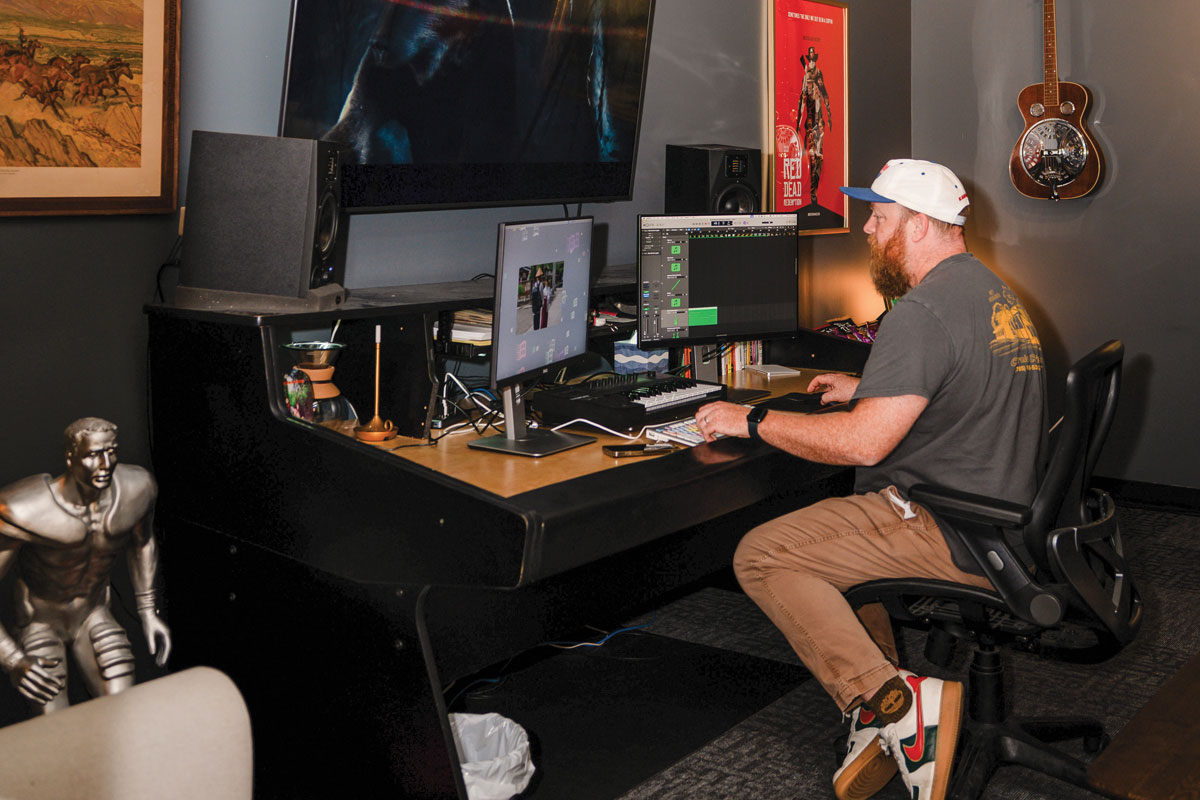
Sam Billen at work in his studio
In addition to being the result of creative impulse and a desire to craft art, music can also be a commercial product. Those with musical talent can use their skills and knowledge to make something to fill a particular niche or use. While the process may seem similar from the outside with the end result a composition that pleases the ear, the skill set required to make music for a defined purpose is different than that of making a purely artistic work.
Sam Billen cofounded Primary Color Music, the company of which he is now CEO, in 2015 with his brother, Dan, and friend Ryan Pinkston. After the breakup in 2009 of his and Dan’s indie rock band, The Billions, Billen realized he wanted a new approach to making music.
“I was just like, ‘I wanna try to have a career in doing music,’ ” Billen recalls. “’I don’t wanna tour. I don’t wanna play live. I just wanna make music, and I wanna make all different styles.’ And so I was like, ‘Oh, maybe I’ll do what my dad did in the ’70s.’ ”
Billen’s father, Bill, wrote jingles back in the 1970s in Oklahoma before moving the family to Topeka in the ’80s to work at Admark, which has since become Callahan Creek. Billen himself started reaching out to places on both coasts—big music houses like Marmoset in Portland, Oregon, or AMBR in Brooklyn, New York—and became friends with a few people there.
“I was like, ‘Hey, I’m just trying to get into this industry,’ ” Billen says. “ ‘Here’s a bunch of samples of band music I’ve done before, but I can make commercial music. Let me have a shot at it.’ ”
From there, the friends Billen had made let him create demos for various projects. He started to understand the process and how projects such as these work, and how it’s big competition amongst professional composers to land commercial jobs with a music house as the middleman between ad agencies and composers.
As Billen built up his portfolio working with BarkleyOKRP in Kansas City, Missouri, Jones Huyett Partners, in Topeka, and Callahan Creek, in Lawrence, he began to collaborate with Ryan Pinkston, who he knew from fellow indie band The Republic Tigers and was also working freelance. Billen’s brother, Dan, was working at Jones Huyett, and finally, Billen came to the conclusion they needed to team up.
In the very beginning, Billen says, “It was like, ‘Let’s do music for anything. We’re gonna do custom music, and we’re gonna do it for films, video games, apps, commercials—whatever.’ And Dan and Ryan and I would always kind of push back and forth. They smartly were like, ‘Sam, we should focus on commercials. We keep wanting to do these films and little projects, but they don’t pay, they take forever, and they take a ton of our resources.’ ”
LOCAL MATTERS
Our Local Advertisers – Making a Positive Impact
Dan Billen and Pinkston were of the opinion that, while making music for indie video games and film was cool creatively, if they wanted to build a business, they should focus on commercials. So that’s what they did, and over the past decade-plus, Primary Color Music has worked with national and global brands such as Wendy’s, Gatorade, Puma, McDonald’s, Google, and Coca-Cola, to name a few.
When it comes to making music for commercial work, Billen says, it is not an objective science; everything’s subjective. While not in a negative way, it’s very much that there’s no accounting for taste, he explains.
“You hope after you’ve worked with a client a couple of times, you have an idea of what they like,” Billen says. “But sometimes, people wanna zig instead of zag.”
Billen relates the story of a music appreciation class he took when he was at Washburn University, wherein the instructor stated there was no good music or bad music. Billen disagreed.
“I think that there is objectively quality music, and I will also say I like some music that I know is objectively bad,” he clarifies. “But also, I think our job in the commercial music world is we need to understand that there is a premium type of music, and that includes production, writing, everything. It needs to be a certain sound.”
This is what sets Primary Color Music and its cadre of composers apart from others. Primary Color has done this work enough to know all the technical rules of how the music needs to be delivered.
“The clients don’t care who the artist is,” Billen says. “It’s so much more about the process of landing the project with them.”
He notes that it’s very different from the artistic work he did as an indie musician in the past, but the end result is still the feeling that he chased from club stages. “It’s funny, though, because the human interaction is so limited there, I think,” he explains. “You’re connecting with people from a stage where you’re like, ‘Oh, I’m gonna play this concert for these people, and maybe I’ll move them, and maybe they’ll listen to my music.’ ”
To Billen, it’s the commercial music experience involves so much more human connection. For him to work directly with a client, get done with that project and move on to the next client, and they’re making music for an audience of three million people or more.
“That’s actually really fulfilling to me,” he says. “I love it.”
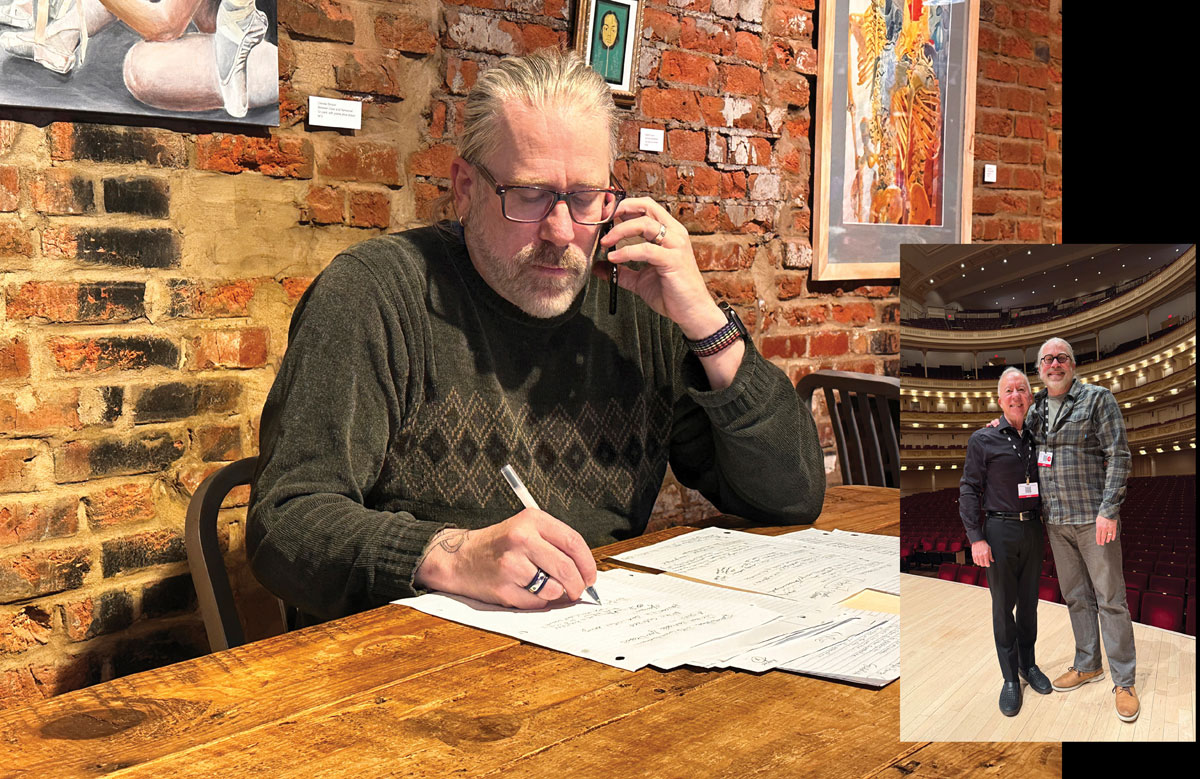
Tony Silvestri at work; Tony Silvestri and Kansas City composer Mark Hayes on stage at Carnegie Hall
With a Little Help From My Friends
Tony Silvestri’s work as a lyricist for classical composers is a world apart from what Primary Color Music does, but the process is very much the same. As with Billen’s company, it began by working with friends.
“My story was a fluke,” Silvestri says. “I got involved because my friend was a composer, and he asked me to write some lyrics for him. I did it as a favor, and it turned out to be pretty good, and other composers noticed, and they contacted me.”
The lesson, Silvestri explains, is when your quirky, creative friend asks you to do something, and your first instinct is, “I don’t know,” just say yes. That goes double when the quirky, creative friend is composer Eric Whitacre, who is arguably the biggest name in choral music for the last 20 years.
LOCAL MATTERS
Our Local Advertisers – Making a Positive Impact
At the time, Whitacre’s career was just beginning to take off, but he had a problem: He wanted to publish a piece setting the words of Robert Frost’s poem “Stopping by Woods on a Snowy Evening” to his music, and he hadn’t obtained permission to use the poem.
“The piece was successful, but he was gonna get sued, and so he couldn’t publish it,” Silvestri explains. “And so, he wanted me to replace that beloved poem with new lyrics to make it seem as though he had written it to my lyrics instead of to Robert Frost.”
That piece became “Sleep,” published in 2001, and with its roaring success along with two other works on which the composer and Silvestri collaborated, Whitacre’s career got a major boost.
“And everybody started noticing,” Silvestri recalls. “And it was at that point that other composers began to call me and say, ‘Hey, do you write lyrics for composers?’ and I said, ‘Yeah, I guess I do.’ ”
Silvestri has now been creating lyrics for 25 years with more than 100 composers and was just this summer selected as a member of The Recording Academy of the United States, meaning he can now nominate artists and works, and vote for Grammy Awards.
“For ‘Sleep’ to be my debut poem, I just couldn’t have gotten luckier,” Silvestri says, noting that he writes poetry as his job. The fact that he phrases it as writing poetry, not lyrics, is important in that the work he does is not dissimilar from what Primary Color does. While occasionally working to compose words for music that is complete, as in the case of “Sleep,” 99 percent of the time, “I write a poem in my little bubble, send it off to the composer, and then they live with the poem for a while, find the music in it and then compose,” he says. “It’s very rare that the music comes first.”
To do this work, Silvestri begins by asking the composer if there are any definitive pieces they’d like to share to give him a sense of what their style is.
“There are some composers where they’ll take a haiku, and it’s a six-minute piece,” he says. “And then other composers will burn through four pages of poetry in the same six minutes, depending on how they set it.”
The magical pieces, Silvestri says, are the ones where the music and the words are intertwined in a way that they’re grafted onto each other. They become a separate, complete thing where it feels as though the voice delivering the lyrics joins the ensemble as another instrument.
“I want to get to know the composer—not just their music but their mental landscape, too,” he continues. “What is the emotional journey that they want the audience to go on in this piece? Do they have any kind of architecture for it? Those help me to structure the poem that I give to them.”
Silvestri’s work as a history professor at Washburn and his background in Roman and Medieval history informs a lot of what he does as a poet, often writing from an antiquarian perspective. When asked by a composer to write in an older style, he approaches the work almost as if he’s forging a primary source document.
“Plus, it allows me to hide behind a persona that’s not me,” he says. “It’s not me, the poet, writing about my world and my sensibilities, because I’m like, ‘Aw, shucks, nobody wants to read that,’ and then all the imposter syndrome stuff comes in.”
But if a client says to write a piece in the style of Sara Teasdale or Walt Whitman? “That is fun, ’cause it’s not me,” Silvestri enthuses. “I’m creating, conjuring this other being that’s writing the poem, and it’s a level of self-protection.”
For all the creativity and excitement in creation, there is a commercial end to what Silvestri does. He wants the piece to sell, not just get commissioned and have it be a one-off performance at the premiere and then it’s done.
“I try to always think about catalogs, sellability, what season this is for,” he says. “A winter piece that’s not about baby Jesus? That’s going to sell like hotcakes.”

Stan Sheldon,
photo by Dave Thurman
Show Me the Way
Musician Stan Sheldon knows a thing or two about music selling like hotcakes. The bassist, originally from Ottawa, played on Peter Frampton’s “Frampton Comes Alive” and Lou Gramm’s “Midnight Blue,” and these days frequently works as a fill-in player for Grand Funk Railroad while not working on his “Stan and the Fan Podcast” with cohost Grant Ritchey.
That said, money wasn’t why Sheldon originally got into music.
“We weren’t thinking about girls or money or anything,” the musician says. “We just wanted to play the music. Eventually, we figured out that part came with dinner. It was attractive because we could make more doing that than we could doing an odd job working at the burger stand in Ottawa.”

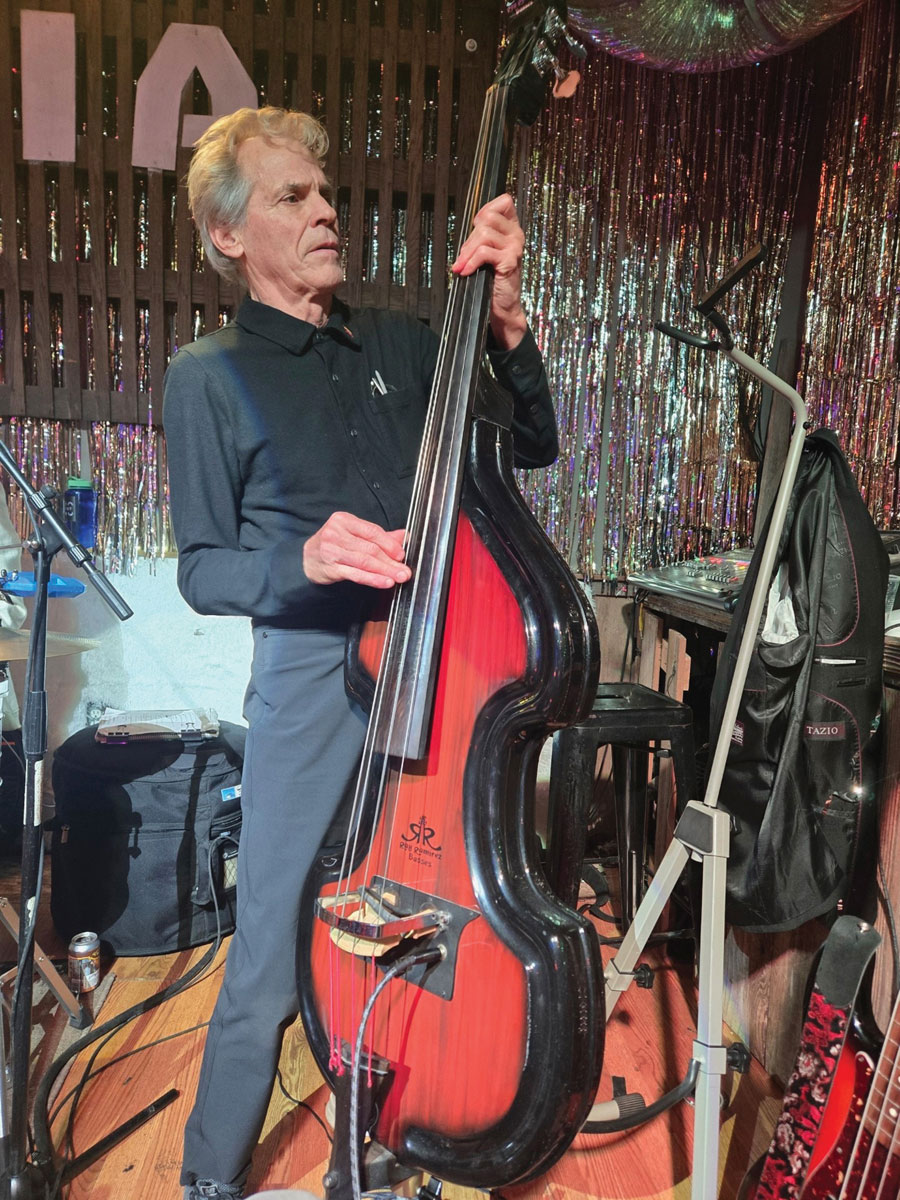 Stan Sheldon on bass with his Stan Sheldon Rhythm Republic Band. Photos by Dave Thurman.
Sheldon and many other bands at the time would play covers of hits of the time, such as The Rascals, The Beatles and Motown, booking out the National Guard Armory in a town such as Garnett and packing the place. Bands like The Red Dogs or The Fabulous Flippers, who were signed to John Brown’s Mid-Continent Entertainment, could do very well for themselves.
“It’s just crazy how many bands could make a living,” Sheldon says of that time in the 1960s. “And not an existence but a good living. That was the focal point for regional players around here. If you could meet John Brown and get a job playing with one of the Mid-Continent bands, that was the pinnacle of success in our eyes.”
Sheldon, however, had his eyes on a higher level, and he found it when he met guitarist Tommy Bolin and moved to Boulder. From there, they moved to Los Angeles, and because of Sheldon’s friendship with Bolin, he got the audition to play with Frampton.
“That was just ’cause I was basically just at the right place at the right time because of Tommy,” Sheldon says, explaining that another bandmate, Kenny Passarelli, referred Sheldon to Frampton. “Peter called him, and Kenny goes, ‘I can’t do it. I’m kinda busy. But you should try this guy, Stanley.’”
Once “Frampton Comes Alive” came out, Sheldon says, that was it.
“It just hit like wildfire,” he recalls. “The whole pop industry was changed by one live album, and I happened to be on it. It’s probably the defining feature of my career. I didn’t get rich—and I could have, you know, if I’d saved my money. I squandered all my money on dope. But luckily, I survived it all.”
LOCAL MATTERS
Our Local Advertisers – Making a Positive Impact
After getting clean, Sheldon pursued his master’s degree at The University of Kansas, writing his thesis on slave societies in the Caribbean and getting involved in the earliest incarnation of Lawrence Latin ensemble Son Venezuela. These days, he sometimes plays with Grand Funk Railroad as well as his main musical outlet, the Latin jazz group Stanley Sheldon’s Rhythm Republic. Their Wednesday night shows at the Black Dolphin, in Kansas City, Missouri, as well as a monthly showcase at Lawrence’s Lucia are the best-kept secrets that absolutely shouldn’t be.
“ I’ve been trying to put this Latin jazz thing together for 30 years,” Sheldon says. “We could never pull it together with the caliber of player I needed. I always knew if I could get Stan Kessler on board, that he would find everybody else over there, and boy, did he deliver.”
It’s jaw-dropping, the skill level that’s on display when Stanley Sheldon’s Rhythm Republic plays.
“They’re just world-class, all of them,” Sheldon says of his bandmates. “Who knew that you could play Puerto Rican, Cuban salsa right here in Kansas?”
Needless to say, Sheldon is very much getting to live the life he dreamed of when he was playing in a garage band in Ottawa.
“I get to play music and hang out with people I like pretty much,” he muses. “For me, it’s just that moment on stage. That’s all I live for.”
While Sheldon says he can go a few weeks or a few months without doing a gig, he’s always played locally with somebody. Even the decade he spent going to college and pursuing his master’s, he was still playing.
“That time on stage is a complete Zen experience for me to escape myself and just be in pure bliss,” Sheldon says. “It’s like a high, and all musicians know it. That’s why we do it. It’s an out-of-body experience, really, when you’ve locked in with all of these disparate players, and it’s a very spiritual feeling. And I feel it if I’m playing to 60,000 people or 10 people.”