
| story by |  |
| photos by | Steven Hertzog |
| OPEN A PDF OF THE ARTICLE |
Small, local farms, have made a comeback, providing personal touches and nourishing relationships, with a focus on sustainability, organic products and community stewardship.
Peaches from South Baldwin Farms
It’s safe to say community agriculture and/or community-supported agriculture (CSA), at least when it comes to the Lawrence/Douglas County area, is having a full-circle moment.
 The farmer has to be an optimist or he wouldn’t still be a farmer.
– Will Rogers
Back when the United States was a toddler among countries all the way up to the preindustrial age, community farming was a way of life. In much simpler times, local growers produced food and distributed goods to community members through local grocery and mercantile (general) stores, if not loaded on a wagon or wheelbarrow, and hand-delivered to a neighbor. It all had a personal feel to it, a general sense that a community was in this life together, always ready to lend a helping hand.
That changed toward the middle and latter part of the 20th century, when industrialization brought about mass irrigation systems that could keep entire fields of crops properly watered regardless of weather patterns. This brought about an emigration of farms to western Kansas, where cheap land was plentiful. Large farms now could grow endless rows of corn, which in turn could supply feed for cattle and other livestock megafarms, feedlots and packing plants.
Big, industrial farming complexes appeared to be trending upward, while the smaller, community farms, with their personal touch and relationships, seemed to start shrinking in numbers.
Then, perhaps an even stranger thing occurred. In more recent years, around the turn of the century, smaller community farms began experiencing a revival of sorts. Concepts like sustainability, organic and community stewardship became popular, particularly in small-town mid-America, but really across the entire U.S. It grew increasingly evident that many consumers preferred knowing where their food came from, how it was produced and by whom. And that it was fresh, flavorful and nutritious.
Strange as it might sound, community farming became cool.
“I feel like there’s nothing more gratifying to me than knowing I’m doing what I can to meet the most basic needs of human beings,” says Gabe Spurgeon, who along with his father-in-law traded careers in engineering to create and operate South Baldwin Farms, near Baldwin City. “Those most basic needs are food and shelter; I obviously fall on the food side of things.
“I try to meet the most basic needs and stay in business,” he continues. “We’re feeding people. I can’t think of anything better I could be doing with my life.”
South Baldwin Farms is one of several community farms in the Lawrence/Douglas County area.
Pendleton’s Country Market, originally called Pendleton’s Kaw Valley Asparagus, began with a half-acre of asparagus in 1980 and can be considered the granddaddy of Lawrence community farms. It has grown to now produce a wide variety of vegetables—still specializing in asparagus—along with bedding plants and cut flowers for celebrations and occasions.
There also are a couple of nonprofit community farms that have gardens and orchards that serve as gathering places and provide educational opportunities for those wanting to learn about how things grow.
LOCAL MATTERS
Our Local Advertisers – Making a Positive Impact
The Sunrise Project serves the county by allowing opportunities to grow culturally appropriated foods while caring for the land and each other. A few miles east in Eudora, the Eudora Giving Garden not only provides fresh produce and flowers to the community, but also educational opportunities for local school children.
None of the owners/operators of these community farms will tell you they have gotten rich off their endeavors. All will say it is a calling that’s worked its way into the very core of their beings.
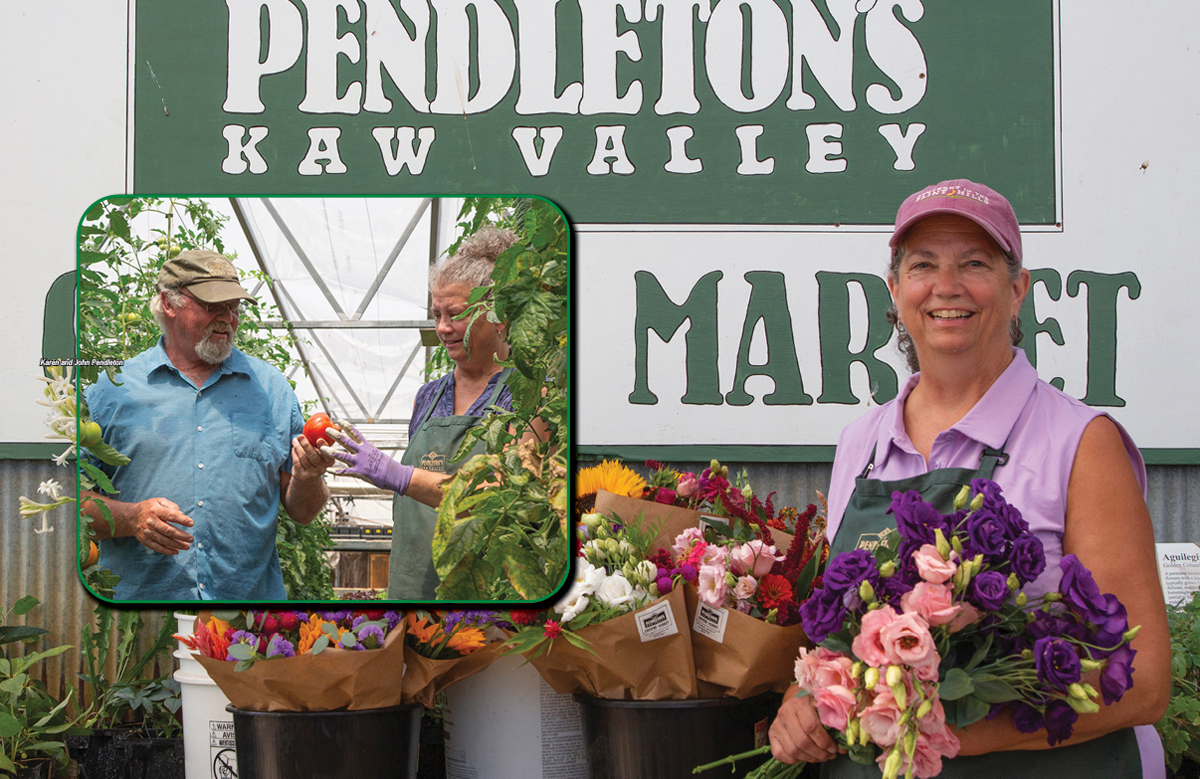
Karen Pendleton with her flowers, and John and Karen with the tomatoes
Surviving 45 Years Through Community
Though the Pendleton’s impact on local agriculture can be traced back more than 70 years to when Albert Pendleton started farming Kansas River Valley land that produced potatoes and peas for the cannery his father managed, the genesis of Pendleton’s Kaw Valley Country Market literally took root in 1980, when Albert and his son, John, planted a half-acre of asparagus out east of town.
“We got started in asparagus because Pat and Mary Ross across town got into strawberries, and we didn’t want to compete,” says John Pendleton, who for the last 30 years has run the farm with wife, Karen.
Pendleton laughingly confesses that timing was never one of his strengths. As he succinctly puts it, “The early ’80s was a nightmare for agriculture.” A perfect storm of drought, government crop embargoes and high interest rates made conditions for farmers everywhere “absolute gloom and doom,” he says.
Pendleton’s survived, he says, because of his dad’s conservative business strategy and by specializing in a niche, alternative product not found regularly in these parts.
“Asparagus was extremely unique,” Pendleton says. “We had opportunities to talk to media a lot because it was unique and a rare positive story.”
Pendleton says his parents also taught him the value of community involvement and being active in a wide variety of community organizations. The Pendletons are heavily involved with Growing Lawrence, which started as the Douglas County Fruit and Vegetable Growers Organization, and is a group of local growers and ag enthusiasts that meets monthly to discuss topics of interest and offer mentoring and networking opportunities.
They also have a venerable presence at the Lawrence Farmers Market on Saturday mornings, as well as the weekly farmers market at Clinton Parkway, and have their own CSA (community-supported agriculture).
It’s involvement with the community that eventually pushed the Pendletons to widen the scope of their farm from just asparagus.
“I jokingly have said I have had no control over our business ever,” Pendleton explains. “We’re always listening to what people want.”
After asparagus, they started growing hydroponic tomatoes. But customers would drive up asking, “Where are your bedding plants?” So they started growing bedding plants in between rows of tomatoes. Later, they added flowers and various vegetables.
In 2006, a microburst hit the farm hard, destroying a couple of silos and a large barn. The Pendletons were able to rebuild, but in 2019, a tornado blew through and delivered even more damage. Pendleton wasn’t sure his family farm would make it back this time.
Again, involvement with the community made all the difference. Cars lined up on the side of the gravel road leading to the farm loaded with customers and community members ready to pitch in wherever they could to help clean up and rebuild.
“That was the best example of a community saying, ‘We’re not going to let this stop you,’ ” he says. “The community came out and picked us up.”
Today, Pendleton’s Kaw Valley Country Market sells three varieties of asparagus and more than 80 varieties of tomatoes. A workforce of 12 part-time employees helps sell those and a variety of other vegetables, along with bedding plants and cut flowers (Karen handles flower designs for special occasions such as weddings). About one-third of the company’s business comes from the farmers market, a third comes from flower sales and a third is harvested vegetables. About one-third of those sales come from the CSA.
“Times are good now,” Pendleton says. “As long as we have good help, we have plans on doing this.
“It’s been the community that’s been helping us all along,” he adds.
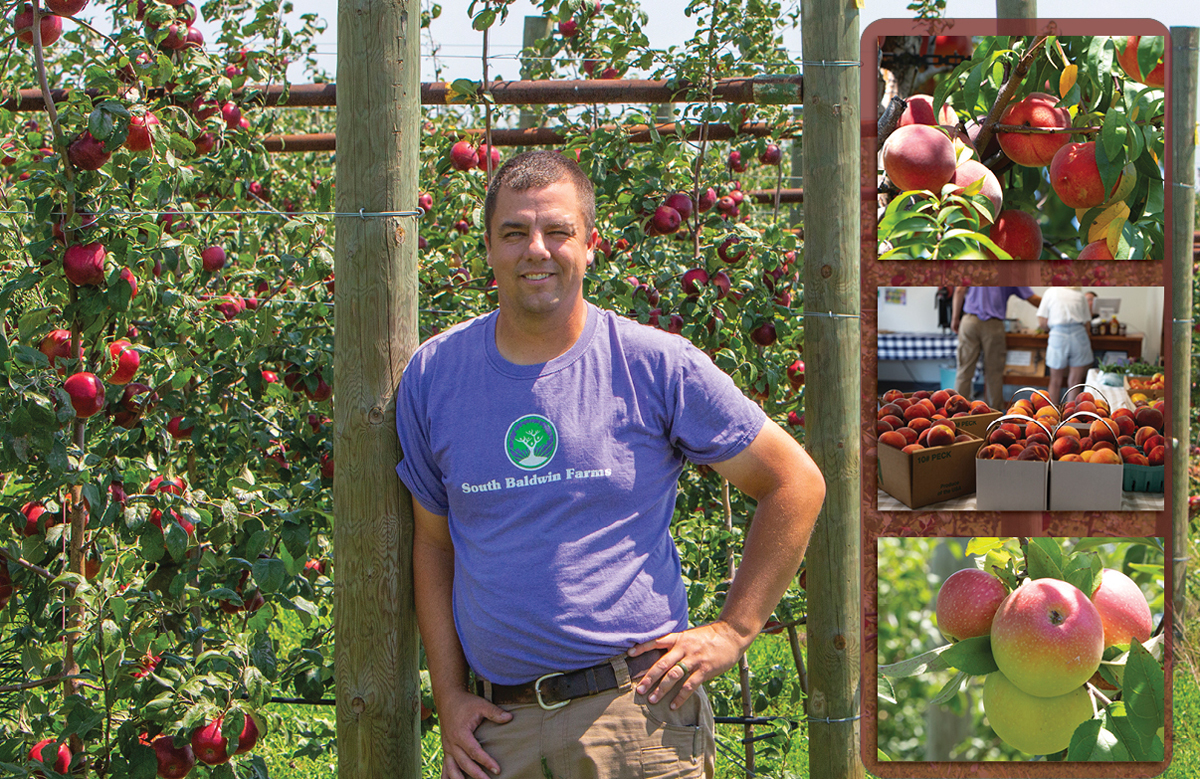
Gabe Spurgeon, South Baldwin Farms; right: Peaches and apples ripen at South Baldwin Farms. Baskets and cartons of fruit are sold at the South Baldwin Farm store.
The Apple of Douglas County’s Eye
Back in the early 2000s, Gabe Spurgeon and his father-in-law, Dave Miles, were engineers with a deep passion for agriculture. Spurgeon grew up in southwest Missouri working summers in peach orchards. Miles was raised on a dairy farm in northeast Kansas. In 2010, the two men began talking and decided, just for fun, to plant less than an acre of apple and peach trees.
Today, South Baldwin Farms has more than 100,000 trees on 70 acres.
Tree fruit, mainly apples, is the farm’s major product. While there are some peaches, Spurgeon says the weather the last five years—specifically bitter cold temperatures—have made conditions difficult.
The farm also has 2 acres of blackberries it mainly sells by allowing customers to come out to the farm and pick their own, though they also sell prepicked blackberries in the farm store.
“I also have my own farm that grows some vegetables and pumpkins, mostly tomatoes, some jalapeños,” Spurgeon says. “I do a bit of wholesale sweet corn.”
Spurgeon says South Baldwin Farms sells its goods from Eudora to Manhattan. The Farm Store, open six days a week through August (then four days a week until early November), is where Spurgeon sells most of his vegetables. Apples, of which there are 30 varieties, and 18 varieties of peaches are distributed to other area farm stores and grocery stores.
“2020 was one of the best years we’ve had for our Farm Store,” Spurgeon says of the year of the COVID-19 pandemic. “It was more than just a food store. It became a sort of playground destination for children since there was a lot of outdoor space.”
Five years beyond the pandemic, and 15 years after planting a few apple and peach trees for fun with his father-in-law, South Baldwin Farms is going strong, though Spurgeon says it’s rarely smooth sailing.
“We’re never without a challenge, whether it’s the market, weather or disease,” he says. “Right now, growth is a challenge. We’ve started building another large building for refrigeration.”
Those are good problems to have for a business that, as Spurgeon puts it, has as its No. 1 product the No. 1 fruit sold in the United States.
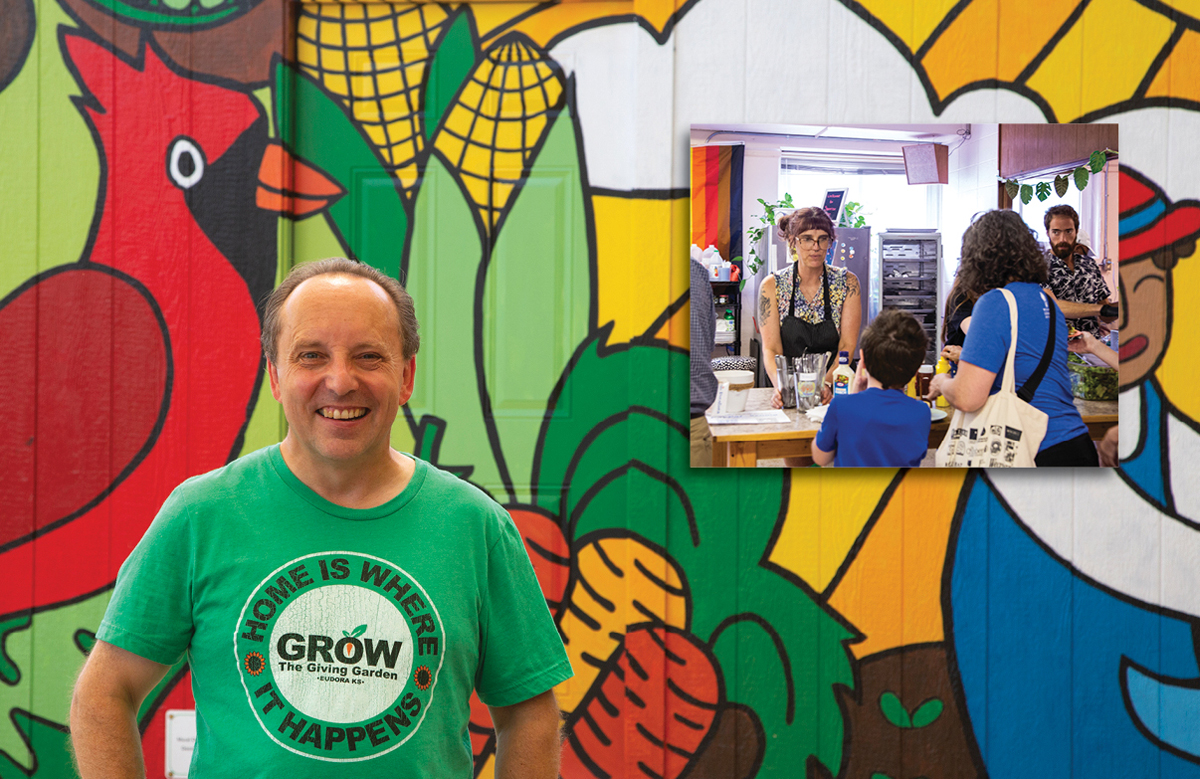
Nolan Jones, by the mural in the Eudora Community Garden (insert) Executive Director of The Sunrise Project Melissa Freiburger serves meals at one of their dinners.
Agriculture as Education
Yet other community agricultural properties in the area don’t so much function as businesses but more so community assets—public places to gather and become informed as to how our food and other plant life grows and is harvested.
The Eudora Giving Garden started in 2020 at 706 Main St. but moved four years ago to 545 West 20th St. when Noland and Stephanie Jones donated land on their property to expand the garden and its offerings. A group of community members came together to grow and give produce to senior citizens in Eudora.
But feeding people never has been the sole purpose of the Eudora Giving Garden.
“What we really want is for people to come here, have a picnic, do a tour,” says Diane Guthrie, president of the Eudora Giving Garden. “We like to put on some workshops, make this a destination for people.
“We feel like we’ve grown up in our fourth year (at the current location),” she continues. “The community has supported us, stepping up with funding.”
Grant funding also has helped expand the garden so that it now can hold events as well as food and herb growing, a cut flower garden, prairie garden, bee habitat and pollinator garden, some sculptures, even a a little free library. Nolan Jones especially enjoys hosting busloads of schoolchildren who come out to pull on lambs ear, a velvety plant species, touch a sensitive plant and watch as its leaves close to protect itself, or to learn about composting.
“It’s just a neat community of folks interested in this,” Jones says. “The idea isn’t to produce mass amounts of food. It’s to educate. It’s been real joy to be a part of something like this.”
The Sunrise Project in Lawrence is a nonprofit organization formed in 2015 designed to provide space and opportunities for people of all ages and backgrounds to come together and build social connection. One of the ways it accomplishes that is with a community garden, open for all to explore from dawn to dusk. Another is the Lawrence Fruit Tree Project, first formed in 2008 as a community-based solution to food insecurity. In 2012, the Lawrence Community Orchard was created on four-fifths of an acre in Burroughs Creek, with more than 100 plants composed of about 30 species. Typically, the community comes together on the first Saturday of each month (March through November) for Community Orchard Days.
“People have really responded to our growing gardens and orchard; people of all kinds feel at home here,” says Melissa Freiburger, co-founder and executive director of the Sunrise Project-Lawrence. “It feels really good to see people coming here because they want to come together.
“It’s our space,” she adds. “It’s not the Sunrise Project’s space, but our space together.”