| story by | |
| photo by | Steven Hertzog |
| OPEN A PDF OF THE ARTICLE |
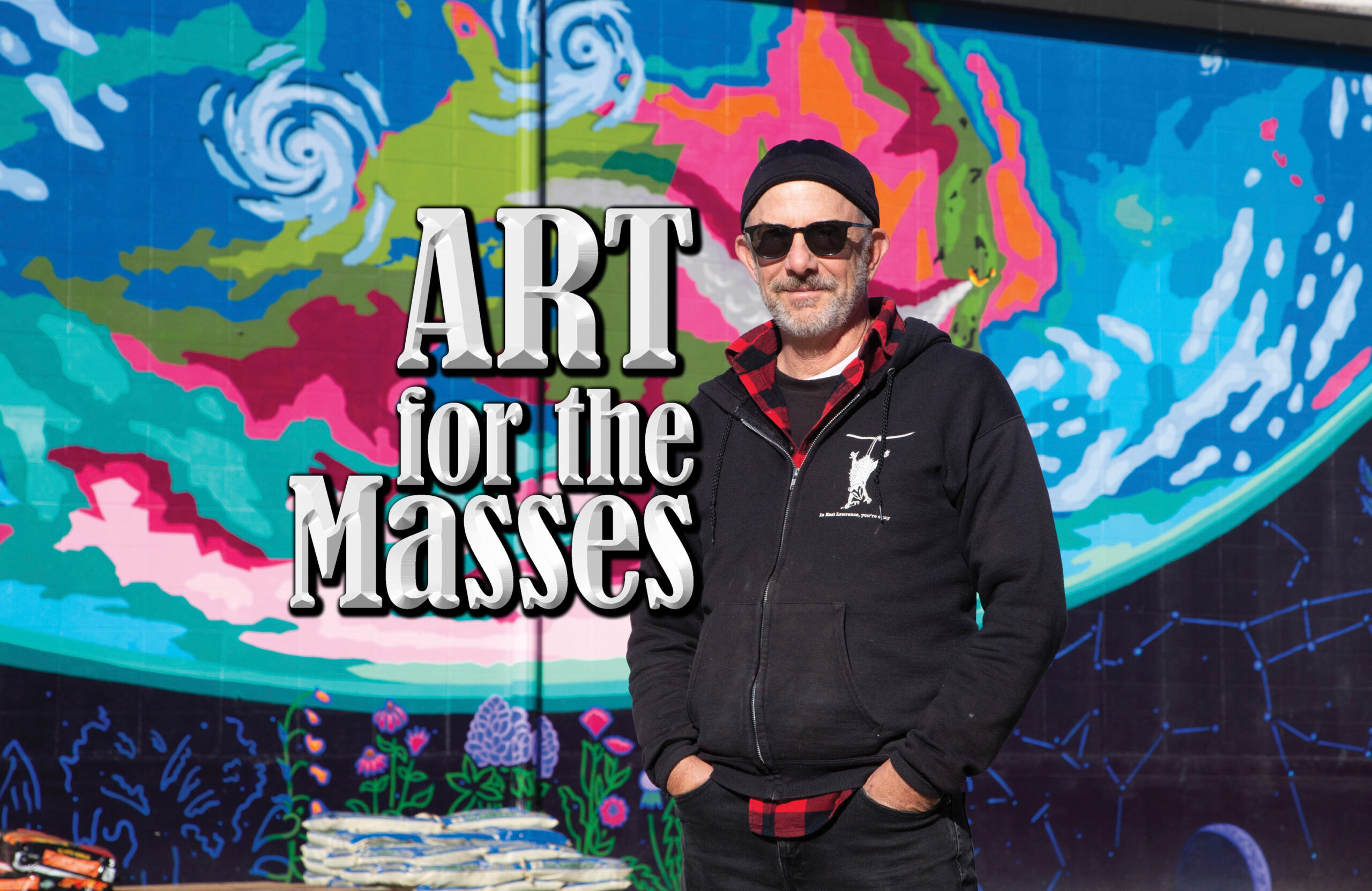
Public art is not only aesthetically pleasing in community spaces but many times also reveals a deeper meaning from the artist.
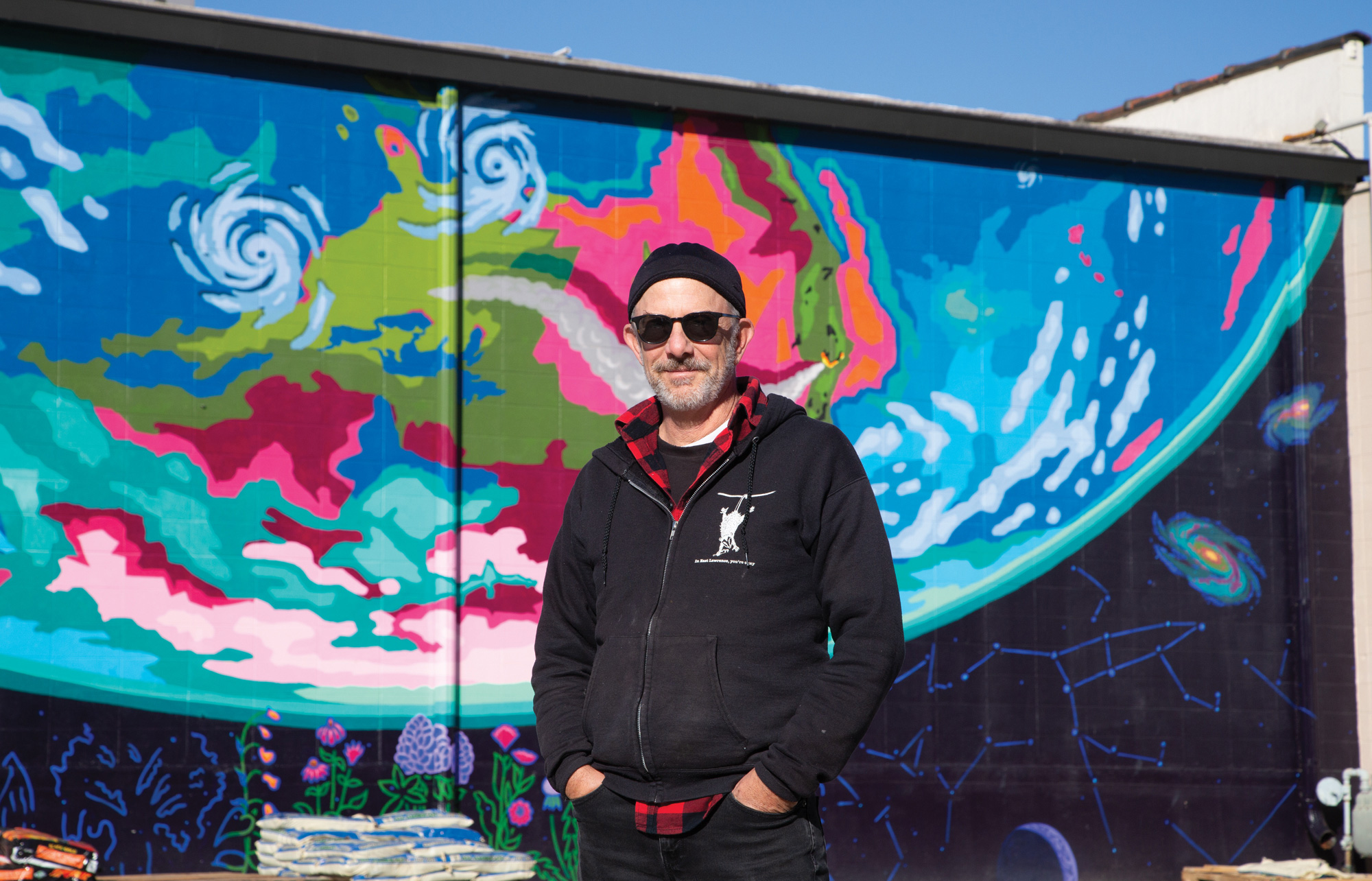
Dave Lowenstein, international muralist and printmaker
Walls are more colorful, outdoor spaces display eye candy, entrances become entrancing. What is the point of public art? Is it merely decoration? Or must it tell a story or relate a historical lesson?
The answers to those questions are as varied as the artwork itself and as the people who create and view it. Therein lies the joy and challenge of creating public art, local artists say.
Lawrence buildings and landscapes are dotted with murals, sculptures, panels and paintings. Concentrated around downtown but covering ground throughout the city, the origins of the art vary from community-based efforts to fulfilling requirements of the City’s Percent for Art program, to university- or privately owned displays. Most were intentionally placed, and they vary in age from multiple decades old to just a few months old. All are free and accessible for anyone who cares to view them.
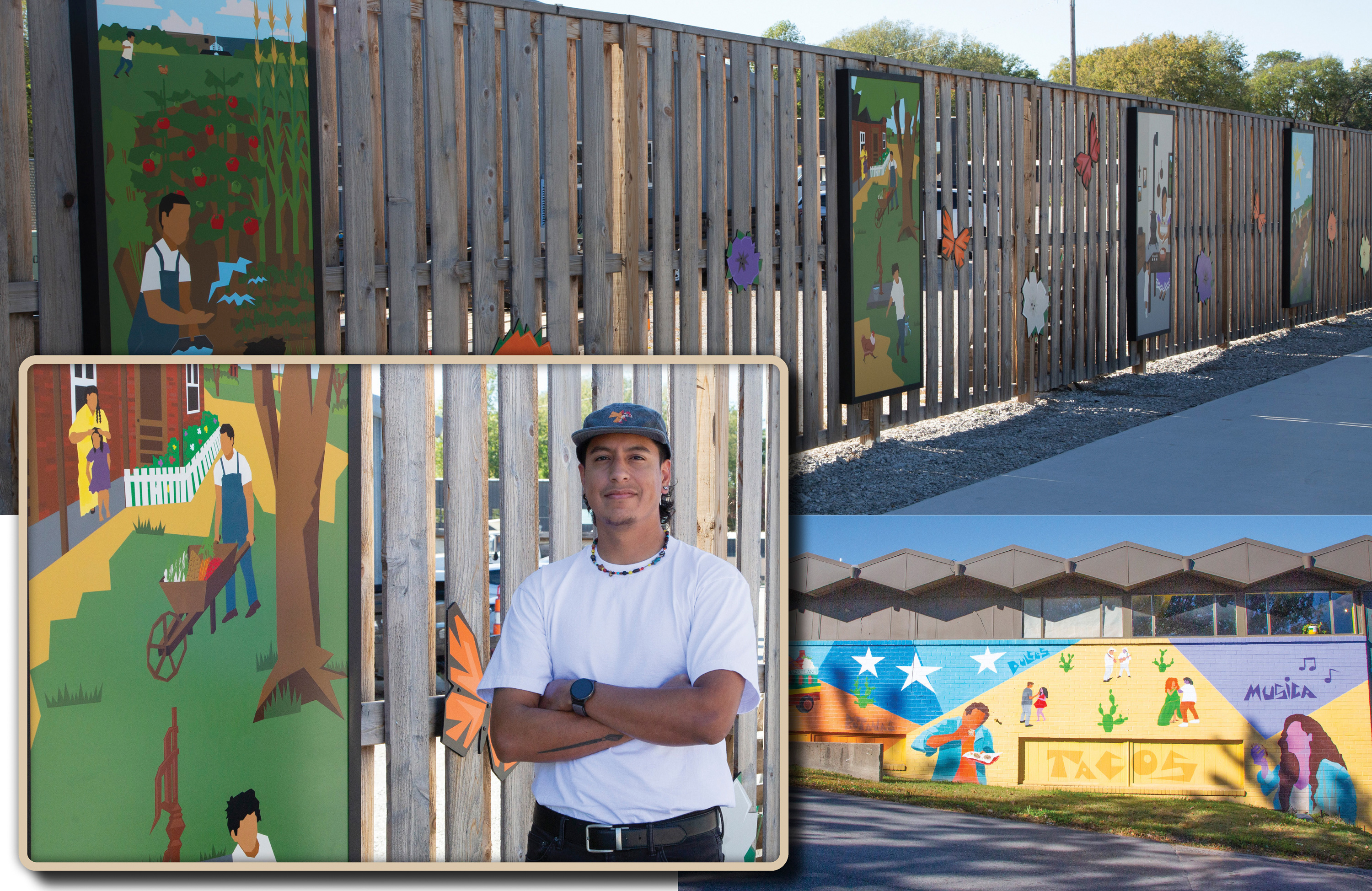
Javy Ortiz, painter, spray painter and muralist in front of his LaYarda installation on the Lawrence Loop at 8th and Delaware; Bottom: La Estrella Mexican Restaurant and Market Mural by Javy Ortiz
Public Artworks’ Purpose
“As a community, what do we hope to get for it? Is it for visitors? For civic pride? Is it to engender our stories?” international muralist and printmaker Dave Loewenstein asks. “I don’t think most folks are thinking about those questions. In my world, we’d have all those things, and we’d have support and funding for them.”
Deciding what to depict or portray in murals or sculptures can be either a collective effort from the community; an individual’s perspective on a story or message; or some of each. The source of funding, such as a particular type of grant, may determine at least some of the direction or content of the art. Other art may solely be the artist’s or business’ decision of what to present to the broader community in a public-facing space.
LOCAL MATTERS
Our Local Advertisers – Making a Positive Impact
Mona Cliff is a multidisciplinary artist in painting, beadwork and fabric appliqué, whose public art also appears outside of Lawrence at Kansas City International Airport, Topeka’s NOTO Arts District and The Museum of Kansas City. Her painting on the underside of 23rd Street near Haskell University, a project called “Reclaiming Indigenous Spaces,” and her large-scale mural of Lawrence icons inside the parking garage and Ninth and New Hampshire streets, feature bright colors and clear representations of familiar symbols.
“I can only share what I’m making, and they can only experience it from their lived experience. I’m still straddling that public-art perspective,” she explains.
Cliff, who has Native American Aaniiih and Nakota heritage, likes to express universal Native American symbols and messages in all her public art, particularly as part of Lawrence’s story.
“I knew that I especially wanted to focus on making art that our Haskell people would recognize ourselves in around the city,” she says.
Alicia Kelly’s art typically is paper, cut paper and printmaking. She has done large installations in galleries before with paper, but paper won’t weather outdoors in public. So her first public art project, on the outside of the Lawrence Public Library parking garage, was as much about experimenting with a more durable material as it was about the art itself. In 2017, she worked with a sign company to print her circular design onto Tyvek pieces that she attached to the garage’s exterior for one year. Earlier this year, she installed new public art on the same garage facade.
“I wanted to know, ‘Can I do it?’ It was curiosity and a test of the material for the first one. As far as the art, I want the audience to question it, to not know what it is. It’s not one strict thing. I hope people and kids will sit and daydream while they look at it—I relate to that,” Kelly says.
Public art can reflect people back to themselves, sometimes through their ancestors in this very place—and at the same time, from a faraway land. Javy Ortiz is a painter, spray-painter and muralist who cocreated an outdoor mural at the restaurant and store La Estrella. This year, he built a multipanel art installation commemorating La Yarda, the housing unit built for Mexican-American railroad workers in the 1920s on the Lawrence Loop at Eighth and Delaware streets.
“I do believe in beautifying spaces and making the cityscape look pretty, but it holds a lot more weight when it tells a story,” he says. “It’s less about explaining everything and more about the audience’s feelings about it.”
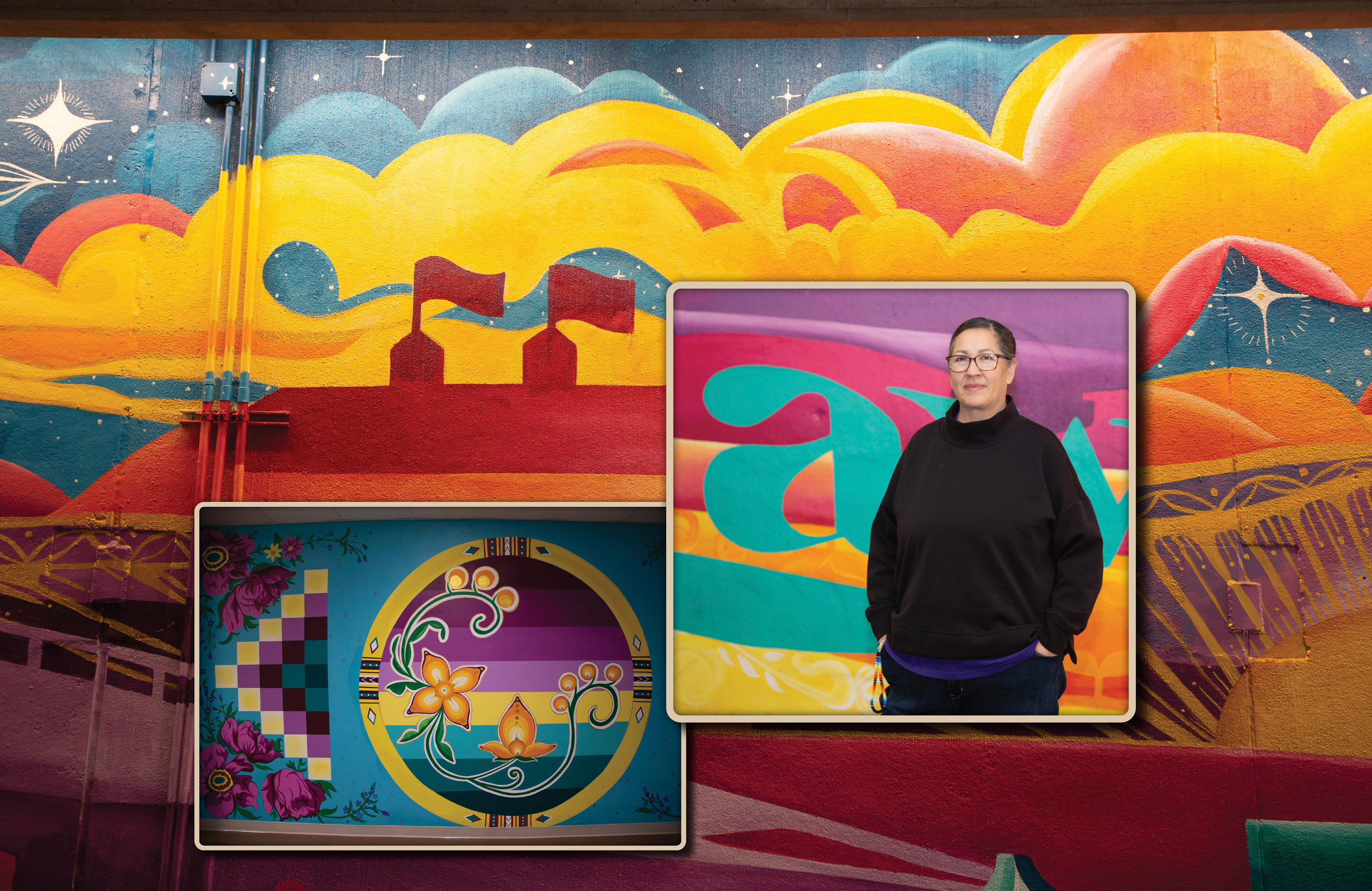
Mona Cliff, multidisciplinary artist in painting, beadwork, and fabric applique; One section of Welcome to Lawrence and Sequoyah Hall by Mona Cliff
Personal Connections in Public Art
Just because dozens to hundreds of people see their public art every day doesn’t mean the art is generic or meaningless. To the contrary, the artists say they have deep personal connections to the depictions, symbols and colors in the art.
Cliff endeavors to incorporate elements that bridge both her own tribal and ancestral experiences, and those of other Native Americans, regardless of tribe.
“I’ve broadened my visual language to be more accommodating to all types of Natives. I use content shaped by common imagery that Native people share across the U.S.,” she says. “[In my first solo mural] I have incorporated the orthography of the Osage tribe word for ‘people,’ making the language that used to be spoken here more common.”
With the bright colors and floral patterns, there is something accessible and approachable for all who view the artwork, but Cliff hopes that the ribbon-skirt designs and particular plant choices speak directly to Native American viewers most especially.
“There are so many people that don’t have any proximity to our community, and I wanted to share that we have a beautiful, thriving culture that’s contemporary,” she explains.
Kelly’s second parking-garage design showcases her new venture into incorporating color into her typically black-and-white designs.
“I am a pattern maker and meditative in my work, because it’s good for my mental health. This is a newer pattern I was working with. I didn’t know what I wanted to say with it, but the color adds an emotion, a playfulness,” she says.
Kelly tends to stick with a particular pattern in all of her media for around three years, continually working with and through it, until she says it is “too easy.” Then she retires it and invents a new pattern.
“Even if you’re not meaning to tell a story, a story is going to come out. My abstract works aren’t deep political meaning; my work doesn’t need to be interpreted. Sometimes I don’t know why I did it,” she adds.
Ortiz’s works are both in locations that are connected with Mexican and Latino culture in Lawrence—Latino-Lawrencian, to coin a phrase—at La Estrella and near the former site of La Yarda. It’s no accident that those are the projects he has chosen for his public art.
“My biggest drive with both projects is my own Mexican heritage. It’s my desire to represent my community in Lawrence and beyond, to help leave our mark as a culture,” he says.
Loewenstein’s murals are usually a culmination of an intentional community effort to depict a story or commemorate a particular event, era or person. He has made a national specialty of unifying communities or groups, researching and gathering feedback in order to generate the designs and layouts for his murals. Though the images are not directly personal to him per se, the impetus behind the mural and its message is the driving force for him to create the murals.
“I’m so niche. I come from the Civil Rights Movement as a way of making interesting art and as a way to model communities coming together to do something together. I’m both a community organizer and an artist,” he says.
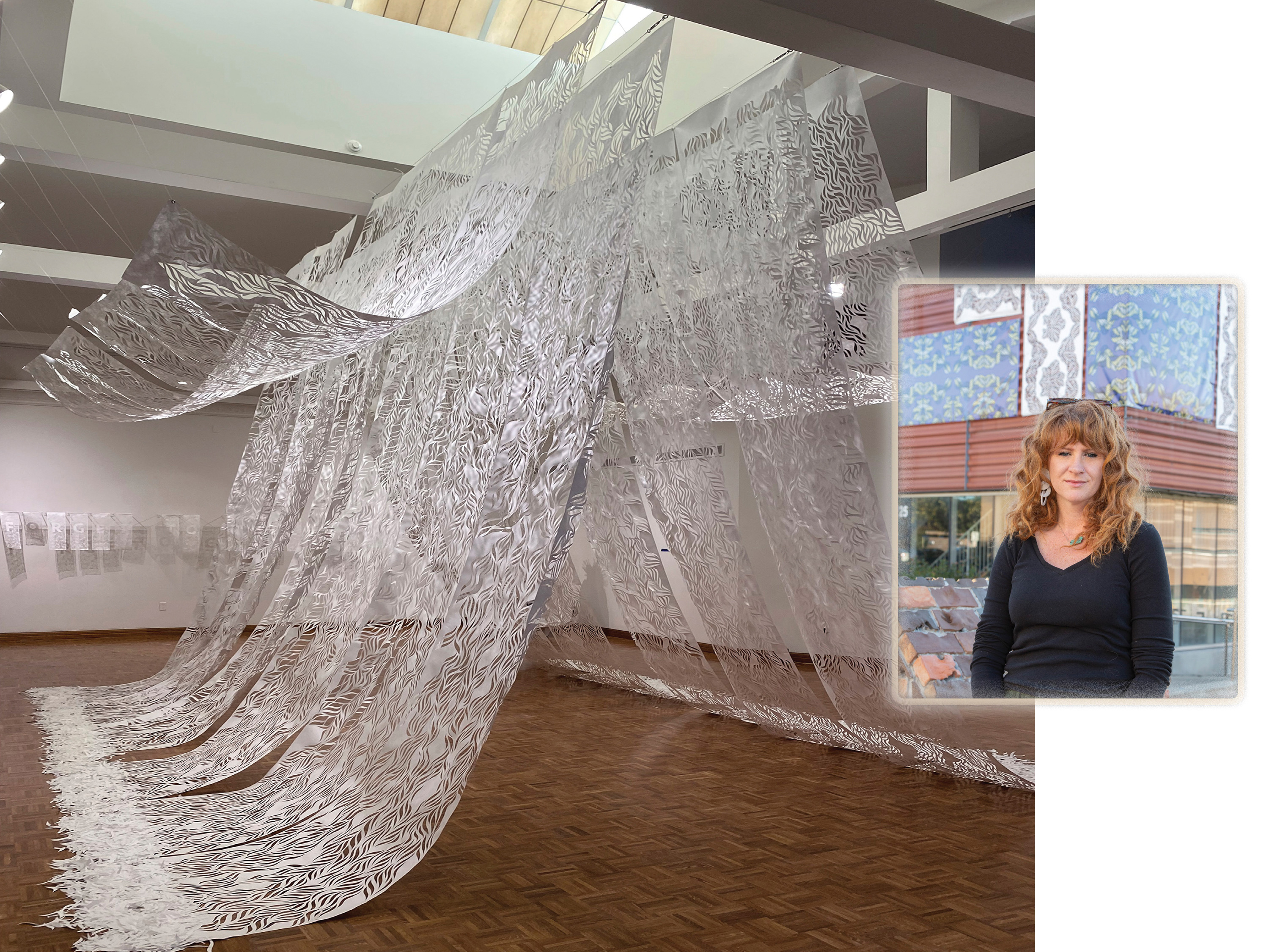
Alicia Kelly, printmaker; Alicia Kelly’s The Passing, site specific installation at The Salina Art Center in 2023
A Spectator Sport
When installing and/or painting public art, there is no way to avoid having an audience at any given moment in the process. All four artists agree that the on-site feedback is always overwhelmingly positive. It likely doesn’t hurt that they most likely are putting something interesting in a place that was either empty or underwhelming before. They say they enjoy hearing peoples’ responses to the art and engaging with their questions.
“You fully expect that anytime you engage in a particular project, that it’s going to spark conversation and discussions,” Loewenstein says. “People even argue about it sometimes. It’s good to see whether you’re open to new ideas, or if you’re closed. You also get to see how people work it out.”
Cliff says when she was painting underneath the 23rd Street bridge, she was surprised how busy the Burroughs Creek Trail was at all times of the day. She chose the location because she often took her children there, but she didn’t know how well-traveled it was. She became accustomed to people stopping and asking her questions while she was painting.
“There was a sense of enthusiasm from people that there was something happening in a place where nothing was happening. It was gray and bland and sad before,” she explains.
Public Art an Endangered Species?
LOCAL MATTERS
Our Local Advertisers – Making a Positive Impact
With budget constraints in local governments and continual cuts to arts programs and grant funding for visual arts, the artists expressed concern for future additions to public art—in Lawrence, in Kansas and nationwide.
“Now, most of the funding sources are dry, and we don’t know if they’ll be back. People with experience and resources are the only ones who will continue,” Loewenstein says.
The City of Lawrence operates a program called Percent for Art that designates a percentage of a building project’s budget, either 1 or 2%, depending on the era, for public art. The Unmistakable Public Art Exhibition, which annually rotates the Downtown Lawrence collection of outdoor sculptures, is a partnership between the City and the Cultural Arts Commission, a volunteer community group. Those programs and the Lawrence Arts Center are the main sources for local public art funding, Loewenstein explains, but there isn’t established funding or staff to engage the town or create a standard of art life.
He compares Lawrence to Salina, another Kansas town with a thriving public arts scene, which boasts both the Salina Art Center, a nationally known contemporary art spot, and the Salina Arts and Humanities Council, which has a museum, staff and programming. Lawrence could benefit from something similar to Salina’s council, Loewenstein says, to formalize and establish a baseline of arts engagement. Of course, that would require a large amount of funding and momentum.
Despite a lack of such source money and unity, Lawrence has amassed a colorful—in all aspects of the word—collection of murals, sculptures and paintings that tell people’s stories for all who come here.
“As a city, we continue to put up more and more public art. With our history being so layered, the public art makes those stories visible. We need to keep telling more stories and uncovering them,” Ortiz says.