| story by |  |
| photo by | Steven Hertzog |
| OPEN A PDF OF THE ARTICLE |
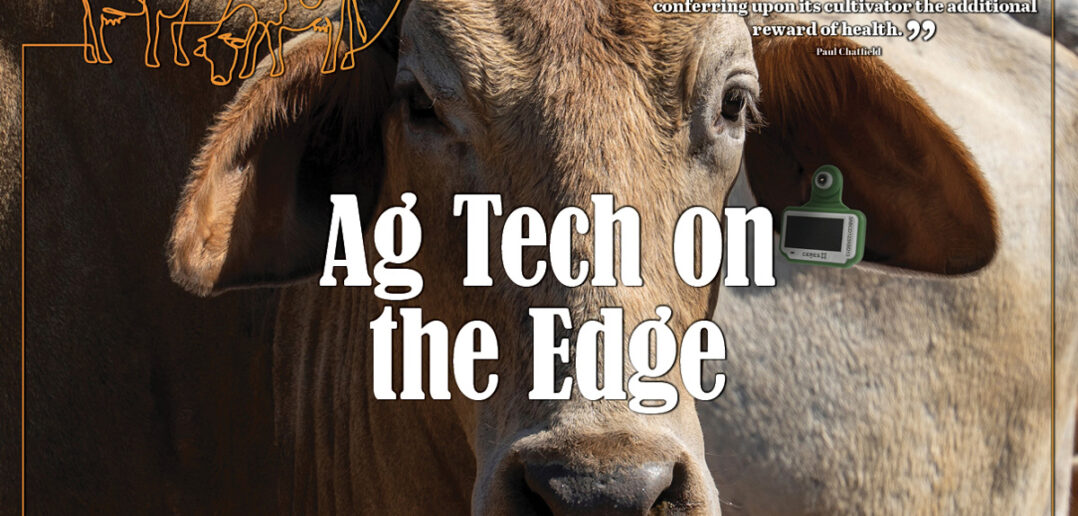
New and improving technology is being used by farmers to not only track and protect their animals, but to improve land health.
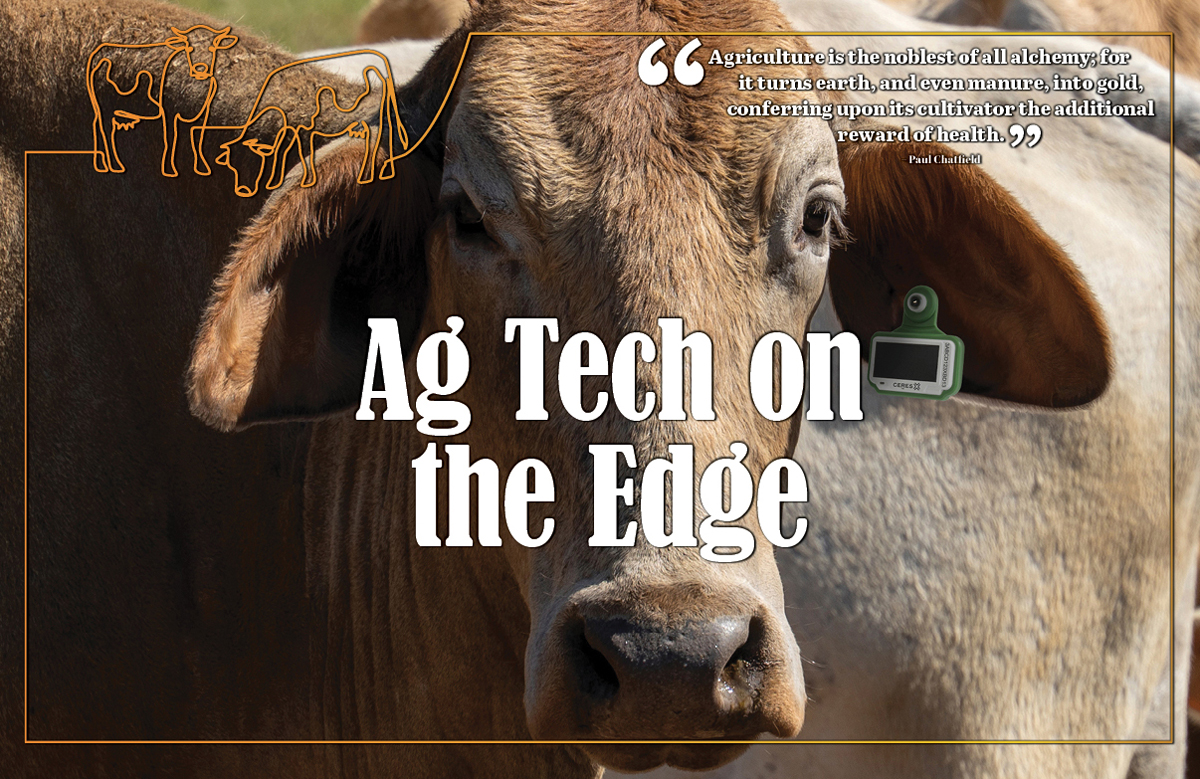
CERES Rancher device in action-delivering real time insights on animal welfare, location and behavior via satellite ear tags
Be it tracking cattle, verifying the identity and health status of those cattle, placing farmland with those who need it or making sure best practices are followed for the benefit of future generations, technology plays a big part in making things happen for modern farmers. No longer are those working the land limited to what they can see from their tractor seat. Instead, farmers can now view a previously hidden world of possibilities.
An Eye on Cattle
 Agriculture is the noblest of all alchemy; for it turns earth, and even manure, into gold, conferring upon its cultivator the additional reward of health.
– Paul Chatfield
The world’s first animal monitoring information platform with direct to satellite capability through a proprietary smart ear tag, Ceres Tag was founded in Australia in 2016, according to its website. As David Smith, CEO and co-founder puts it, the company began with the goal of improving animal traceability, as well as the health and performance of livestock. The company then underwent a five-year research and development program, and Ceres Tag came to market in 2021 with what Smith describes as “the world’s first direct-to-satellite livestock monitoring platform.”
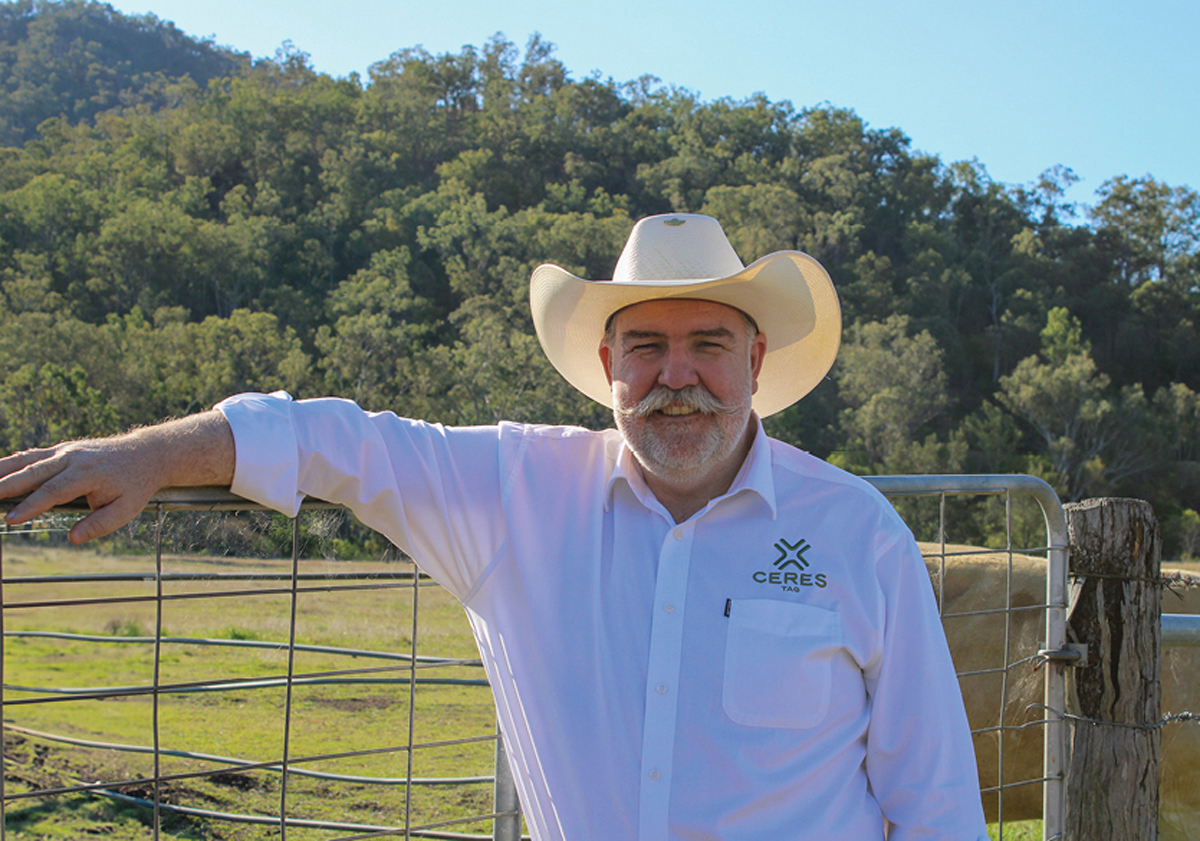
David Smith, Founder & CEO of CERES TAG
What Ceres Tag does is allow traceability of individual animals to ensure the safety of our food and the optimum welfare of the animals. This ability to transfer information about open pasture animals on an unlimited scale had never been done before.
“And it’s not just knowing how they are, but that allows those who own the herds of cattle to know where they are in the environment,” Smith says. Anyone who’s grown up in Kansas is likely familiar with what cattle pastures and feedlots smell and look like. Being able to make sure cattle are in specific areas and keeping the land managed so that farmers can continue to use it year after year with a clean water source is essential, Smith confirms.
“One of the other very distinctive features of our platform is that it involves machine learning so we can continually add new algorithms to determine new things about the animals,” he adds, saying it’s similar to adding apps to your iPhone. “You add a new app, and the iPhone can do more things. Likewise, our platform, the way it’s been developed, is that we can continually add new algorithms to determine new things.”
One example is the primary algorithms that are on the platform right now, Smith continues. “Pasture feed intake, with that algorithm developed by one of Australia’s leading science research institutions, we can determine the amount of grass that animal eats.”
LOCAL MATTERS
Our Local Advertisers – Making a Positive Impact
By taking the dry matter intake per day and looking at the cattle’s growth rate, farmers can determine which animals are feeding the most efficiently. Called a phenotype or heritable trait, cattle ranchers can determine which of their animals should be breeding with which to optimize their stocking rates, as well as the impact to the land.
One of the things that Ceres Tag has done in its platform is design it to integrate with whichever software customers want to use, because all through the supply chain, different people want different things.
“Ironically, the same data is required, but people need to see it in a different format to suit their particular thing of interest, ” Smith says. That could be anything from straight operations to genetics to soil carbon to banking or insurance. “It could be any of those things, but this information is critical to be able to ‘de-risk’ and know more and make better decisions. Greater profitability from greater productivity, “” he says.
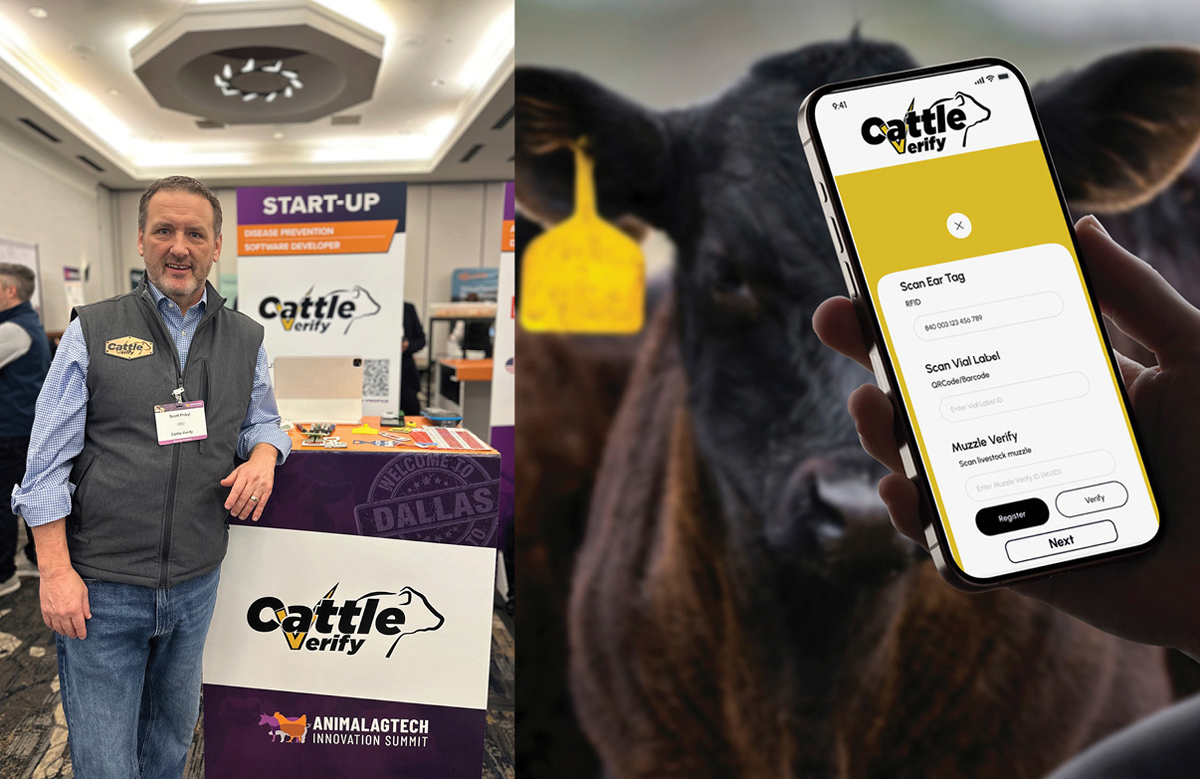
Scott Pribyl, CEO Cattle Verify
From Human to Animal
Cattle Verify is “pandemic prevention software for beef and dairy that uses ID scanning for medical traceability and is managed with the first cattle-centric electronic medical record (EMR) and telehealth for the large animal veterinarians and producers to stop the spread of communicable diseases,” according to its website.
Scott Pribyl, company founder and CEO, spent the first half of his career in biotech. In 2010, he became an entrepreneur and built software for human health care focused on specialty drugs. Specifically, he built software for the U.S. government’s 340B Rebate Model Pilot Program, a program for hospitals that see a high percentage of indigent patients, wherein manufacturers participating in Medicaid agreed to provide outpatient drugs to covered entities at significantly reduced prices.
“We were finding millions of dollars per month in lost specialty drug claims through this program, which was important to keep the doors open in rural hospitals,” Pribyl explains. Then COVID-19 hit, and within a month, he took that software and turned it into what he calls “one of the most robust softwares for COVID-19 in the country.”
In practice, a patient would register online and show the QR code on the phone to start testing at a clinic. In only three clicks, that clinic started and completed a medical encounter, and sent a notification of the results automatically to the patient. This software workflow is what eventually became Cattle Verify.
Around the same time, the Cattle Verify founder was getting calls from veterinarians and pharmacies saying there were a lot of issues they were trying to resolve, and they needed help.
“When you look at the cattle side, they have RFID [radio-frequency identification] chips in their ear tags,” Pribyl explains. “It dawned on me that it was the same thing we did for COVID-19. Instead of walking up and scanning the QR code on the phone, we can now scan the ear tag on the cattle, and three clicks later, we have started and completed a medical encounter.
“We take for granted medical management on the human side; however, it is not as seamless on the cattle side,” he continues. “There is not a standardized electronic medical record system, different regulations to navigate and significant challenges in animal telehealth. If we learned one thing from COVID-19, it was that we like our telehealth.”
On the animal side, there is a regulation called veterinarian-client-patient-relationship (VCPR). Per the American Veterinary Medical Association (AVMA), “Most states require that a VCPR be in place for your veterinarian to diagnose or treat your animal, or prescribe or dispense medications.” Because of that, if your animal is sick, you cannot go to a national telehealth platform to get a prescription filled from a veterinarian without a direct relationship.
With the software Pribyl built, however, there are things that could be done to bring telehealth to the animal side.
Cattle Verify is used in conjunction with platforms such as MyAniML, which uses an AI scan of the cow’s muzzle as the livestock biometric marker. The idea behind MyAniML is that ranchers or farmers can set up cameras that scan muzzles as the cattle walk by. That technology can detect a disease up to two or three days earlier than the current care model.
“Pink eye and shipping disease (bovine respiratory disease), those two alone are about a billion-dollar annual cost to the economy,” Pribyl emphasizes. “We partnered with MyAniML because once their software detects a possible illness or sickness, it can connect to our software, and we can notify the veterinarian directly. If the primary large animal veterinarian can make an informed decision quicker, it could significantly reduce the spread of the disease.”
For example, when cattle are being loaded onto a shipping trailer and scanned with MyAniML, animals using the Cattle Verify plus MyAniML systems could notify the primary vet in real time about the likelihood of an infection that needs veterinary attention. Ideally, the vet could say, “Don’t put them on the trailer. Quarantine them. I’ll ship you the drug overnight for tomorrow morning.
“If we can improve the time to earlier diagnosis, we could prevent some of the endemic and pandemic diseases from spreading,” Pribyl explains. “For example, over a three-month outbreak period, a 500-animal beef cattle ranch with a 90 percent infection rate will spend an estimated $15,000 in total treatment costs and experience approximately $41,000 in revenue loss due to reduced weight gains for a total loss of $65,000 per outbreak.”
To make the entire process work seamlessly, Cattle Verify is building the first cattle-centric EMR (electronic medical record) with pandemic disease modules and the first VCPR-compliant cattle telehealth platform. The large animal veterinarians are in desperate need of a solution, since one visit to a ranch could be four hours round-trip, and there are not enough vets to manage the 90-million head of cattle in the U.S. No other group needs telehealth more than the large animal veterinarians.
There is also a global need to manage pandemics, and Cattle Verify is currently in discussions with one of the largest beef-producing countries in the world to bundle the software with every ear tag and provide the medical audit trail needed for exports.
“For telehealth in cattle to be successful, the direct relationship between the vet and the animal must be maintained through the chain of custody,” Pribyl says. “We are streamlining the medical information to use telehealth to aggregate all of the data so the primary veterinarian can make an informed decision earlier. The economic costs of these outbreaks could be catastrophic, like the $11-billion cost to the U.S. for mad cow disease in the early 2000s. I’m very sensitive to the potential financial impact of the producer’s herd being wiped out from a pandemic while still protecting their need for privacy and making sure their data is secure.”
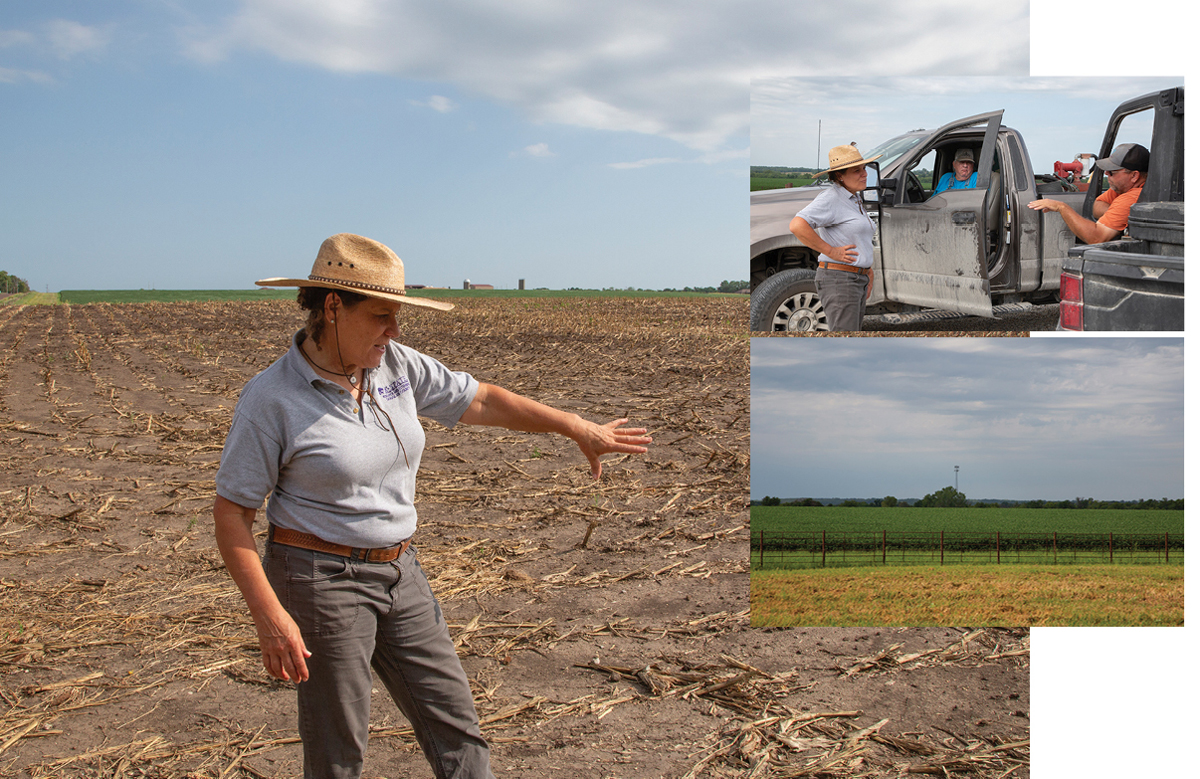
Margit Kaltenekker, Agricultural agent for K-State Extension inspecting soil and talking with local farmers in Douglas County
Stewards of the Land
While Ceres Tag and Cattle Verify offer broad technological ways to protect the health of both animals and the environment, one of the prime tenets of the K-State Research and Extension Douglas County (Douglas County Extension) is land stewardship. Their work is rooted in the six principles of soil health woven together in a holistic framework—from field to farmer. By applying these principles with cutting-edge tools like no-till, precision agriculture, cover crops, advanced soil testing and drone-based rangeland and nutrient analysis, they’re helping farmers create resilient systems that capture and infiltrate water, lower input costs and build long-term profitability while protecting the environment.
“What we mean by land stewardship is the proper care of the resource so that it can endure for generations,” says Margit Kaltenekker, agriculture agent for Douglas County Extension. “And yet, what we’ve been seeing—not just in western Kansas last spring but Illinois this previous year or ongoing in parts of Nebraska—is the return of major dust storms.
“The drought cycle that we’ve been in the last few years, I think, is directly related to a breakdown in our water cycle as related to poor soil health and function,” she explains, and native plants are better suited to retaining water and soil because their roots are designed to go more deeply into the soil. However, depending upon how it’s managed for grazing purposes, even if a pasture of native plants is overgrazed, and the plants can’t recover their crown, that can actually deplete the root mass.
“The plants have to draw on its root reserves to grow up, but if it’s constantly being eaten and eaten and eaten without giving it enough rest time,” the plants can’t properly grow back, Kaltenekker continues. So a combination of impact management and rest is required to prevent soil erosion from areas used for grazing.
“Some of the newer landowners who might have purchased 10 or 20 acres of land, they don’t really know how to take care of it and to maximize its potential,” she says, and that doesn’t mean they have to go into some form of commercial agriculture. “There’s still a lot they can do, even if they want to put in a fishing pond or restore a native prairie remnant. These are all things that will build biodiversity into our overall environment.”
Some of Kaltenekker’s work in the last few years is helping create workshops where farmers can learn about the best management practices to incorporate soil-health practices, such as regenerative agriculture, which includes keeping the soil covered and minimizing tillage. While a lot of farmers with which she interacts are already no-till, not all of them are.
“Minimizing tillage is keeping the soil covered with the living root,” she explains. “And if that means rotating through cover crops, at least save something growing in between their cash crop.”
Soil-health principles include increasing diversity of rotational crops, so ideally, farmers would fold wheat back into their rotation to add one more area of diversity or implement integrated livestock that can graze the crop residue or the cover crop itself, and fold that in with some perennial pastures to create more diversity and get the animals onto row-crop fields.
“It’s a good thing,” Kaltenekker says. “It’s beneficial to keep the poop in the loop, because everything flows downstream. It doesn’t stop at your fenceline, and I think farmers must recognize that we’re part of a whole ecosystem, and we can’t ignore the human element of that ecosystem, like it or not, where there’s development encroaching upon farmland. We must find the right balance.”
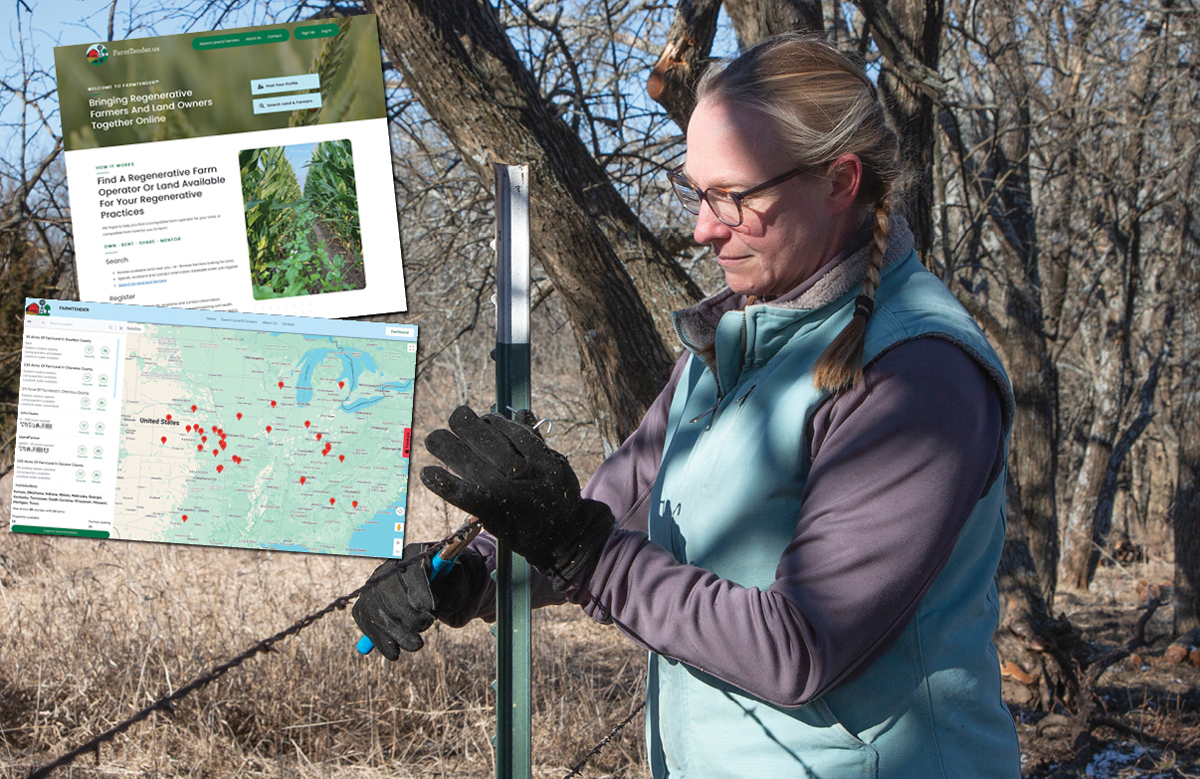
ounty Commissioner Karen Willey repairing a wire fence on her farm. Insets top: FarmTender.us allows regenerative farmers and landowners to explore new farming relationships including mentoring, lease, or sale; bottom: Search dashboard for participating farms and farmers currently includes the contiguous US. Zoom into the map or search a location to find opportunities near you. The zoom feature limits location data to preserve privacy until both parties agree to share.
Improving Communication
FarmTender.us was founded in 2021 by William Bradley and Karen Willey “for the purpose of providing an online platform to promote regenerative farming by connecting farmers and landowners with similar land stewardship goals.” The site brings together those with spare farmland and those looking to acquire it to get into farming.
The pair met at a regenerative agriculture conference and became friends.
“We came to it from different sides,” Willey explains. “I was a first-generation farmer, lucky and blessed to get the opportunity to have access to land. Brad was struggling to find tenant farmers that would do the work in that regenerative [agricultural]sphere.”
It took Bradley three years to find a suitable tenant for his west farm, and on a shared ride with Willey, he was bemoaning that fact.
“We just started talking about what it would take to create a service where farmers could find land, and landowners could find farmers,” Bradley recalls. From there, something not unlike a dating site emerged, although one that is very specific. The “Tender” part of the name is a play on the popular dating app.
“We needed something that would run without a lot of babysitting,” Willey explains. “Some of the tools that were out there that were either state-specific—and Kansas didn’t have one, they had people behind the scenes that were doing all of this matching and then following up.”
While there’s a need and a role for that, it wasn’t what Willey and Bradley hoped to contribute. They envisioned a site where people could input information they were looking for in a match and take that and start communicating with each other.
“That first communication is anonymous,” Willey points out. “If you reply to it, then you’ve shared your information. Just trying to have a little bit of privacy there to get it started, and then people put themselves out there.”
The idea went back to a Kansas Rural Center survey, which was put out a decade ago.
“They put out a survey, among other things, asking, ‘If you’re a landowner, would you be willing to offer an acre or corner of your land to a beginning farmer if it were the right person?’ ” Willey recalls. “And overwhelmingly, people said yes. There’s a desire to have a connection and to see more food grown in your neighborhood by people who don’t necessarily want to be the ones that put in that amount of work. But there was no mechanism to follow up and say, ‘Who are those people, and how do you find them?’ ‘What does the right person mean?’ This doesn’t just do that, but it also allows for that.”
It could be as small as an acre or even less—any size fits the model they’re working from. But the site is mostly geared toward larger acreages. Bradley’s own farm is over 600 acres, for example. The land-access relationship could be a sale, lease, co-op or anything in between. Farmers may be looking for grazing land, row-crop or specialty-crop space.
While the pair did a fair amount of testing before launch and got most of the bugs ironed out, FarmTender.us hasn’t really changed since then other than having grown.
“It’s grown at a slow pace, but it’s still grown from month to month,” Bradley notes.
Willey points out that farmers across the nation are getting older and aging out of the business, and the next generation is not coming up in the way that it traditionally has—from within farm families. Instead, there’s been a groundswell of people who have not been farmers wanting to be farmers.
“We can train them, and they’re especially interested in these regenerative [agricultural]techniques, but they don’t necessarily have a way to access that land,” Willey continues, saying that much of the land is still in the hands of traditional farm families or other landholders, many of which are siblings who have inherited land but live in the city, and don’t want to get rid of it because of the family connection but don’t know how to manage it or to communicate with farmers. “We knew that, across the board, there was a need for farmer and land communication, and that’s what we’re working on.”
When setting up FarmTender.us, Bradley and Willey worked hard to determine what were the right questions to ask and to get away from things like, “What’s your demographic?” because, as Willey explains while drawing from her own experiences as a first-generation farmer, there’s bias toward what a farmer should look like, including race and gender and age.
“We’re trying to ask the other questions like, ‘What are your values around the land?’ or ‘What are you hoping to accomplish with the land?’ We were mindful of that … just trying to get away from the imagery that people are expecting of a farmer, because I’ve certainly been up against that,” she says.
“If they find each other, they go on and do their thing, and there’s no reporting-back mechanism where they can tell us,” Bradley reflects. “I mean, the numbers are still climbing from month to month from people finding out about the site and being interested in joining. We’ve had a couple of emails that said this was long overdue—’Thank you for doing something’—and that’s nice to hear.”