

| story by | |
| photos by | Steven Hertzog |
| OPEN A PDF OF THE ARTICLE |
The physical work involved in larger-scale farming can be taxing, but so can the less-seen mental struggle going on behind the scenes to keep the business profitable.
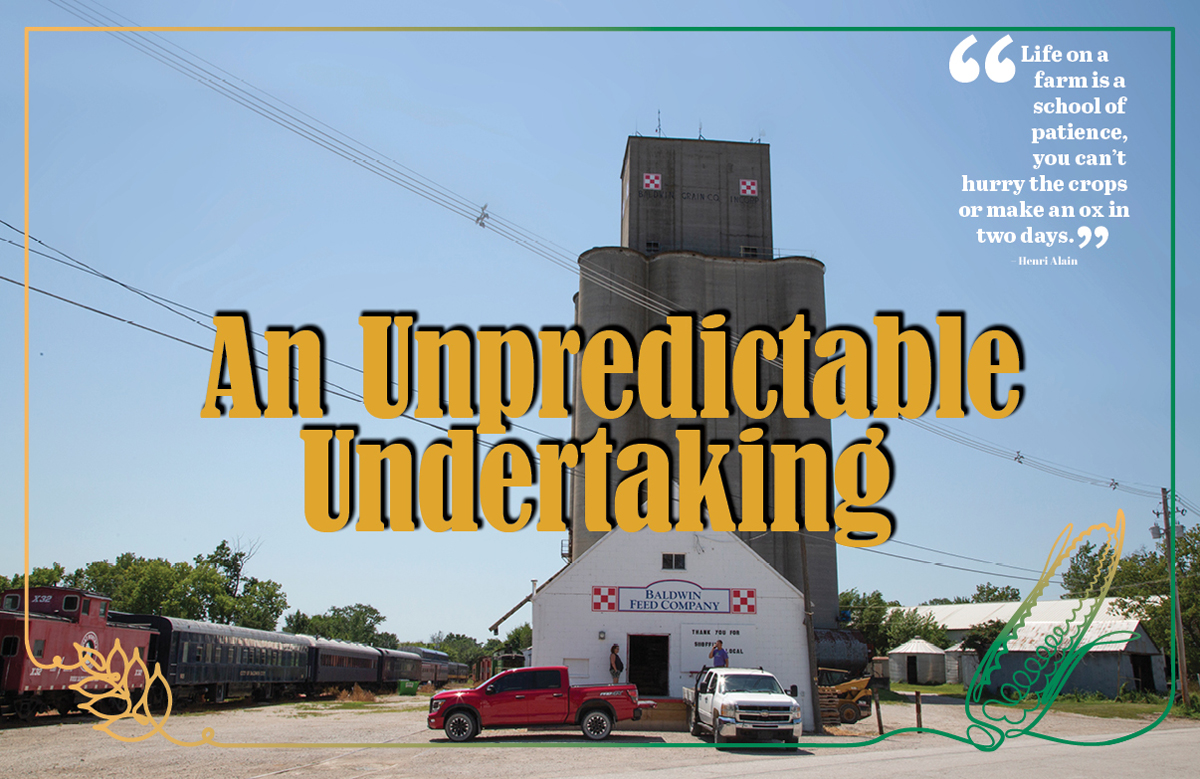
Baldwin Feed Company
 Life on a farm is a school of patience, you can’t hurry the crops or make an ox in two days.
– Henri Alain
When the work is 24/7/365, then it’s a lifestyle and not just a job. Large-scale crop farming both literally and figuratively covers so much ground that it can be hard to come to grips with the scope of the work for someone who has never done it.
Cultivating and harvesting crops on hundreds to thousands of acres involves physical labor, to be sure. But the mental anguish of risk-taking and decision-making occupies far more of any farmer’s time than the physical work, farmers say.
Trenton Reavis and Lee Broyles are local crop farmers whose families’ farms are in Douglas County and neighboring counties. Steve Wilson’s family owns Baldwin Feed Co., in Baldwin City. All three are integral to Douglas County’s farming community and economy.
Farms with operations the size of Reavis’ and Broyles’ have been on the decline for decades, as 1980s movements such as Farm Aid brought to light. That isn’t just a 40-year-ago story, though: Between 2001 and 2016 alone, 11 million acres, or about 2,000 acres per day, were converted to nonfarm uses, according to the American Farmland Trust.
With less land, though, demand is still paradoxically high at times, here and abroad, for crops such as wheat, soybeans and corn. So, how do they do it? And how will they keep doing it?
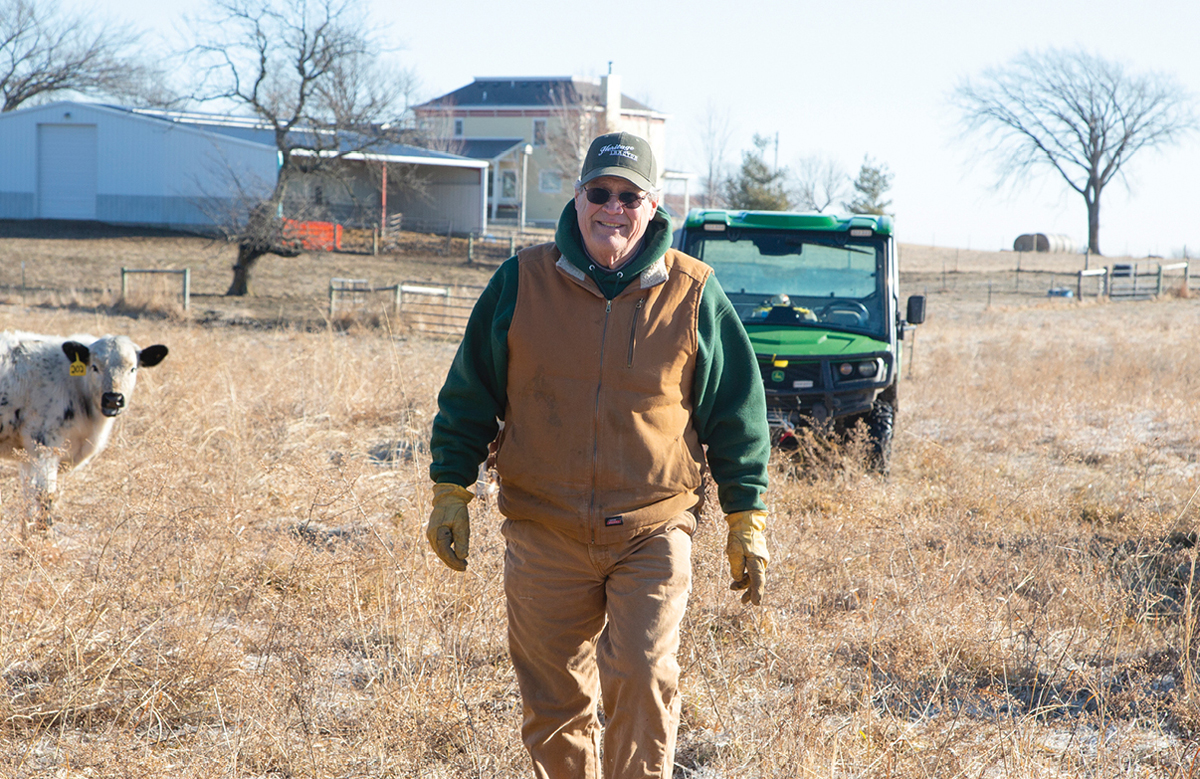
Lee Broyles
Farming Crops on a Large Scale
Reavis and his father-in-law farm about 1,300 acres of corn, soybeans, wheat and hay. He moved to the area in 2011 from Indiana with his wife to take on the leading role in the family operation.
Broyles says he has been farming since he was in junior high, when he first helped a neighbor plant oats. “It’s the only permanent job I’ve ever had,” he says. Now, he is in business with one friend and another neighbor, who, together, farm about 2,200 acres of soybeans, corn, wheat, hay and pasture in Douglas and Franklin counties.
Wilson has run Baldwin Feed for 33 years and has seven employees, including himself, most of the year.
So many variables factor into a farm’s inputs, outputs and profitability that when combined, they read like the most nightmarish, unsolvable math-class word problem. With wild unpredictabilities that are outside of any one person’s control, the scientific method can’t unite or isolate the variables in any logical way.
LOCAL MATTERS
Our Local Advertisers – Making a Positive Impact
The farmers themselves control factors such as whether to till the soil, which seeds to plant and how many, what machinery to employ, when to plant, how to fertilize, how to control weeds and how often to water. All of those things involve costs, both financial and physical, so budget and time constraints guide and affect how decisions are made.
“There is no guaranteed right answer. You have so many factors that are uncontrollable,” Wilson explains.
Indeed, even the soundest logic and reasoning can be obliterated in an instant when the work is directly affected by weather, demand (or lack thereof), market prices and other government decisions at the national, state and local levels.
“Every year, you plan for the best crop you can make. And what happens happens. You worry about what you can change and not about what you can’t,” Broyles says.
Stagnant Market Prices
Through the past few decades, machinery costs have skyrocketed, wages have risen dramatically, and land costs have increased. Yet some market prices for crops are almost the same dollar amount as they were decades ago.
“The crop price has not appreciated proportionate to what the cost of ground has. We’re able to make it work by increasing yields with hybrids,” Reavis explains.
Broyles says farmers begin every year not having any idea whether they will make any money at all. It isn’t until about December, when the harvest is done and equipment is put to bed, that he knows. And even then, “a lot of years, I turn my cash flow into the bank, and it’s negative,” he adds.
Wilson has a front-row seat to local farmers’ struggles and victories.
“The price they’re getting for their grain hasn’t gone up, not like wages and other costs. It’s pretty tough for them to make ends meet,” he says.
There’s another pressure on farms with Douglas County locations that has nothing to do with crops or equipment: the value of local land.
Reavis says that being near Lawrence and in eastern Kansas, in areas that continue to grow, makes businesses and local governments scrutinize the farmland more closely. The University, other business and residential development from Kansas City have affected land values. With steady market prices that haven’t adapted over time, he says the returns per acre of farmland don’t justify their use compared to what the land could pay out with other development.
“The statistics are sobering. This is prime soil for feeding the world, and some of it is going under concrete,” he explains.
They can’t control the market prices, so what can the farmers do? For one, they can get their arms around their input costs and engage in a strategy game to maximize crop yields on their land, aiming for the lowest input costs for seed, fertilizer, equipment and labor.
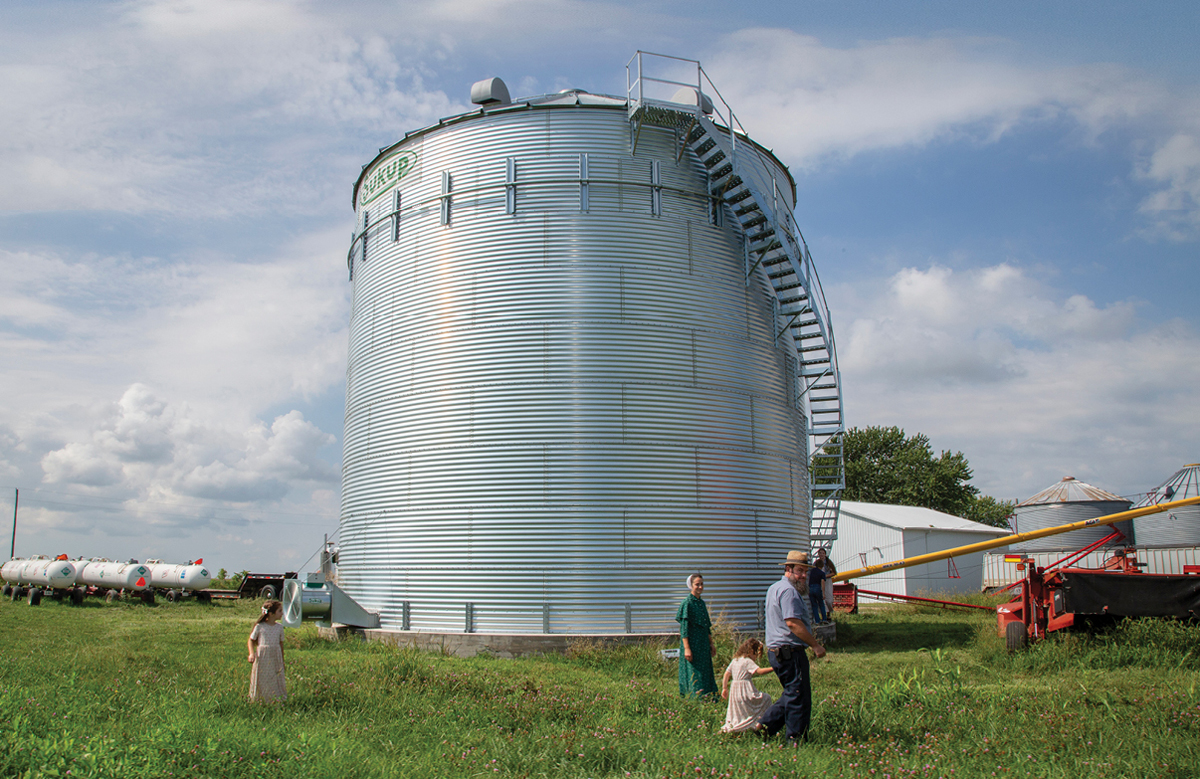
Trenton & Esther Reavis with their children Carina, Landon, Delee and Elin on their Baldwin Farm
Controlling What They Can Control
Reavis says part of his approach is to focus on soil health. He has planted cover crops to keep the soil in place, restore carbon to the soil and help its microbial life.
“I’m trying to be a student of the soil and place nutrients underneath the plant. When margins are tight, you’ve got to balance this long view to stay in business,” he says.
He also chooses hybrids and varieties of plants that do well in a drier climate, and he applies tactics such as strip-tilling the corn to retain the soil’s natural moisture.
Focusing on his technology and machinery are what Broyles says works best to keep his operation running efficiently.
The technological advancement he says has affected his farming the most is a planter that plants each seed only where there hasn’t been a seed planted before. Computer programming in the tractor records the yield in the field, in every location. The next year, Broyles uses software to program the fertilizer to apply more or less fertilizer in the field according to the data of the previous year’s yields.
“It’s unbelievable what has happened with the technology,” he says.
Number-crunching has helped Broyles and a cofarmer to coalesce around a strategy for upgrading machinery, particularly the combines.
“We don’t buy new. Combines usually have five owners over the lifespan of the machinery. We like to be the second owner in that five. We keep the machinery upgraded but are able to pay for it,” he explains.
Similar to Reavis, Broyles and his farming partners have moved toward a no-till approach for the soil alongside the technology and machinery strategies.
Running the feed store, Wilson must stock and offer all the tools, equipment and supplies for farmers taking an infinite number of approaches to their farm inputs. He has become well-versed in a range of tactics and has stayed up-to-date through interactions in the store about what farmers need and use.
“We try not to advise, just provide support for what they need to do,” he says. “Nothing ever stays the same.”
Baldwin Feed has a feed mill, grain elevator and building. Wilson says the operation is versatile enough to make as large as a 16,000-pound order of feed, or it can make as small as a 300-pound custom batch of feed—or anything in between.
The DeLong Co. businesses in the Logistics Park intermodal facility in Edgerton have drastically affected farm traffic and operations in the area around Kansas City and Emporia, which Wilson says used to be its own sort of district. Many farmers now have semitrucks for carrying loads and can supply directly to their end users, which has affected businesses like Baldwin Feed. Wilson says he and his staff appreciate their customers and strive to be an integral part of every farm’s team.
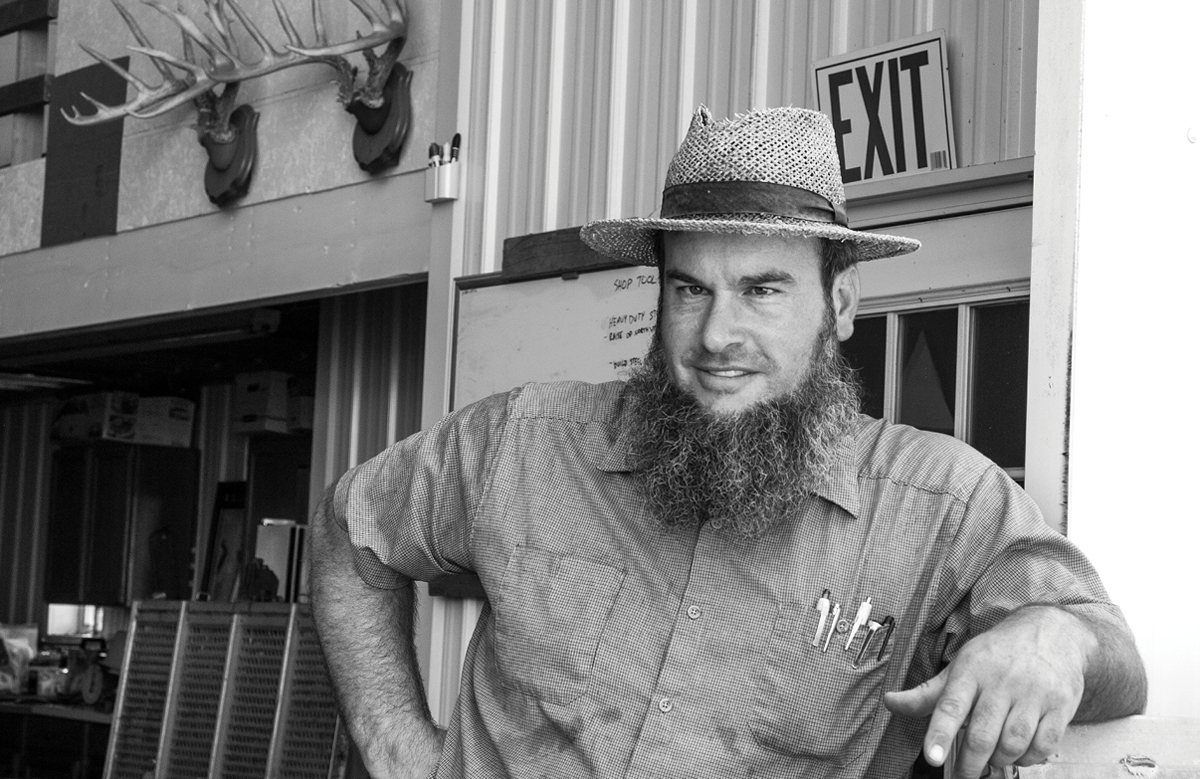
Trenton Reavis
Government’s Role in Farming
About 2 percent of Americans are farmers, but every single American, 100 percent, relies on a farmer each day, according to the American Farm Bureau Federation. The supply chain for farmers, from land to grocery store, comprises about one-seventh of the U.S. economy.
As outlined above, though, profit margins are razor-thin and depend on factors as capricious as the weather. Farming is too big to fail, and that is just from the financial angle. With every American dependent on a farmer every day, failure would mean a lot more than a spending deficit.
“Everybody gives windmills a bad time, but, well, farmers are subsidized, too. It’s good for the economy for farmers to do well,” Broyles says.
Only about 7 cents of every dollar consumers spend on food goes directly back to the farmer. The other 93 cents of each dollar reaches all the wrap-around industries that deliver, sell and market the products—from retail and wholesale operations to transportation and finance/insurance sectors, according to the U.S. Chamber of Commerce. Farmers and the farm industry are integral to the U.S. economy for the way their dollar moves through it.
“We’re thankful for crop insurance, because it gives us a floor. Even if we grow a reasonable crop, it protects us,” Reavis says. “The objective is to keep production agriculture on a solid foot. The government wants to keep farmers, and that’s part of our equation that gives us peace at night.”
What Else Is on Farmers’ Plates?
Choosing who they are in business with is crucial to a farmer’s success, Broyles says. Wilson knows his store and his staff are part of each farmer’s and customer’s teams. Broyles says farmers must choose the right sources for seed, fertilizer, feed, etc., to even have a chance at a decent crop.
“Everybody has to be at the top of their game, and they have to care about your game,” Broyles continues.
The same goes for hired help on the farms, which he says has gotten increasingly difficult because of retirements and farm consolidation.
Finding good help is going to be a real problem for all farmers, Broyles says, because people will be able to make the same wage doing work that doesn’t involve extreme heat or as intense of physical labor.
“It’s either what you want to do, or you won’t do it. If you get up in the morning, and you don’t like farming, it won’t work,” he says.
Looking at the broader philosophy of farming, Reavis says he hopes there will someday be a way to recenter farming around rewarding nutritious food. He says it is a noble and worthy cause.
“I would like to see the market pay attention to quality, but it’s going to take some time to come to fruition,” he explains.
Both Broyles and Reavis emphasize that farming comes with rewards alongside all the hard work and challenges.
“People drive an hour and a half to get to their workplace. I take one step outside in the morning, and I’m at work,” Broyles says.
For Reavis, farming is part of his spiritual purpose.
“I’m fortunate to have the opportunity to farm. We want to be profitable and care for the family, but ultimately, I view the land as the Lord’s. I’m just a steward of the land right now,” he says.