| story by | |
| photo | courtesy Kansas Memory |
| OPEN A PDF OF THE ARTICLE |
The international exhibit displayed local manufacturing and agricultural products to encourage settlement in the state.
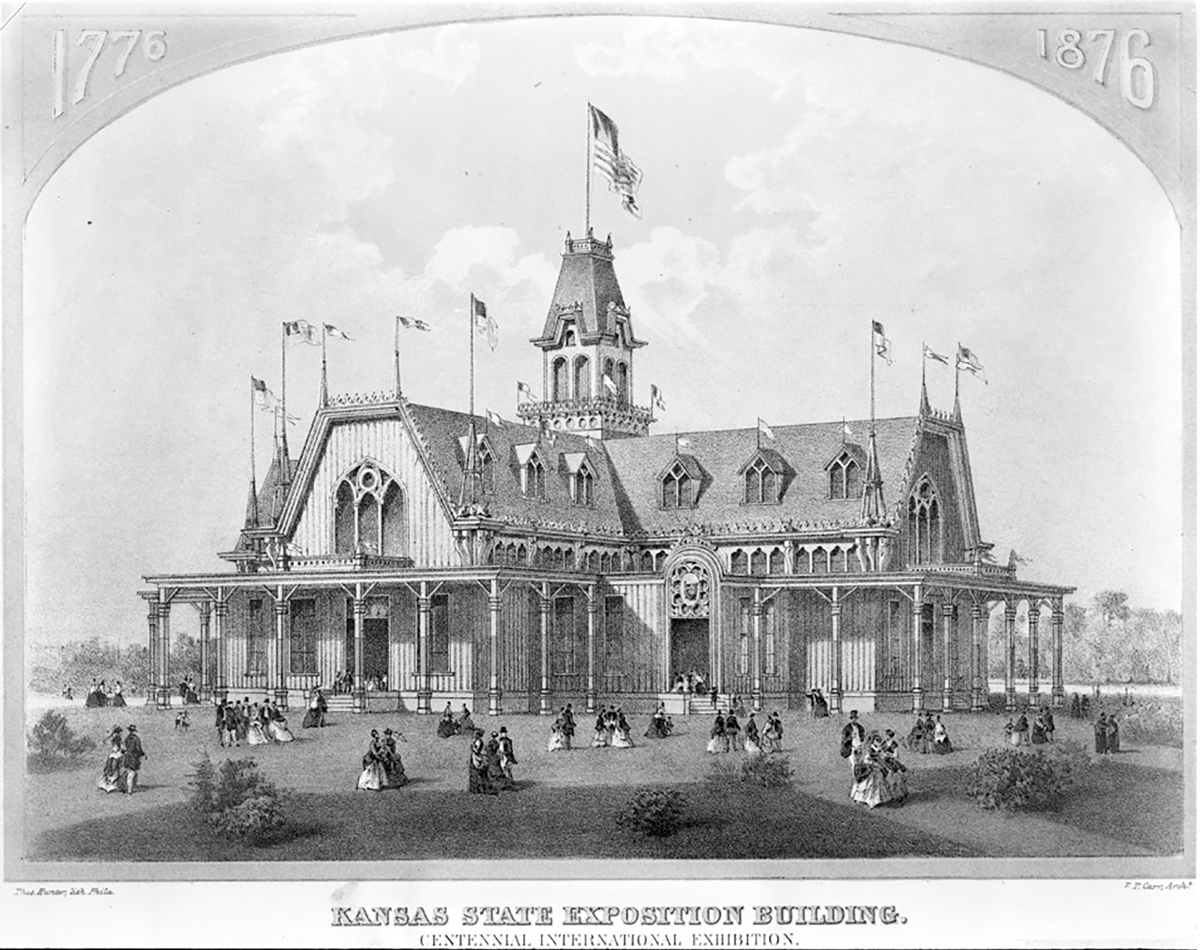
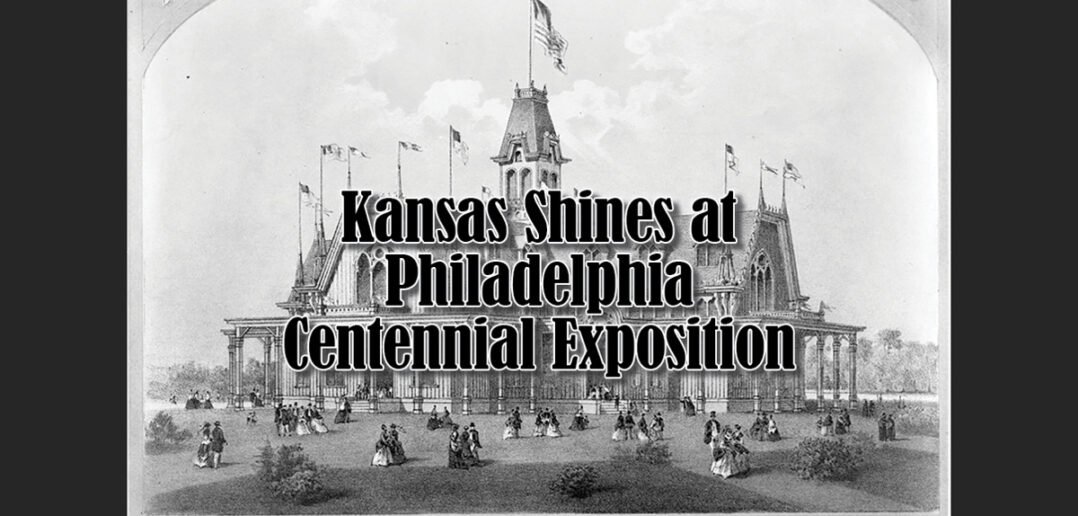
Kanssa State Exposition Building – Centennial International Exhibition, photo courtesy Kansas Memory
In 1876, the United States celebrated the 100th anniversary of its independence from England with what was commonly known as the Philadelphia Centennial Exposition. Its official name was the International Exhibition of Arts, Manufactures, and Products of the Soil and Mine, and it was held from May 10 through Nov. 10, 1876. Approximately 10 million people visited the exposition, with 37 countries participating in the event. Kansas leaders felt it was important to participate and show the manufacturing and agricultural products of Kansas as a way to encourage settlement in the young state. They also thought a positive Kansas presence would offset the negative impression it held because of the recent grasshopper plague.
States that participated built their own buildings, with Kansas’s designed to showcase the state’s exhibits. It had broad verandas that gave it an engaging appearance and was shaped like a cross, with each arm at 132 feet long and 40 feet wide. The building was described by an 1876 Board of State Managers report as follows:
- ” … in each of the angles was a room 30 x 30 feet—giving a total floor surface of 12,560 square feet, about 9,500 square feet of which was devoted to exhibition purposes, the remainder to offices and the necessary private rooms. The total length of the building each way, through the transepts, including verandas, was 160 feet, and the whole height to the top of the cupola, 80 feet. The peculiar construction of the inside afforded a central or rotunda space 80 feet in diameter with a total height of 43 feet, leaving four transepts 40 feet wide by 30 feet deep, with height the same as the central portion; and, as the light came from above, the whole wall-space (368 lineal feet) was left for exhibition purposes.”
LOCAL MATTERS
Our Local Advertisers – Making a Positive Impact
In 1875 and 1876, the Kansas Legislature appropriated a total of $30,000 for the collection of products to be displayed in the building.
Kansas shared the west wing of the building with Colorado Territory and the north wing with the Atchison, Topeka and Santa Fe Railway.
The Kansas Building had a reading room where Kansans and other visitors to the structure could relax in comfort. The floor was carpeted and had sofas, chairs and tables for reading the 150 Kansas newspapers contained in the room. Many of the issues were from July 4, 1876, when publishers were encouraged to include a history of their cities and counties, as well as illustrations. The room was decorated with photos from The University of Kansas, as well as other Kansas locations. The most popular objects in the reading room, however, were tumbleweeds. Several large specimens were on exhibit and generated great interest from Eastern visitors who had never seen them before.
The building had large porches on all sides of the structure that provided shade. Each porch contained a bench that went around the exterior wall so visitors could rest. It also had indoor toilets—one for the “gents” and another for the ladies, which was furnished with a carpet, chairs and sofas.
The exhibits in the Kansas Building were diverse. Several cases contained geological specimens collected in Kansas, while three contained taxidermized birds. One exhibit had silkworm cocoons and silk ribbons from Silkville, a commune located in Franklin County, Kansas.
The report of the state managers contained the following description of agricultural products that were on display:
- “Above the door a great pair of elk horns were filled with millet, flax, and a huge “tumble-weed.” Antelope heads on either side held wheat. Broadhorns, supporting millet, represented the Texas cattle trade. Directly above the door were pendants of ears of corn, in clusters. A triple gothic window, reaching nearly to the roof, was lattices with a trailing vine. On each side, tall stalks of corn, reaching nearly to the top were set like pillars. Beneath was a buffalo head, arched by a half-circle of corn pendants. On its either side were other heads, and sheaves—some on buffalo horns. … The opposite doors leading to the office and reading room, were supported by columns of corn on either side, and arched with sheaves set in wreaths over the buffalo head. The arches of the roof were supported by columns of corn in the stalk, and there were pendants of corn ears in profusion.”
In addition, the Kansas Building contained all sorts of displays of Kansas-grown agricultural products.
The two most spectacular displays were apples shaped like the U.S. Capitol dome and a Liberty Bell. The dome of apples was 19 feet tall and more than 8 feet in diameter. The apples completely covered the frame that supported them. The replica of the Liberty Bell was popular with Philadelphia residents and hung from the ceiling. It was over 8 feet high and nearly 9 feet in diameter, and made of broom corn, millet and stalks of wheat. The clapper was a gourd that was 8 feet in diameter.
As indicated earlier, the Kansas Building was one of the most popular exhibits at the Centennial Exposition, with thousands of visitors viewing all sorts of Kansas agricultural products. It was a great showcase for the young state. The “Kansas Board of Agriculture Report” included reactions from eastern newspapers to the Kansas exhibit. At the end of the exposition, Philadelphia’s The Times on Nov. 22 wrote that Kansas was “The State That Showed The Best,” and that its exhibit was the largest and best of the state displays, as well as one of the most artistically prepared displays. The July 18 issue of the Kansas City Times contained the following praise for the Kansas efforts at the Centennial Exhibition:
- “Of all the places of interest, the grand centers of attraction upon the grounds, none draw more enthusiastic crowds than the Kansas Building, or, more properly speaking, the Kansas-Colorado Building, the Centennial State having one of the four wings. Kansas, however, honesty and justly wears the laurels, the Colorado exhibit being mainly confined to minerals and animals . … Of the contents of the Kansas Building, the grand display of the wonderful resources of the young commonwealth books might be written, while of the glowing encomiums and expressions of delighted surprise encyclopedias might be compiled. It is perfectly safe to say that no one feature of the Centennial has called out more genuine surprise or has bestowed upon it more enthusiastic praise that the Kansas exhibit . … of products that all heartily concede the world cannot equal. In a single stroke Kansas has lifted herself head and shoulders above every State here represented, no other State exhibition being worthy of mentioning on the same day.”
- The Michigan Farmer’s reporter at the Centennial wrote on June 16: “The exhibit from Kansas shows what a prairie State can do, and that from Colorado shows forth the wealth of a mountainous region, and the two show a combination of advantages in proximity to each other that, of themselves, independent of any other State or Territory, would make a wealthy and prosperous commonwealth of almost unlimited natural resources. In fact, Kansas and Colorado have shown all the older States how to make an exposition that shall secure to the State the full measure of advantage and distinction occurring from its concentrated labor.”