| story by |  |
| photos provided | by businesses |
| OPEN A PDF OF THE ARTICLE |
Sustainable energy products are not only valuable to businesses but are becoming more mainstream, helping consumers of all types save money and reduce their carbon footprints.
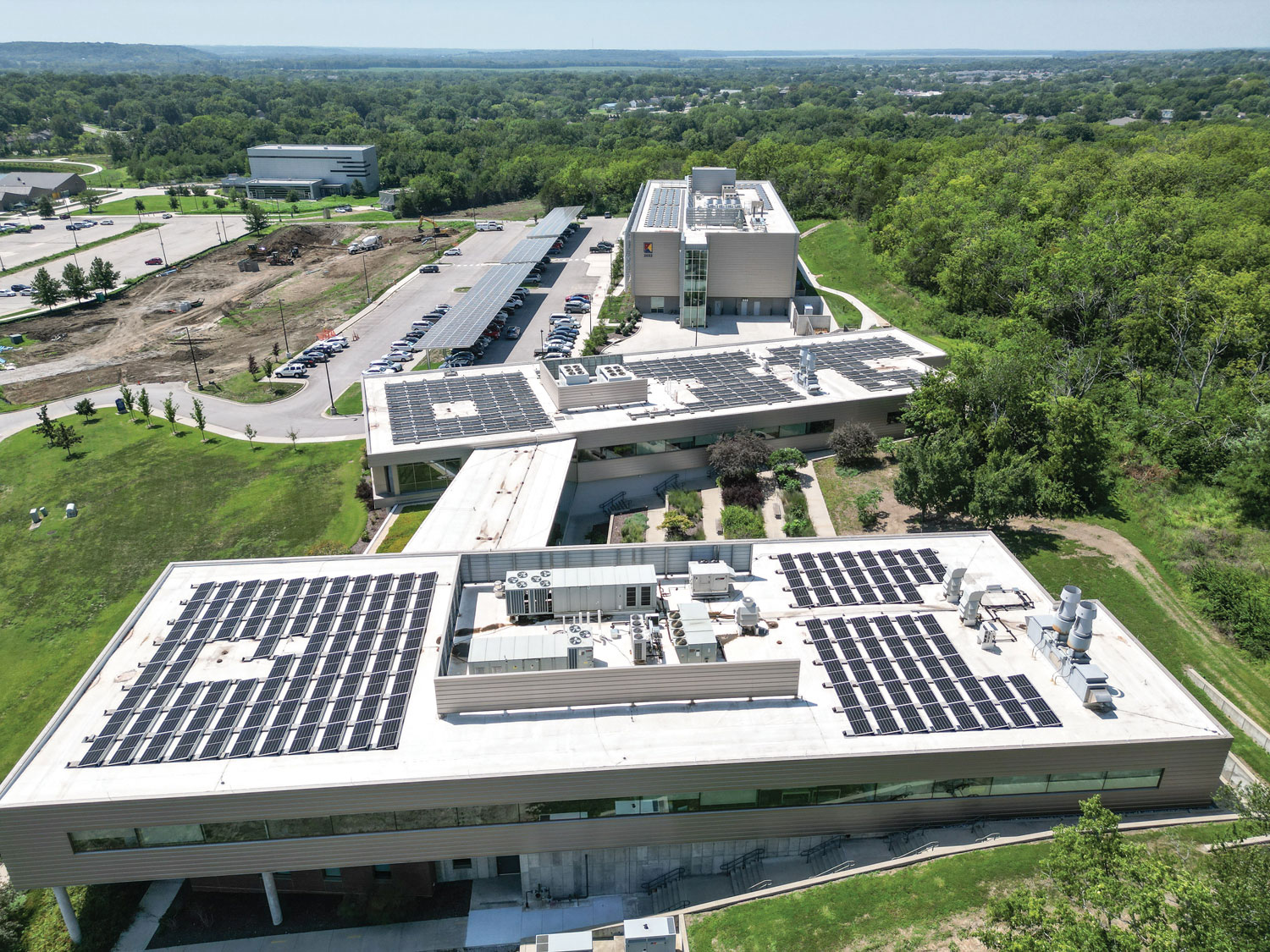
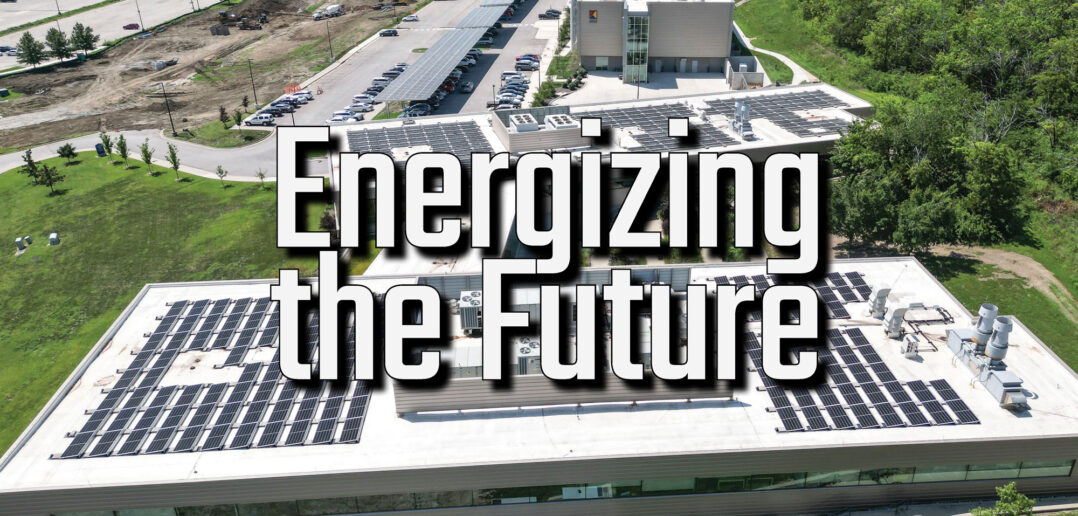
Cromwell Solar installation at KU Innovation Park on West Campus consisting of over 1000 solar panels across three rooftops and three carports. (Courtesy of Cromwell Solar)
Sustainable electrical production is having a moment, with the “seemingly unstoppable growth of renewable energy” named as Science magazine’s 2025 Breakthrough of the Year. Renewables surpassed coal as a source of electricity worldwide, according to the article “Good Morning Sunshine,” by Tim Appenzeller, and solar and wind energy grew fast enough to cover the entire increase in global electricity use from January to June.
As renewable energy becomes more mainstream, it also becomes more affordable because of economics of scale. Rather than operating a niche industry, sustainability advocates have seen their projects become adopted by everyone from homeowners to those who run factories. As Science further states, manufacturing in China has resulted in solar panels produced “better, vastly cheaper and in staggering quantities.”
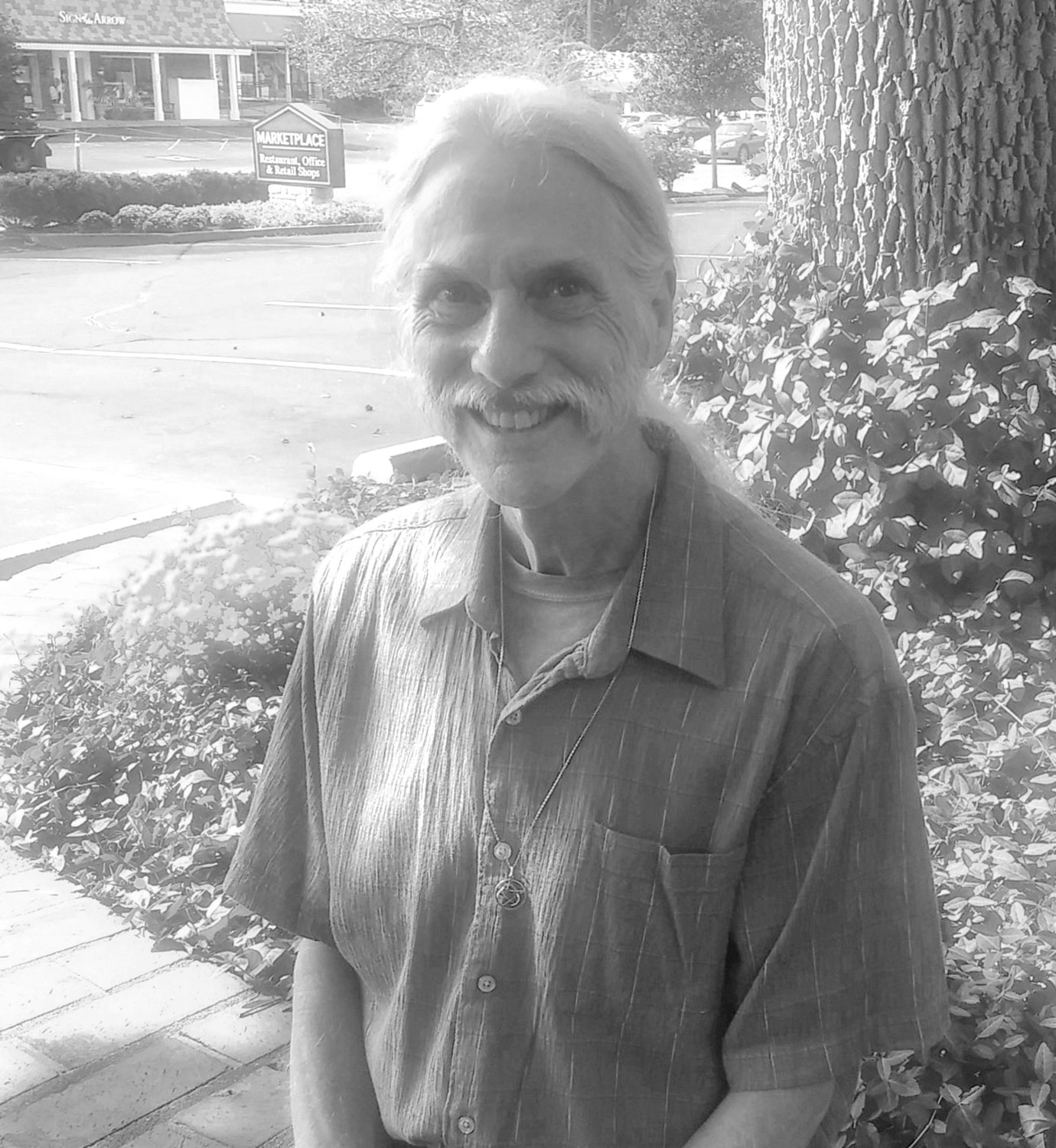
Mike Almon, owner of Paradigm Design
Michael Almon, owner of Paradigm Design, which sells and services ecological building products, notes that in his business, it’s all about energy as the guiding principle, because, “Without that, we can’t really do anything,” he says.
On the other hand, Almon continues, if we abuse it, we’ll be undermining our own life support system, so it’s a matter of how we do things, as well as what we’re doing.
“As population expands, and with our mass of human-made products that are continuously being depleted by planned obsolescence, resource and energy extraction then has to expand to meet that growing demand,” he observes, pointing out that as things fall apart, they need to be replaced. However, the use of fossil fuels for both energy and material goods makes for a growth curve that really can’t continue on a finite planet.
LOCAL MATTERS
Our Local Advertisers – Making a Positive Impact
“That’s the principle that I’m up against when I’m trying to live and trying to do a business to do something that can live within a sustainable planet,” Almon explains. Over the course of his time with Paradigm Design, which began in 1995, as well as his previous businesses Bluestem Electric Co-Op and Simple Goods General store, the business owner has seen numerous products he once purveyed as niche become mainstream. Among them are compact fluorescent lighting, which gave way to LED and can be found at Walmart, along with recycled paper and nontoxic paint.
“The principle I’m operating on both in business and in my own life are trying to live a comfortable life, living within the planetary boundaries,” he says. “Mainstreaming these kinds of materials and products helps more people do that.”
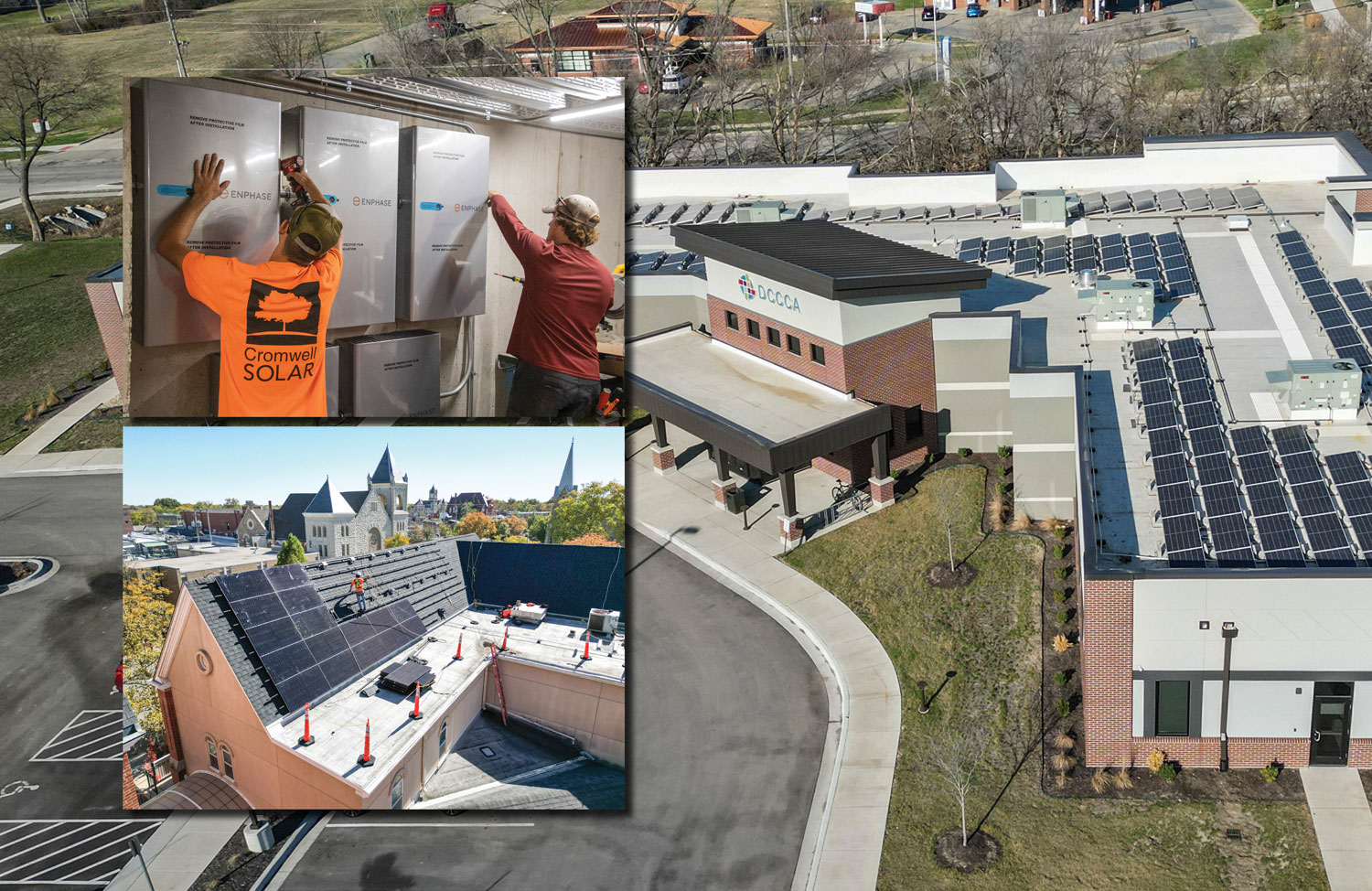
Cromwell Solar installed the panels for DCCCA’s new outpatient treatment facility building in Lawrence; Cromwell installing batteries for a backup power system Cromwell Solar installation at Plymouth Congregational Church
Not Just for the Wealthy
The mainstreaming of renewable energy is also something that has been noted by Aron Cromwell, CEO of Cromwell Solar, over the course of his 26 years with the company. When he started with the business that now bears his name in 2000, the CEO says they were installing solar at $12 a watt in today’s money and now do it for $3 a watt.
“If you think about inflation, that cost should have more than doubled by now,” Cromwell continues. Instead, it’s a quarter of its original cost. “It’s just really flipped. At the same time, the cost of conventional electricity has gone way up.”
The rising costs of conventional energy has garnered Cromwell’s company more and more interest, taking solar panel installation from more than a demonstration project or something that’s exclusively for the extremely wealthy. While once consumers might have decided to put solar panels on their home because of a one-time 30% tax credit, the price of powering their homes has come to a point where solar makes solid long-term financial sense, especially as standard electricity rates have risen 10% a year for the past half-decade.
“It’s something that a normal business, nonprofit, homeowner can do and expect a good payback on,” Cromwell explains. “A few years ago, we were looking at 12-year paybacks for residential with the tax credit. Now, without the tax credit, it’s still 12 years.”
He notes that while the residential tax credit has gone away, it still exists for commercial and nonprofit customers: “They can get it as long as we can get rolling on it here in the first half of the year. After July, it’s done.” Some of their commercial and nonprofit projects “are down to five years payback or less, which is fantastic,” he adds.
While Cromwell once dabbled in wind turbines and other forms of sustainable energy, the amount of upkeep and maintenance for those projects—while manageable at scale for wind farms—isn’t practical for someone who might consider it for their farm, for example.
“The nice thing about [photovoltaic], PV has no moving parts,” Cromwell explains. “I’m a science-y guy, an engineer, but to me, it’s still magical in a lot of ways. Sunlight hits the roof, and it somehow cools my house. It’s amazing. I love it.”
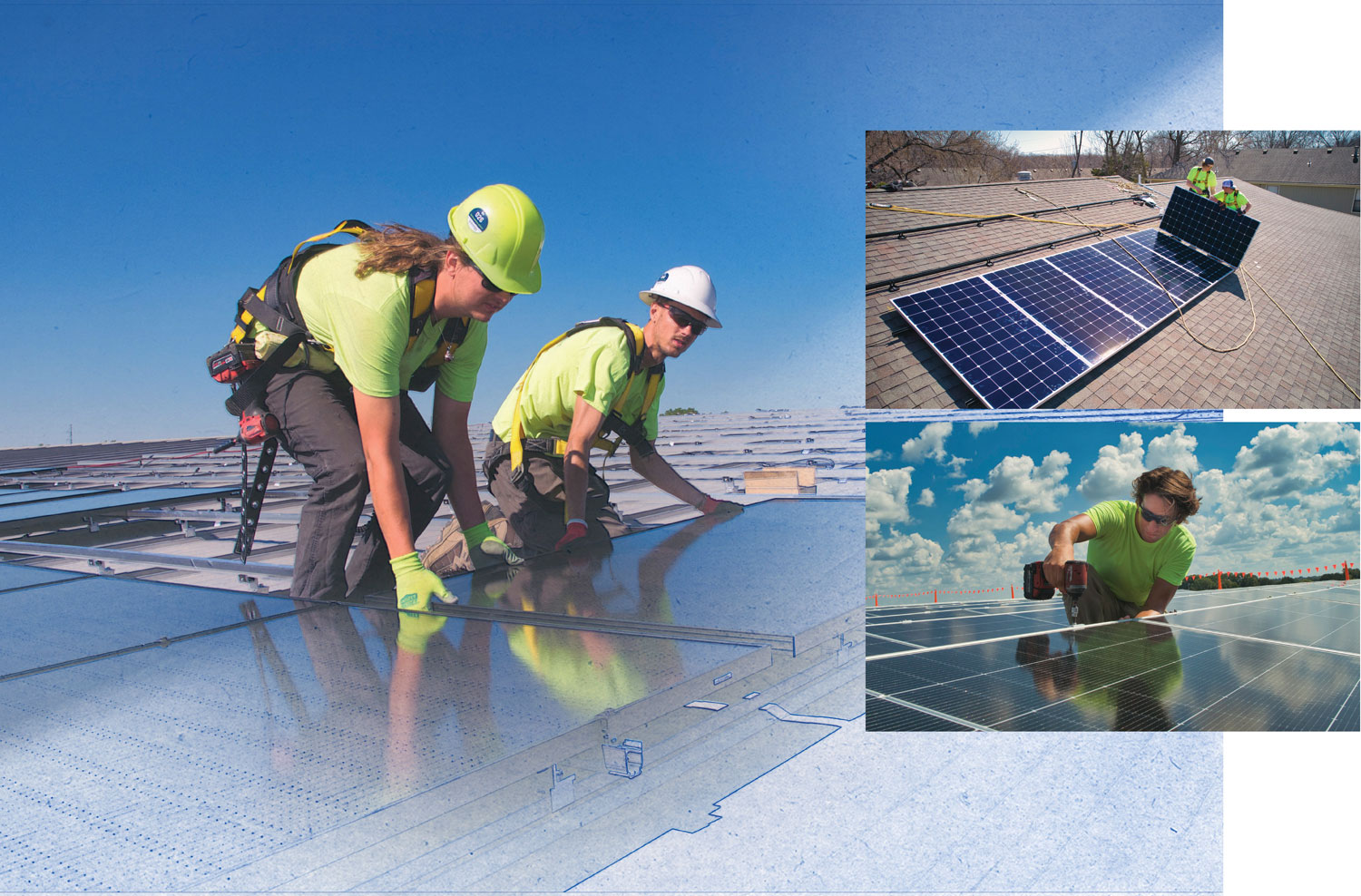
top to bottom (Courtesy of Good Energy)
Good Energy Solutions solar installers Guy Smith and Greg Johnson, install a solar module on the Evergy Service Center in Salina, Kansas.
As part of the company’s yearly solar giveaway to local nonprofits, Good Energy Solutions solar installers, Guy Smith and Tanner Mason, install solar modules on the roof of Family Promise in Lawrence, Kansas. Good Energy Solutions solar installer, Paul Bolig, installs a solar module on the roof of Crestwood Cabinets in Salina, Kansas.
A Technical Revolution
Also founded as a more holistic renewables firm is Good Energy Solutions. Kevin Good, founder and majority owner of the firm, holds a patent for a geothermal condenser pump, and in the early days of the company, founded in 2007, Good Energy installed many geothermal systems, as well as some small- to medium-scale wind turbines for residential use that are still operating today.
“But as solar went through this amazing technological revolution in the late 2000s, early 2010s, it became pretty clear to Mr. Good that solar was the easiest way to help people just really reduce their carbon footprint and save the most money,” says Malcolm Proudfit, CEO of Good Energy Solutions.
LOCAL MATTERS
Our Local Advertisers – Making a Positive Impact
“I had a customer today I was talking to, and they were thinking about wind turbines, and logistically for a homeowner, it is just not there,” says Amory Bottorff, Good Energy’s vice president of solar sales. “The height and the wind patterns at 250 feet are different than at 50 feet, so windmills never really scaled for residential use. Solar has taken over that market entirely.”
For utility scale, he continues, wind is great and really cheap in the right spaces, but it does have fare more maintenance intervals and so forth. That said, solar isn’t completely free of maintenance.
“It is a low-maintenance product,” Proudfit says, and because of that, the company ended up starting a solar service division in early 2025 that keeps a full-time solar service manager and a part-time helper busy going out and servicing existing systems.
“It’s maintenance free in the sense there’s no moving parts,” says Jeff Dunn, Good Energy’s vice president of solar operations, pointing out those with solar don’t need to go and wash the panels off every day, nor do they have to turn something on and off all the time. “As with any electronics, though, things do go bad, but that’s where not only the manufacturer warranties are important when customers are making that decision but our warranty, as well. We’re able to go in there and get that taken care of.”
Bottorff notes that while they have service contracts for commercial installs, he sees the potential for a solar service contract that covers checkups, replacement parts and labor, much like the five-year warranty when you buy a new car.
Good Energy “tends to come across three different types of customers,” says Proudfit, offering that someone can be a combination of two or three of these categories. There are those seeking energy resilience from the grid, looking to produce their own power and store it on-site in a battery in the event of a backup event. Then there are the people who are financially motivated, looking to save over the long term as opposed to what it would’ve cost them to buy their power from the grid over 25 years. Finally, there are those who are simply looking to reduce their carbon footprint and leave this planet cleaner and better than it was.
“Those people are, interestingly, almost never financially motivated,” Proudfit notes of the latter category. “They’re almost just looking for the thing that’s gonna operate the best and the longest. They’re truly doing it with the best of intentions, which is really cool and admirable.”
Bottorff adds that in his experience being sales or sales-adjacent for 15 years, most customers who are environmentally motivated do have a financial concern with it, as well. “I’d say 90% of customers are looking for smart investments. The financial motivation is huge. Republican, Democrat, Libertarian—doesn’t matter. It saves money, and it’s smart.”
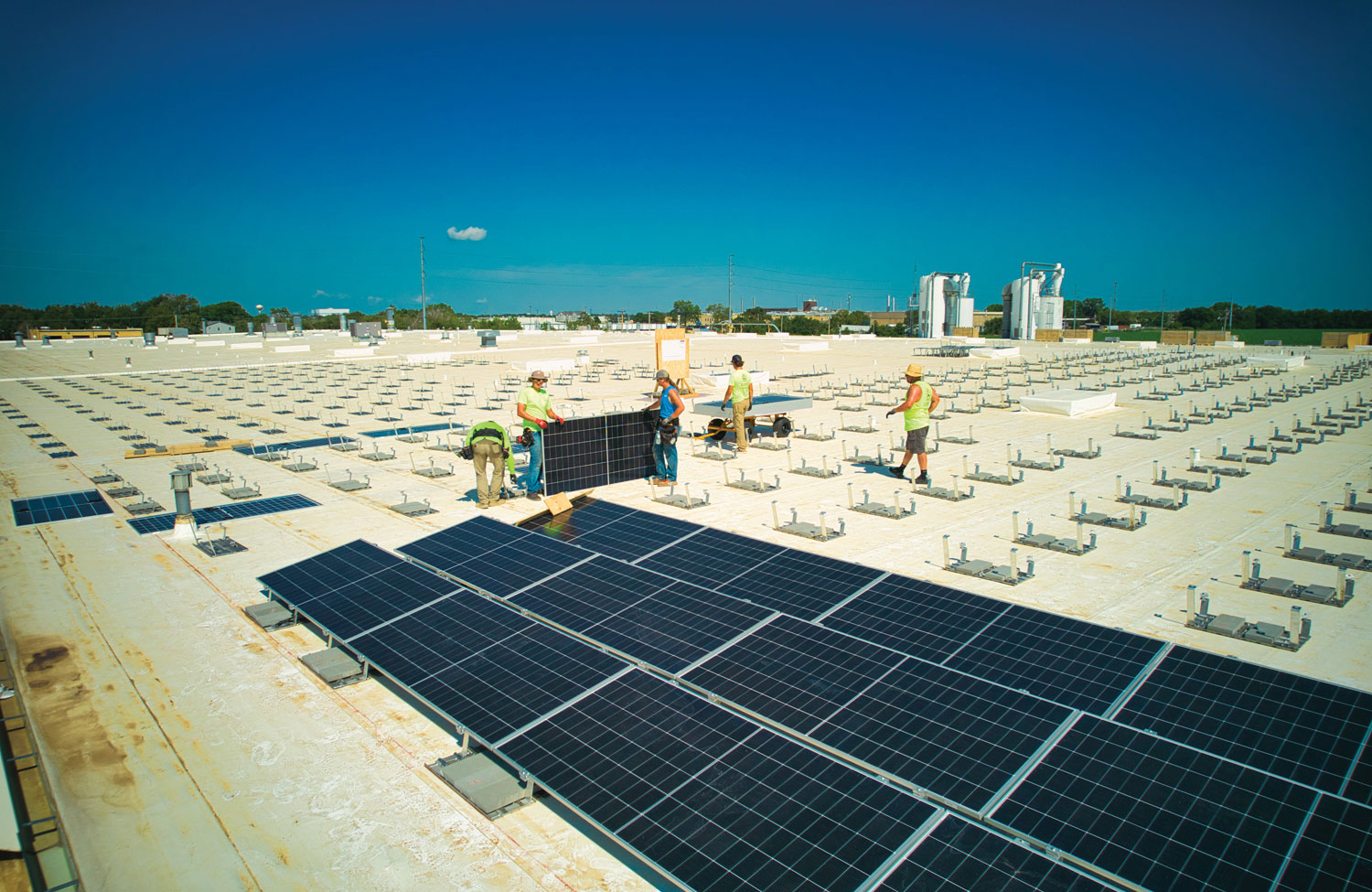
The Good Energy Solutions commercial solar team installs new modules on the roof of Crestwood Cabinetry, Inc. in Salina, Kansas
Battery Operated
LOCAL MATTERS
Our Local Advertisers – Making a Positive Impact
As to where solar is headed these days, both Cromwell and Good Energy agree it’s all about batteries. Concurrent with the decreasing cost and quality of solar panels themselves have been better-made batteries that are longer-lasting and cheaper. As the cost on those items have gone down substantially, there are very few customers these days who don’t at least want to explore the idea of a storage solution.
“The other thing is that the grid has become much more unstable with all the additional power needs,” Cromwell says, pointing out that it is also aging and fragile, and with all those demands and infrastructure issues, there is a resulting disruption in supply. “With the price going down on batteries and the need for continuous power increasing all the time, we see a lot more interest in battery systems.”
Battery backups are safe and sound, Bottorff says, pointing out that with the grid instability Cromwell noted, you want battery backup in an outage.
“The sun replenishes that battery every single day,” Bottorff concludes. “You don’t need any gas or natural gas, propane, etc. And then you have the cost of solar per kilowatt hour—way lower than the utility, and it’s frozen for time.”