
| story by | |
| photo by | Steven Hertzog |
| OPEN A PDF OF THE ARTICLE |
Working with an architect with knowledge about local requirements when building or renovating a home can save not only time but money in the long run.
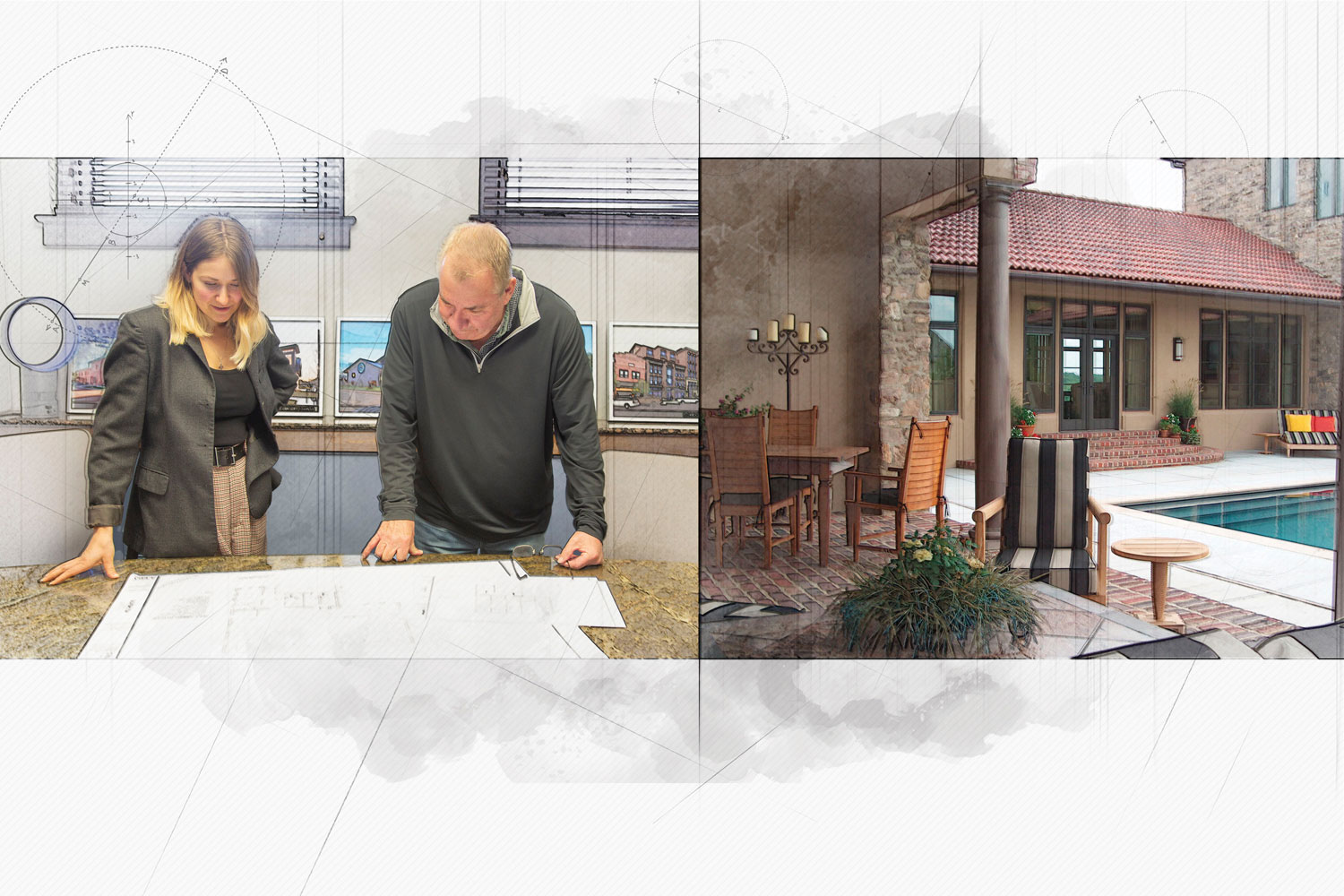
Left: Paul Werner, owner and architect of Paul Werner Architects looking over design plans with PW architect Bianca Buescher
Many people dream of the opportunity to design a custom home, where every square foot has been thoughtfully appointed for maximum use and comfort, and every wall promises to hold dear each memory yet to be made. They may spend half their lives saving for and contemplating this monumental leap. Once the funding is secured and the shovel sits eager to meet dirt, though, the road from concept to move-in day can be long and unpredictable.
New-home construction in Lawrence might be down roughly 90% from the boom of 20 years ago, but each home built from the ground up or remodeled to meet a family’s changing needs still brings new business to a wide swath of local companies and independent contractors, from heavy-equipment operators to doorbell distributors.
With so many hands at work—and an internet rife with both natural and artificial intelligence clambering for followers willing to make a deep dive into the world of DIY residential construction—where should prospective home builders begin after making the commitment to build their dream home?
With more than 30 years of experience as an architect, Paul Werner, owner and architect at Paul Werner Architects, in Lawrence, has had a front-row seat to the evolving art and science of residential architecture as new technology has developed and building trends have changed. He offers guidance for those interested in creating their own home.
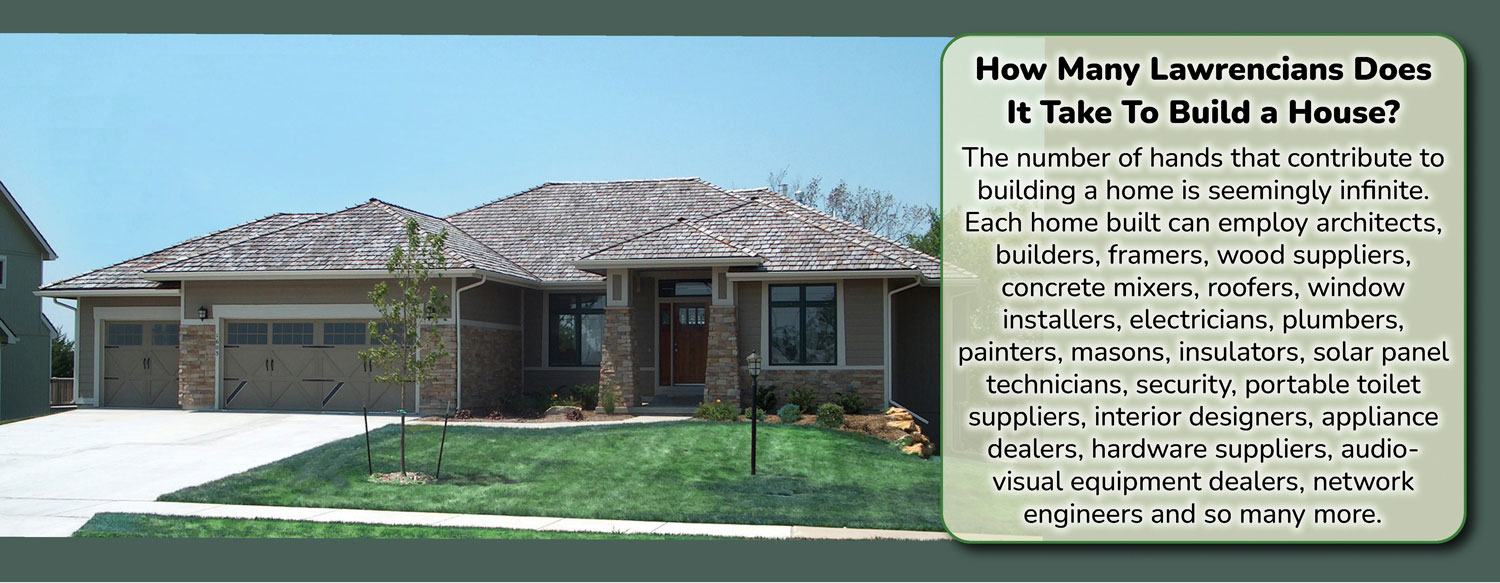
Local homes designed by Paul Werner Architects
Where To Start
Werner recommends that prospective homeowners first consider the location for their home. A design plan can evolve, but the location is fixed. Finding a lot or a plot of land that meets their need for privacy, convenience, proximity to schools and zoning allowances and restrictions requires patience and careful discernment.
Carrie Stallwitz and her husband, Dave, understand the need for patience quite well, as they are currently building their own oasis in East Lawrence. The couple, both University of Kansas graduates, have looked forward to moving to Lawrence from Houston for retirement, spending many, many visits scoping out the right spot for their new home.
LOCAL MATTERS
Our Local Advertisers – Making a Positive Impact
“We knew we wanted to be in East Lawrence in a neighborhood with walkability to downtown,” Carrie explains. They considered both renovating and building something new, avoiding blocks with protective restrictions that aimed to preserve historic architecture so as not to disrupt the aesthetic. “We wanted a contemporary house and didn’t want our contemporary design to stick out.”
Their patience paid off, as the couple recently poured the foundation for their home, which will sit on a reconfigured property that previously held three older houses.
Zoning regulations, lot sizes, neighborhood context and permitting processes all shape what can (and cannot) be built. An architect familiar with local requirements can help navigate those constraints more efficiently. They also design for the realities of living in different parts of Douglas County, adjusting plans to work appropriately with the property.
“We have different things to think about out in the country than the houses we work on in the city,” Werner says. “We’re working on two houses right now that have driveways that are very steep. They absolutely picked the right spot for their house, but they might not have been thinking about concrete trucks and roof trusses getting up a huge hill. We like to help the owners, along with the builder, to think about those things.”
Bianca Buescher, an architectural designer with Paul Werner Architects, who is working on one of the homes, recalls how an early site visit allowed them to make some important changes before breaking ground. “We realized that the neighbors to the south are closer than we’d thought, and there would be some privacy issues. And the views that we wanted to capture are actually to the west. So we decided to reorient the house. Visiting the site is very important.”
Creating the Best Plan
Werner and his team meet with clients well before building permits are filed or ground is broken, helping future custom homeowners find and refine (and refine and often even further refine) a floor plan that meets their family’s current needs for daily living, anticipated changes, potential resale and energy use, all while considering the family’s budget and potential roadblocks to staying within it.
Visualizing how mornings will work in this house and where will people naturally gather leads to more efficient layouts. Understanding which direction the house should face for the fullest morning sunlight, the best evening sunsets or the right amount of privacy prevents costly changes after construction begins.
“The last thing we want is for you to walk into your brand-new house on the first day and say, ‘Why is that there?’ ” Werner says.
The design phase can vary widely in length, with an average custom home taking four to six months to finalize, depending on how well clients know what they are looking for in a home.
“We have people that come in with a binder with awesome pictures, but we also have clients who come in and aren’t exactly sure what they want,” Werner explains. “We can give them different elevations based on different styles that might have the same floor plan, but it could look completely different from the outside.”
LOCAL MATTERS
Our Local Advertisers – Making a Positive Impact
He adds, “Most people come in with something that they found online, and for the most part, those (online) companies do a reasonably good job. But usually when they are here and start looking at those plans closer, we realize there are changes to be made to fit their needs.”
Werner cautions that many of the plans available online are created by and for people in other states, and may not be draft-ready for a home in the Midwest. Plans made for a house in Florida, for example, likely won’t have a furnace or a basement, both critical for living in Kansas.
“I like it when clients have photos of what they like but, more specifically, what they like about that photo,” Buescher adds. “They might show me a Tudor house, and I’ll ask them, ‘Do you like the roof pitch, or is it the door that you like?’ And through conversation, we can get there.”
The back-and-forth can take many months, but it is critical both the design team and the clients communicate their intentions clearly.
“If you’re staring at that drawing, I want to make sure what you think you’re seeing is the same thing as what we think you’re seeing,” Werner emphasizes.
The Stallwitzes bring unique insight to the process, as Dave is an engineer and Carrie has a degree in architecture. The couple has taken a more technical approach to the design work than most clients might, which has helped them more clearly communicate their vision to their architectural team—though at times it has lengthened the process of fine-tuning final plans.
Carrie flinches slightly when recalling the year-plus she and Dave spent working with a fellow KU School of Architecture and Design classmate on designing their home, admitting the process took well over a year to complete.
“I was really picky about the roofline,” she says with a smile.
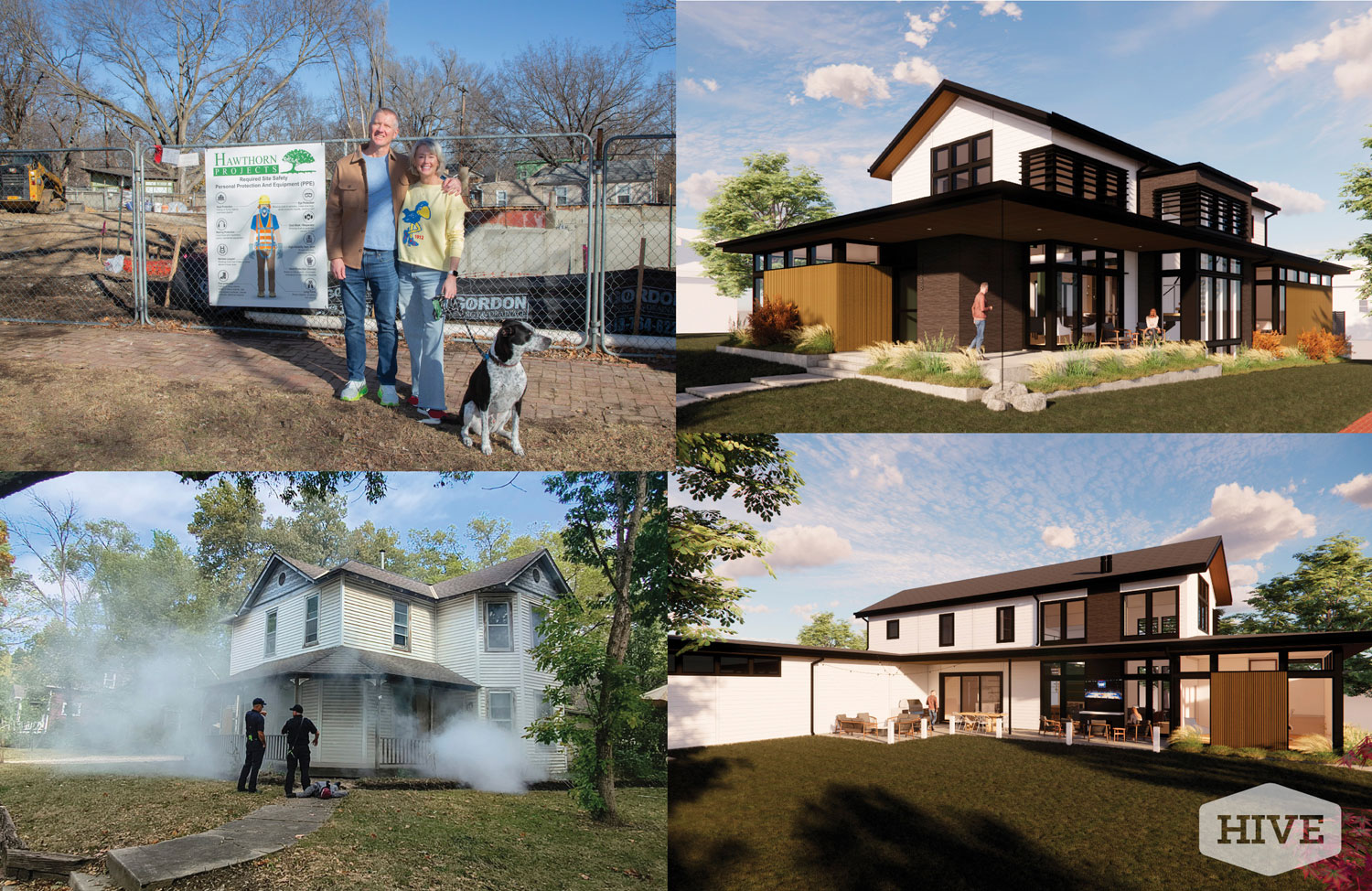
Carrie and Dave Stallwitz pose in front of their lot in east Lawrence; Lawrence fire department using the former house as a training exercise before final demolition; Renderings of the future exterior of their new house
From Demo to Done
HGTV may lead viewers to believe that once the land is secured and a design plan that fits the site appropriately has been finalized, demo begins and—a few commercial breaks later—a fully staged home is ready to greet its new owners.
In reality, it usually takes a year or more for a new home to go from hole to whole, with many more steps in between than simply fast-forwarding the ads.
“You’ll have to pick a builder,” Werner says. “We want you to know what this will cost. I don’t want you digging a big hole for a basement and then find out not everyone is in agreement on what this is going to cost.”
The Stallwitzes have incorporated some unique ways to not only alleviate some of the costs but use as much of the existing property and materials as possible during the teardown, benefitting the community and the environment.
“We invited Habitat for Humanity to pull items out (of the existing houses) for resale,” Carrie says. “They pulled windows out, sinks, faucets, tubs, the hot water heater … it’s a win-win for everybody. You’re diverting waste from the landfill, and they sell it at their retail store.”
The couple also donated the existing houses to Lawrence-Douglas County Fire Medical to use for training. She says the fire department can pump theatrical smoke inside to simulate search and rescue, break windows and/or walls for drills, and practice spraying hoses inside the home. No fires are set, and firefighters are able to safely work through problem-solving in an actual home, not just a model made for training.
Carrie encourages area home builders to engage with resources like these, adding that they have also been impressed with the work being done at the KU School of Architecture and Design’s Studio 804 program, a yearlong intensive for students pursuing their master’s degree in architecture.
The price of a custom-built home varies widely from home to home and is dictated by the cost of the land, the extent of any infrastructure that needs to be built to support the project, the complexity and size of the project, permits and fees, the choices of appliances and cosmetic finishings, and desired tech features, among other considerations.
Werner says the “McMansions” of decades past (massive statement homes) are giving way to “right-sizing” (building with intention only what is needed). While square footage and oversized design elements may be scaling back, costs are not.
“There’s this bundle of costs you’re going to get hit with right out of the gate, regardless of what your house costs,” he explains. “A water meter for a $100,000 house and a water meter for a $450,000 house cost the same amount of money at the city. Your building permit is based on the size and the cost of your home, but there are several other fees. We just want everyone to know the costs they may incur so we can discuss options, if needed.”
Werner says he and others in the industry have explored ways to spread out those costs, but no solution has been found yet.
Breathing New Life
New-home construction is not the only way to customize one’s dream home. People who find themselves in need of a different home configuration but do not have the budget for a rebuild or who have enjoyed the same neighborhood for many years and are not quite ready to leave it often opt to remodel their homes to meet their current lifestyle without taking on a new mortgage or sacrificing a beloved location.
Werner and Buescher have worked with many families on home remodels. “Adding on to a house may be a better option for people who love their neighbors and love their neighborhood, and don’t necessarily want to start over,” Werner says.
LOCAL MATTERS
Our Local Advertisers – Making a Positive Impact
While cosmetic-focused renovations such as changing out the tile in a bathroom or installing new kitchen cabinets do not typically require an architect to draft plans, Werner advises consulting with an architect before making any structural changes to a home. An initial consultation is often complimentary and can save homeowners a mountain of headaches—and dollars—in the long run.
“We can walk around your house and take a look around,” Werner says. “This wall you may not think is anything, but there may be a heating vent in it that’s the return air for the whole house. The last thing I want you to do is tear down this wall and find there’s a plumbing stack right in the middle of the wall you thought you were going to get rid of.”
Buescher adds, “A lot of people can hire a builder, and the builder has great design sense and great vision, but it can be helpful to have architectural input on the general design vision of your house, especially if you think you’re going to be selling it in the future.”
An architect familiar with a city’s building regulations can also be extremely helpful when remodeling a home that is registered with the Historic Resources Commission, as the regulations and requirements dictating what can and cannot be done to a historic home may determine if a homeowner’s dream remodel is even possible.
Werner advises homeowners to consider the potential cost of temporarily moving out of the home while work is being completed, especially for projects that involve removing exterior walls or are projected to last multiple months.
“We try not to destroy too much of your house,” he assures. “You really need to do a benefit analysis. How much are you spending, and what are you going to get out of it? Are you going to live through that while you stay in the house while all these people are coming in and out of your house?”
In spite of the tremendous amount of work and unavoidable uncertainties of building and remodeling homes, Werner very clearly loves helping people create their dream homes.
“One thing that is cool about doing (custom houses) is that we have a stack of cards and letters from clients about how much they absolutely love their house,” Werner says, noting that these are the buildings where clients actually live before adding with a smile, “You don’t always get that from the office client.”