| story by | |
| photo by | Steven Hertzog |
| OPEN A PDF OF THE ARTICLE |
Local artists in this digital era market themselves in many different ways—using online platforms, selling at fairs or posting flyers and sending out newsletters—all in order to earn money from their art.
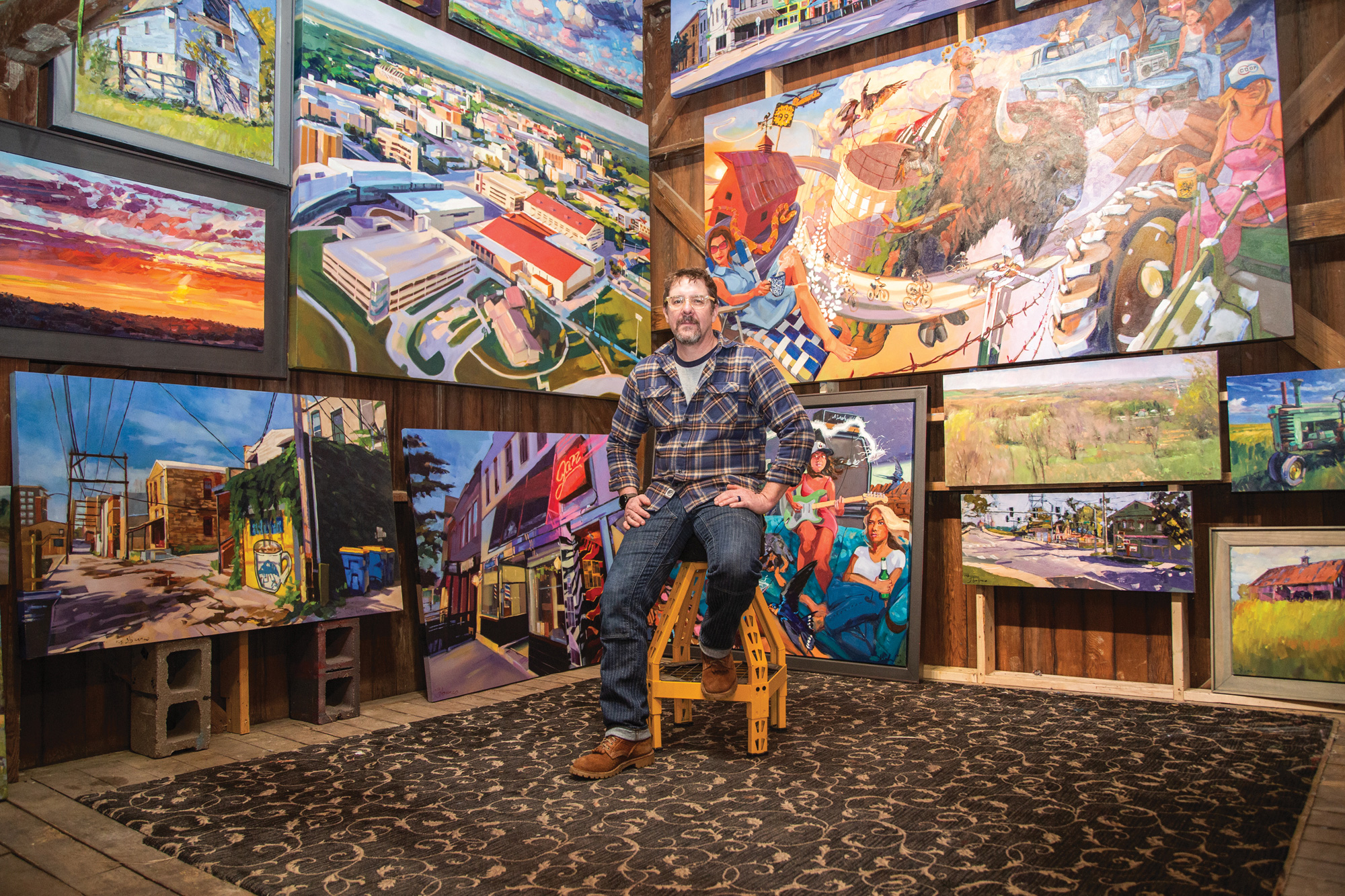
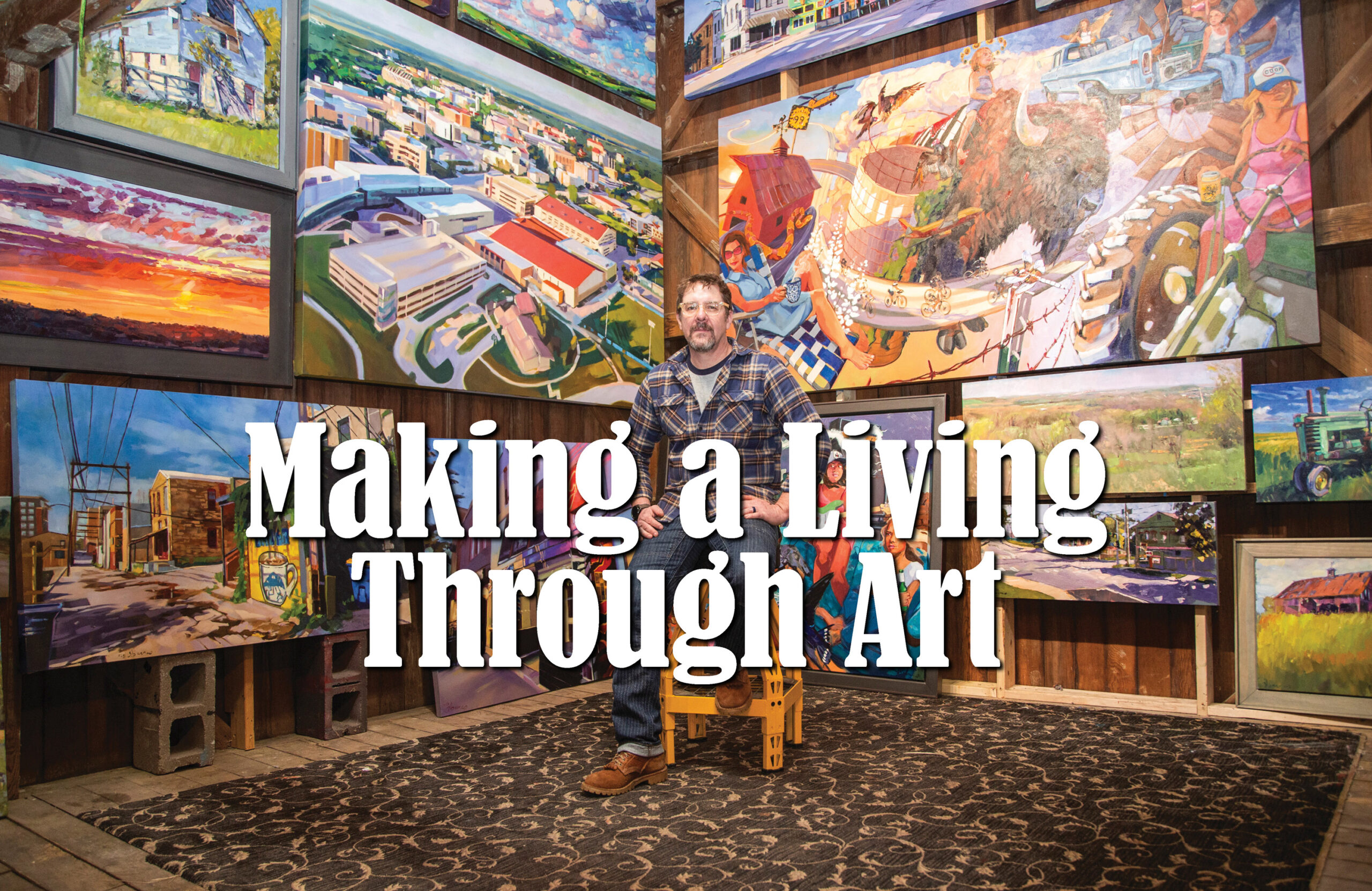
Zak Barnes in his studio barn with his paintings
Creating a career as an artist is not for the faint of heart. There are challenges that go beyond just passion and creativity, including hard work, lack of business and marketing skills, uncertainty in the market and financial instability. The art world can be competitive, with many talented artists struggling to make a decent living. Success depends not only on talent but also planning, perseverance and an eye toward business. Understanding the challenges of the art world is key to making it in this business.
As musician and actor Frank Zappa once said: “Art is making something out of nothing and selling it.” Zappa recognized the importance of creation but also the reality of the business side needed to support it. He also believed an artistic choice should not be based on potential profit.
The question about making money versus staying true to the art can be a challenge for many, but for a working artist, both must be present.
According to the 2024 Rolling Stone article “Art and Commerce Can Mix Well,” by Zain Jaffer, artists shouldn’t feel the need to abandon their ideals in order to be successful in the industry. “There are those who are in art for art’s sake, but there are also those who want to make money (or at least a living) off their works. Each artist is probably in that spectrum, with the purists at one end, and the ‘sellouts’ on the other. There is no wrong or right place to be in; there is only what is right for that artist.”
So how do artists here in Lawrence bridge the gap between artistic creation and marketing and selling their work to help them earn a decent living? The answer to that question seems to depend on whom you talk to.
One-on-One Connection
For Zak Barnes, a full-time artist for 20 years who does primarily oil paintings, what’s most important is the artwork itself. “My approach has always been to do honest work that I enjoy without following too many trends, ending up with something unique. I’ve always kept my work as true as possible to what I think is good.”
LOCAL MATTERS
Our Local Advertisers – Making a Positive Impact
Barnes prefers fine art made by real hands—traditional fine art with some contemporary thrown in. His art tends to be Kansas-based or “regional.” He can be found out in the field doing “plein air” or outdoor painting onsite, along with studio work, landscapes and regional figurative work. “Mostly, I do custom work in-house—stretching, frame-making, all that stuff,” he says.
He believes all communities must have an appreciation of art. “It is what humans make. It is stimulating to see. When you travel, it is one of the things you go to see. It’s one of the reasons why murals have gotten so big. It disrupts the daily flow of the parallel lines everywhere,” he explains.
Being that much of his work is custom for individual collectors, Barnes prefers to have one-on-one relationships and do work at customers’ requests. “I do a lot of correspondence and communications with people. It takes some time to work with people. A lot is one-on-one with the buyer, getting descriptions and discussing the final product details. Often people will come to the studio to discuss the project. There is some skill required to decipher what your client truly wants.”
He says it does take time to get to know people and learn what they want, but once he gets a mental image of what he thinks they will like, it is fun to create the artwork. “I’ve been known to show up in a U-Haul with a huge wet painting, hammer, Ook hooks, a stepladder and a tape measure. I enjoy hanging a work of art where it will be appreciated.”
Barnes was a latecomer to social media, but he does use Instagram to market and sell his art. Though he’s a low-tech guy, he prefers Instagram because it’s image-based. “Social media is wonderful because it is a good way to get feedback and [have]simple interactions with real people. They might gain a better sense of the meaning behind the art,” he says. “Honestly, I do a post of a painting and just hope for the best.”
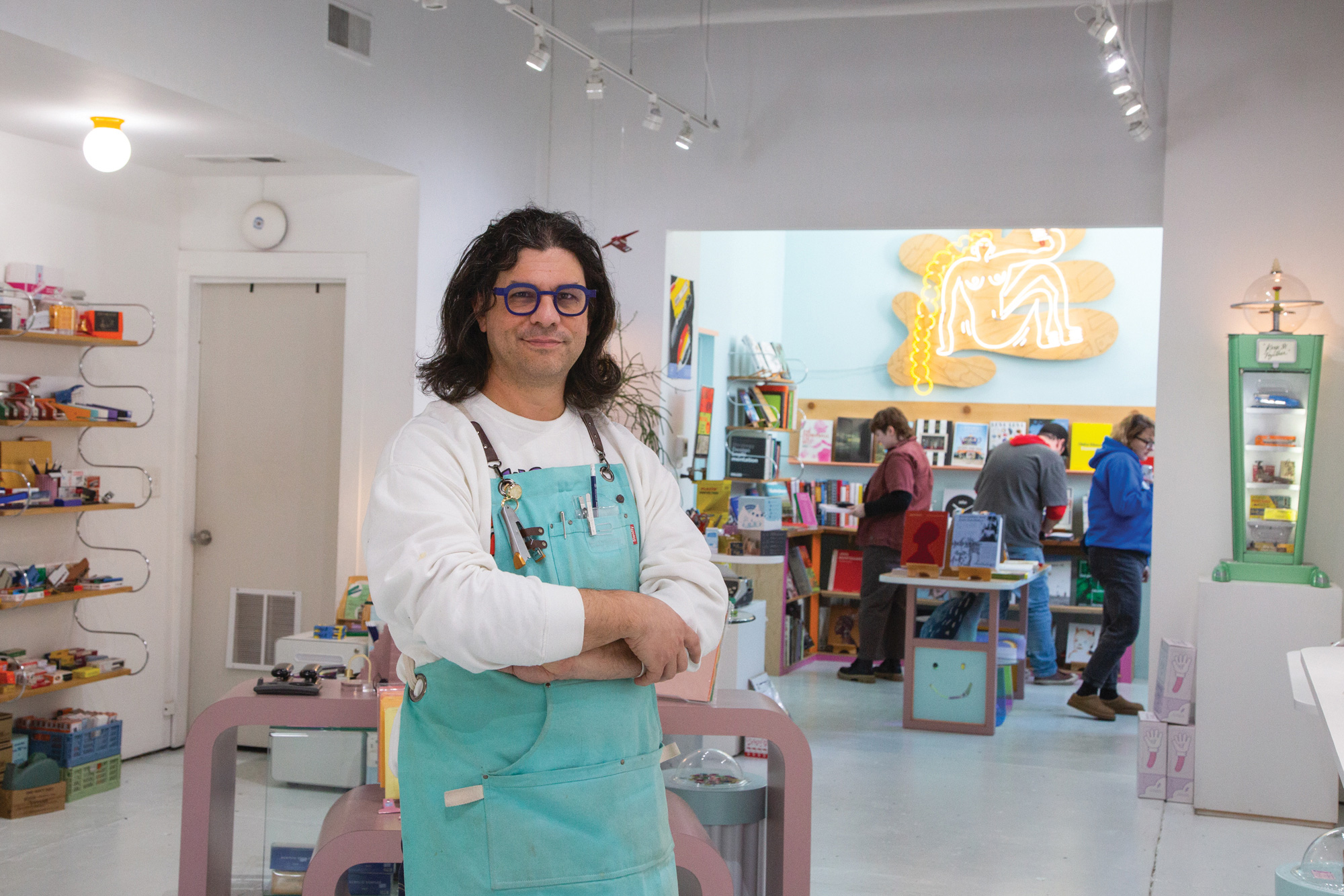
Paul DeGeorge, owner of Wonder Fair and Security Attachments
Hitting the Pavement
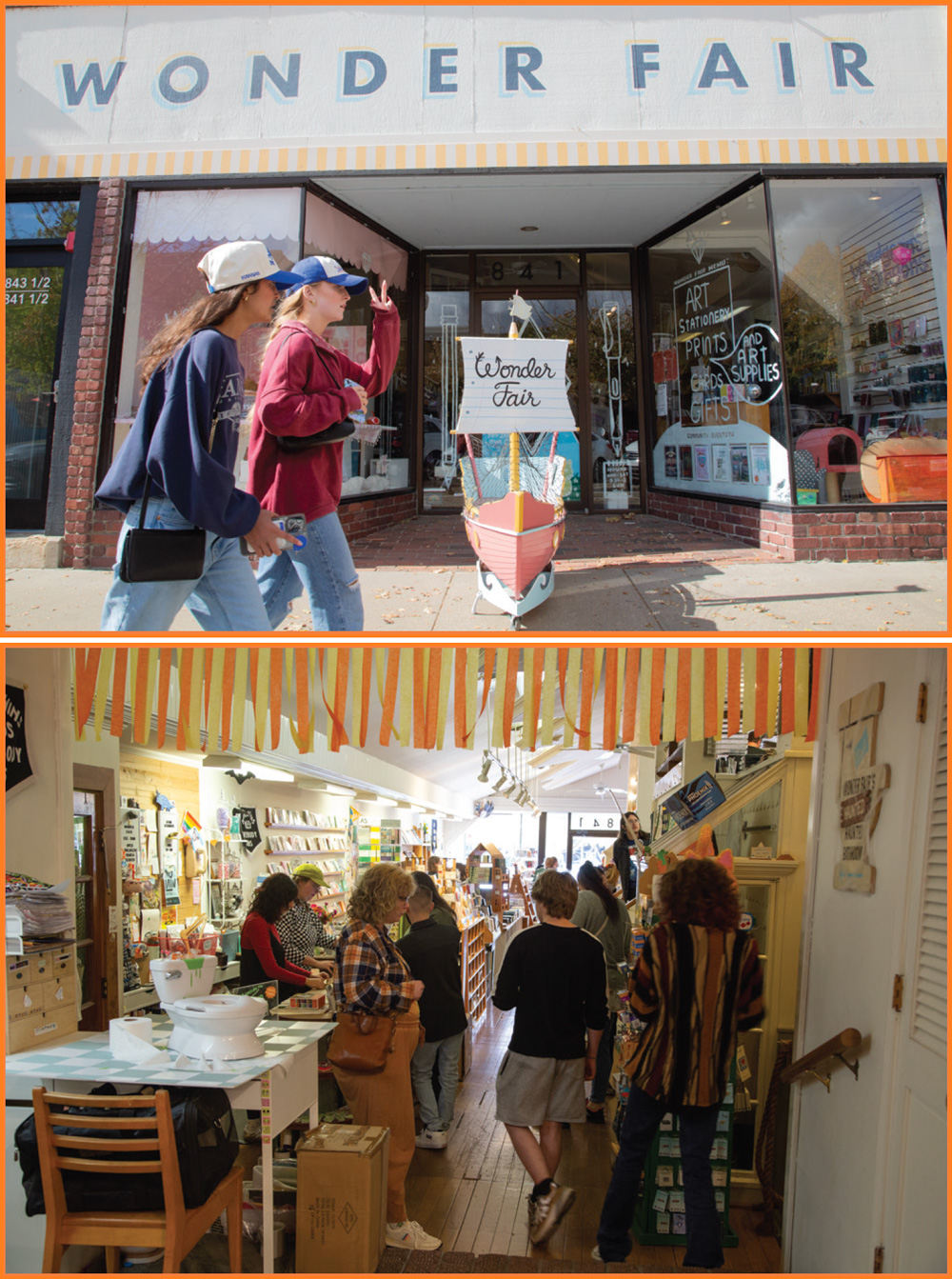
Wonder Fair
Paul DeGeorge believes that art creates community. “This is how we connect with each other and is a huge part of what defines our community in our hearts. Art also represents our community to the world at large,” he explains.
However, the owner of Wonder Fair, 841 Massachusetts St., says there’s an economic impact that is wildly undervalued. “Lawrence is the cultural capital of Kansas, and artists are a huge part of our local economy. But we don’t see that reflected in public investment in the arts and in artists’ careers in the same way we see tax breaks for developers and corporations that promise to bring another 40 jobs to the city.” He believes investing in artists as a community is needed just as much as investing in any other businesses.
DeGeorge and his wife, Meredith, bought Wonder Fair in 2012 from its previous owners. The gallery and shop carries art made by more than 200 different independent artists, from local to international, with a special focus on prints and printmaking—and its tradition of offering affordable art for all people. Though Wonder Fair originally began as an art gallery, it no longer exhibits work in the traditional gallery sense of putting up a show from a different artist every month or two, which they found less sustainable. The artists they work with produce lots of art, not just prints, and the store also carries items such as greeting cards, stickers, pins, patches, keychains, hair clips, zines and artist books. “We favor printmaking processes where the hand of the maker is more evident, so screenprints, letterpress, lino and woodcuts. And for the last decade, we have enjoyed participating in the growth of Risograph printmaking,” he explains.
When it comes to marketing products, DeGeorge says social media just isn’t for them, and they only created an online store as a COVID adaptation. “I’ll be completely honest here: Using social media feels like toiling in some mine for human attention in service to billionaires. Even though engaging may be helpful to our business, it’s probably bad for humanity, and that’s become more apparent than ever over the last few years, as feeds have devolved into algorithmically driven echo chambers and propaganda tools. So that nags at us …”
He says he would categorize he and his wife as “extremely reluctant Instagram posters,” having quit Facebook and Twitter (now known as X) many years ago. “We tend to view posting as a last resort. We’d rather make posters and put them up around the downtown. We have a snail mail list, and we send out a nice little newsletter at least once a year to almost 4,000 people. It’s expensive, but making and producing this newsletter is so much more rewarding and interesting to us than spending our time working on posts to send into the void.”
DeGeorge says the marketing that works best for Wonder Fair is having “a store that is so utterly unique that people feel compelled to take their friends to visit. Our cat, Dave, does a lot of heavy lifting—he’s a charmer. But we’ve also built a ‘haunted bathroom’ (voted No. 2 restroom in Lawrence, 2019) that is essentially a free dark ride for anyone brave enough to visit.”
The couple also commissioned an artist to create a store soundtrack that is unique to the space and employ many great artists who work daily to make all sorts of displays and signage, so when people visit, there’s always something new and surprising to see. “We stock our store with a highly curated selection of goods—not just art but also art supplies and specialty stationery that is frequently challenging to find, even on the internet,” DeGeorge explains. “In some cases, we’re one of just a handful of shops in the United States carrying such items.”
They also have a store that sells staplers, he adds. “Wherever you are in the world, Secure Attachments is probably the closest stapler store to you.”
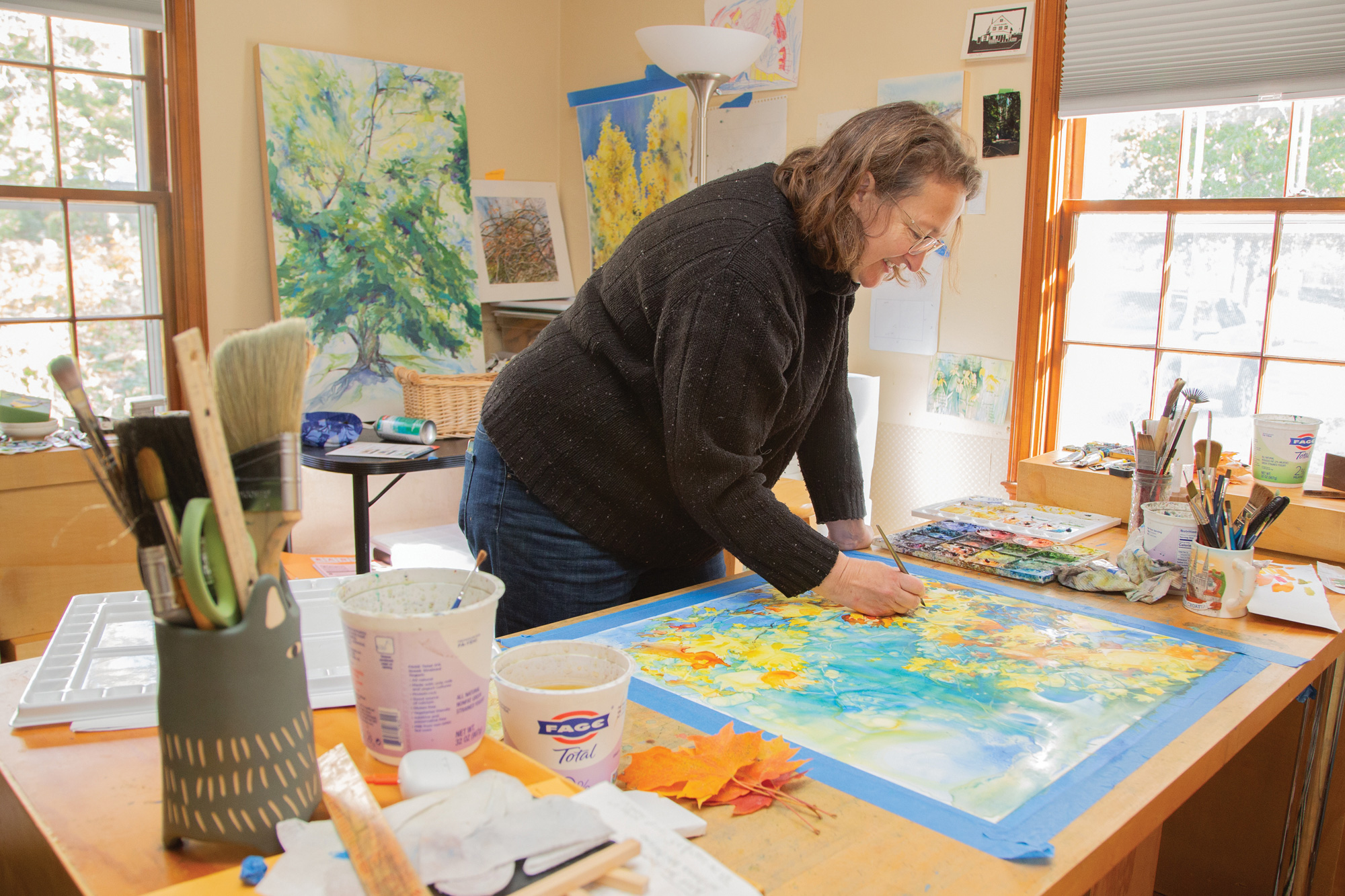
Artist Roura Young at work in her home studio
Perusing at the Fair
For artist Roura Young, a painter who also co-coordinates the Lawrence Art Guild’s Art in the Park, becoming a professional artist has been a one-step-at-a-time process. Young paints large-scale watercolors on both synthetic paper and traditional cotton paper. She then adheres those to cradled panels. Her focus is mostly nature, plants and landscapes. “My first couple of art fair booths were an absolute disaster. But I continually reassess my approach, whether it is focusing on where I will be displaying my work or improving my presentation. After an art fair, my husband and I discuss how we can improve the display, what went wrong, what went right.”
The Lawrence Art Guild is a group of artists that works together to promote artists and the arts within Lawrence. “I’m not sure I would have ever had the know-how to move from an emerging artist to a professional artist without the guidance and support that I received from other artists within the Lawrence Art Guild,” she explains.
LOCAL MATTERS
Our Local Advertisers – Making a Positive Impact
As one of the coordinators for the Lawrence Art Guild’s Art in the Park, Young promotes the event through every avenue possible, casting a wide net to try and draw in a variety of people—those looking for a fun weekend activity to those who are looking to make a major purchase for their home. They use social media, radio and print ads, flyers and banners. Each artist is promoted on social media and on the group’s website.
She believes access to the arts should be a part of all communities, as the arts add a richness and beauty to life. “Here in Lawrence, we are lucky to have so many artists within our community, as well as organizations including the city itself, which support the arts. We have Final Fridays, open-studio events, Art in the Park, galleries, the Spencer Museum, sculpture tours and more, as well as music and theater, all of which lead to a vibrant cultural experience.” She says she views each event or venue as a gift from local organizations to participating artists and to the community as a whole.
Getting your work out there is the most important part, Young adds, because people need a chance to see and relate to a piece before they purchase it. However, marketing can take more time than artists have to give, even though it’s incredibly important to a professional artist. “Paintings don’t sell if they aren’t seen,” she says.
In Young’s personal business, art fairs have been the most lucrative, but she believes using a variety of platforms is the best way to market art since not all patrons like to wander an art fair. So she also uses Instagram and a personal website, as well as a “poorly updated” Etsy page. “I should post images on Instagram more often than I do. There are two reasons why I don’t; not only does creating a post take time, but I also worry that images can be lifted for AI (artificial intelligence) use on Instagram. I try to walk a fine line between posting and protecting my work.”
Because she sells the majority of her work through fairs, Young researches local and regional art fairs, and plans where and when to sell. Selling at fairs involves filling out applications, supplying three to five images of her work as well as a photo of her display. Applications can have nonrefundable fees that can run from $25 to $50. “I apply to more fairs than I plan to attend, because I never know if I’ll be accepted. The art world is competitive,” she explains.
In addition to applying, art fair artists must have an attractive display. This includes a sturdy tent, weights to hold the tent in windy weather and panels on which to display work. Her display includes a bin for prints, lights and a battery to power them. A professional art fair display can cost in the thousands but is vital for getting accepted into shows and/or selling well. “Lawrence has amazing artists who might not have the resources or experience to break into the art fair world. Having the guidance of other artists and the materials provided allows these artists to gain knowledge of the art fair business,” she explains.
Young believes marketing and selling compared to creating work are two completely different occupations, and she personally puts more time into painting. “Creating art takes a great deal of concentration and focus, but it’s open-ended with no right or wrong. I can create anything I want. I think of marketing as a puzzle—trying to find the right market, the right venues or creating the right social media posts.”
Plus, marketing and selling can feel like checking off all the boxes on a to-do list. “Selling art is competitive. Only so much space exists in galleries. Because of the competitive nature of the art business, I’d say that marketing and selling is the more difficult of the two,” she concludes.
In the World of AI
 One thing all these artists agree on is that AI can be dangerous.
DeGeorge believes AI is a way for people and corporations who don’t care about art to avoid employing artists. “They don’t understand art and have never tried. To them, it is annoying that they have to pay people to write copy and create visual marketing materials. It’s either a shortcut for lazy people or some cost-cutting garbage designed for the enrichment of the investor class. It is profoundly uninteresting to me.”
He says people who care about art can and should resist this. “We don’t need AI art. You don’t have to participate in this economy. You are not missing out on the next big thing. To resist is to commit to the future that you want to see.”
Young agrees. “I am bothered by AI and the fact that it takes artists’ works and passes it off as its own creation. If an individual did that, they would be accused of copying or even plagiarism. For me, personally, AI cannot create what I create or compete with my work. I think the increase of AI makes patrons appreciate hand-created work all the more.”
No matter what kind of work artists produce and sell, they all put their hearts and souls into every piece created. “I still try to make every painting better than the last …” Barnes says. “Maybe I am in the middle of my career or maybe my prime. Hopefully the best is yet to come. That’s the joy and beauty of being an artist. You never know what projects will show up. I’ve been lucky enough to have some interesting ones. I’m often surprised with what I will be doing next. That keeps things interesting.”