| story by | |
| photos | Kansas Historical Society |
| OPEN A PDF OF THE ARTICLE |
This American artist and diarist wrote about and created art depicting his experiences during the American Civil War.
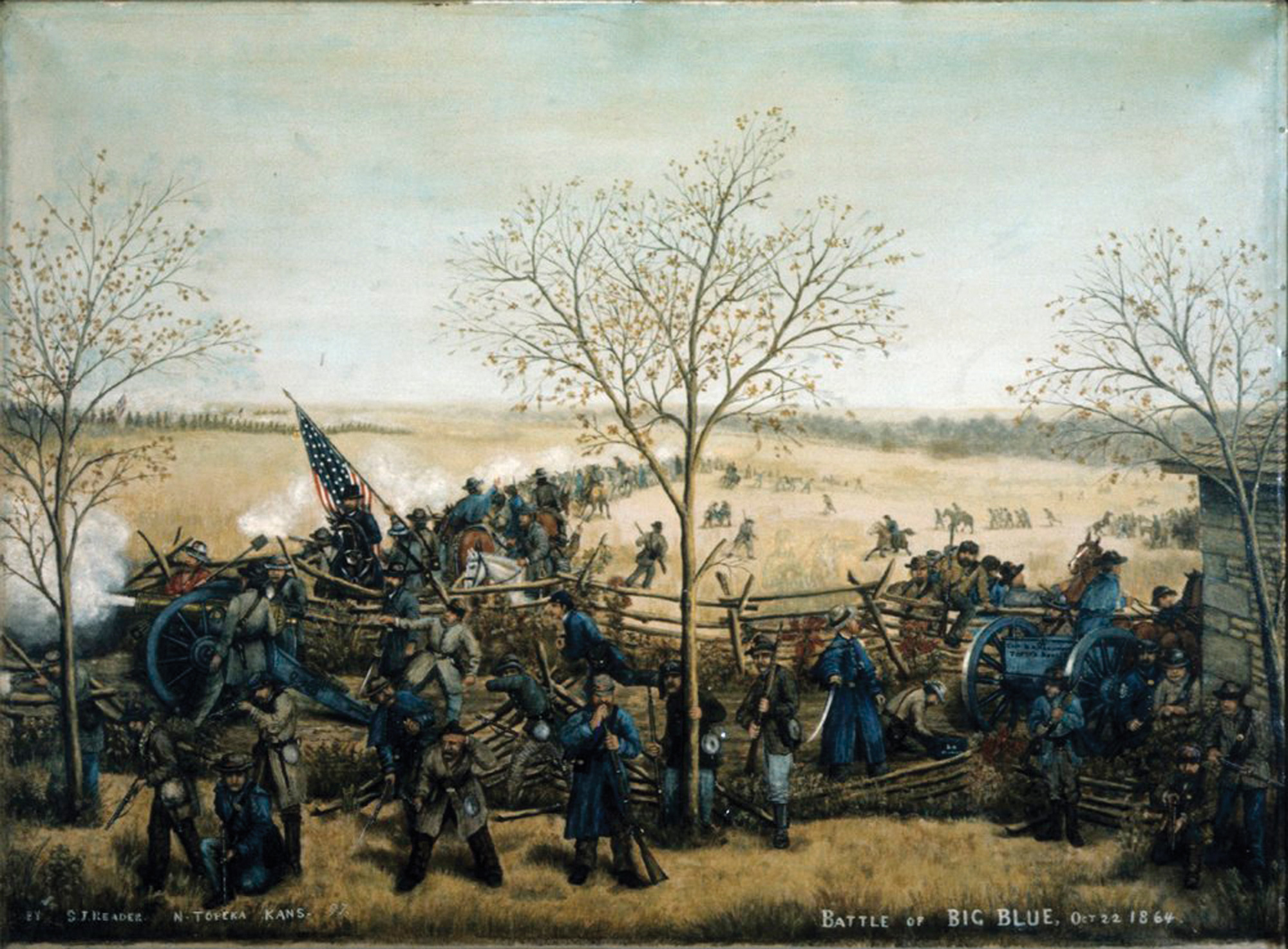
Battle of the Big Blue-Samuel J. Reader
Samuel J. Reader moved to the Kansas Territory from La Harpe, Illinois, in 1855 with his sister and aunt. He kept a diary for most of his life and created artwork to illustrate his experiences. His folk art/primitive illustrations, supplemented by the verbal descriptions from his diaries and autobiography, document his activities in Territorial Kansas and during the American Civil War. They are a unique and amazing resource for learning about these turbulent times in Kansas history.
Reader was born in Pennsylvania in 1836, and his family later moved to La Harpe. In 1855, Reader settled near Indianola, in northern Shawnee County, Kansas, and lived there until his death in 1914. He was present at the Battle of Indianola, which occurred on Aug. 30, 1856, near Indianola. He described the day’s events, in which no actual fighting occurred, as the local militia gathering to prevent theft and burning by proslavery supporters.
LOCAL MATTERS
Our Local Advertisers – Making a Positive Impact
Reader’s first participation in the Kansas territorial conflict occurred at the Battle of Hickory Point on Sept. 13 and 14, 1856. James Lane, one of the active leaders of free-state supporters in Kansas, attacked a group of border ruffians (Missourians opposing the efforts to settle Kansas territory as a free state) near Dunavant at Hickory Point, a proslavery settlement on the Fort Leavenworth-Fort Riley military road.[5] This followed an attack on Valley Falls, then called Grasshopper Falls, in Jefferson County. With only a small force of jayhawkers (free-state supporters), Lane’s attack was unsuccessful, so he requested reinforcements from Lawrence. On Sept. 14, 1856, the resulting skirmish ended with four proslavery men wounded, one killed and five free-state men injured. Reader’s painting of the Battle of Hickory Point showed a small volunteer force in the foreground watching fighting in the distance.
It was eight years later that Reader was involved in action during the Civil War. He fought for the Union as part of the Second Kansas State Militia, whose members were almost all from Shawnee County. Reader served as an officer in the “field and staff” of the militia, with the rank of First Lieutenant, Assistant Quartermaster. Price’s Raid, also known as Price’s Missouri Expedition, was a Confederate raid through Missouri and Kansas in the Trans-Mississippi Theater of the Civil War in the fall of 1864. During the raid, Reader participated in the Battle of the Big Blue on Oct. 22, 1864. His dramatic painting of the Battle of the Big Blue shows Union infantry forces in brown and blue coats lining wooden fences. The Confederate forces are shown in the distance on the left side of the image. On Oct. 25, 1864, Reader’s painting of the Battle of Mine Creek, titled “It Went Against Us,” offers great detail of the event. The Battle of Mine Creek was one of the largest cavalry engagements of the Civil War and contributed to a Confederate retreat. It was one of the last major confrontations on the western front.
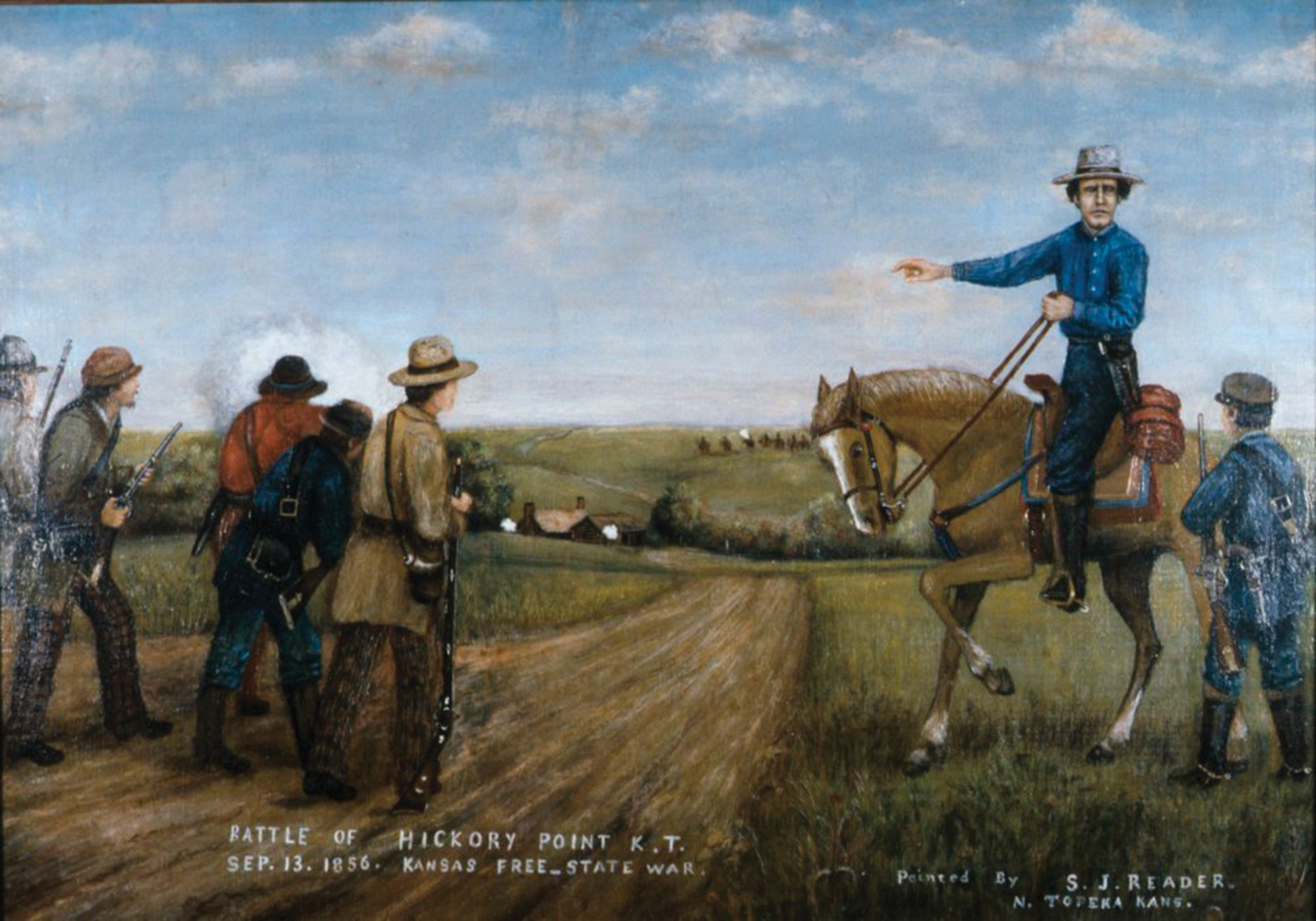
Battle of Hickory Point-Samuel J. Reader
An additional illustration titled “Price’s Raid” depicts Confederate soldiers marching Union prisoners of war to Texas. The artist was an eyewitness to the scene, having been captured with other members of the Second Kansas Militia following Confederate General Sterling Price’s raid into Kansas. The Price Raid was a multiday running battle that happened on the Kansas-Missouri border in the fall of 1864. Reader was captured during the raid’s Battle of the Big Blue on Oct. 22, where Union forces were routed. General Price’s soldiers were defeated the next day at the Battle of Westport.
Ultimately, the prisoners were marched to Tyler, Texas. Reader escaped by tricking his captors into believing he was a Confederate soldier. A four-day walk brought him home to Indianola.
Reader married Elizabeth (Lizzie) Smith, of La Harpe, Illinois, on Dec. 17, 1867, at her home in Illinois. Their first daughter, Ruth, was born on Sept. 25, 1868. Reader and Lizzie later had two other children, Elizabeth (“Bessie”), born on Oct. 10, 1871, and Frederick Augustine, born on Jan. 19, 1873. Both Ruth and Frederick died from disease before reaching adulthood. Lizzie was bedridden for 20 months before her death on March 30, 1898, from a spinal disease. Reader’s daughter, Bessie, lived with and cared for Reader before he died at his farmhouse on Sept. 15, 1914, at the age of 78.