
| story by |  |
| photos by | Steven Hertzog and courtesy Ric Averill |
| OPEN A PDF OF THE ARTICLE |
Whether it’s innate prowess or sticking to what they learned early on, generations of these Lawrence families are bonded by art.
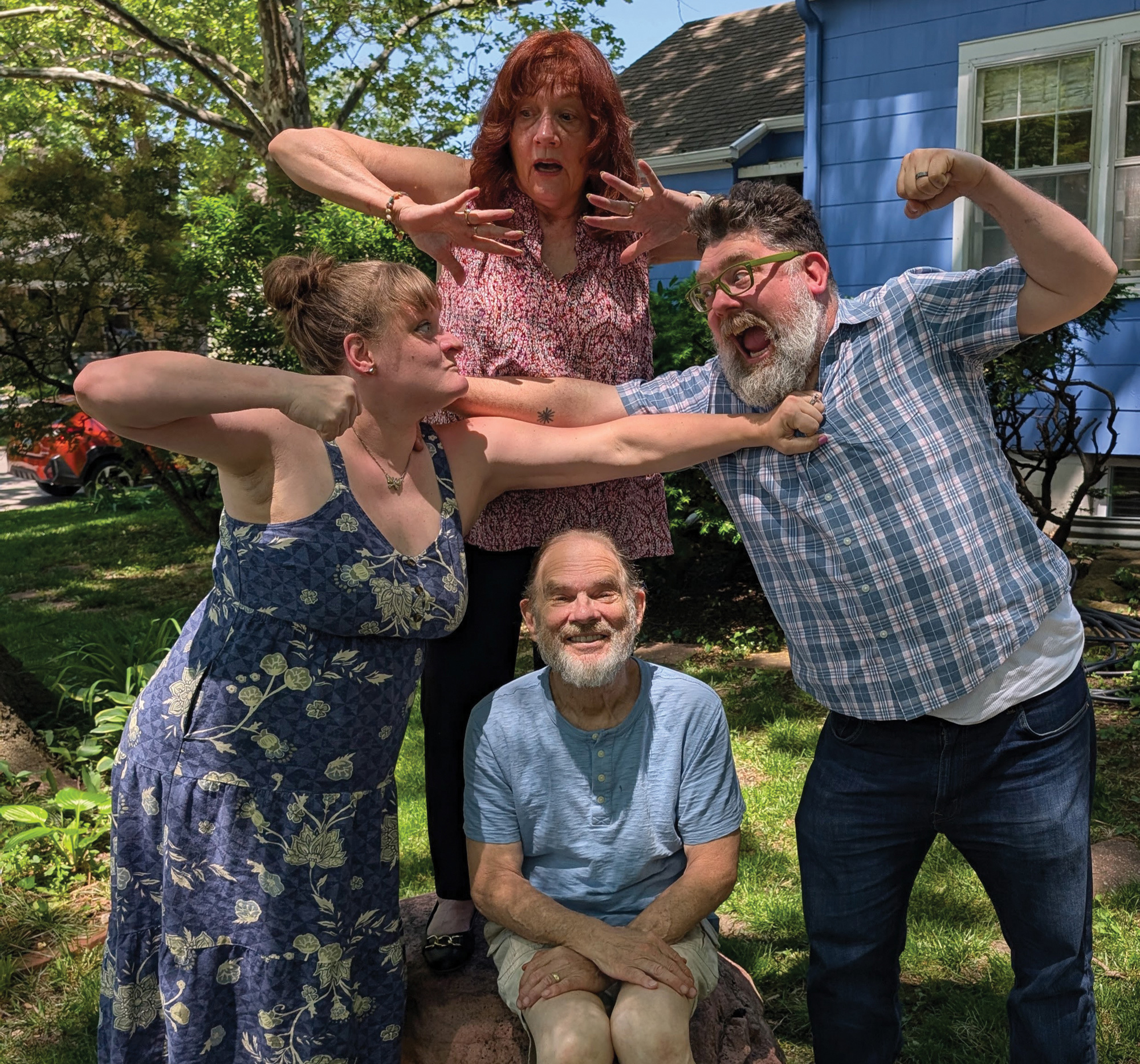
The Averill and Neuteboom Family (clockwise) Jeanne, Will, Rick and Trish – photo courtesy Ric Averill
“In every conceivable manner, the family is the link to our past, bridge to our future.” Author Alex Haley
Will Averill and his sister, Trish Averill Neuteboom, say their parents never “purposely” pushed them toward the family occupation of theater arts. Ric and Jeanne Averill, like all good parents, supported whatever their children wanted to do. Yet growing up around theater—acting, directing, singing, dancing, all forms of performing—the two siblings agree there never really was a question about how they’d spend much of their lives. It was sort of career by osmosis for the Averill siblings.
“When whatever you’re seeing are these wild and eccentric hippies doing wild and eccentric things … ” Will says. “Everything was loud and exciting, and it seemed like everything else just didn’t measure up.”
Likewise, Stephen Johnson never got the chance to meet his famous painter of a grandfather. And his father, while an accomplished drawer, leaned more into an identity as an intellectual and professor in high-level academia, never coaxing young Stephen into the life he’d create as a renowned illustrator of children’s books and versatile artist in his own right.
As were his father and grandfather before him, Johnson was drawn, pun intended, to art and creativity.
“When people are gone, you get a little more reflective,” he explains. “Things that are important to them become important to you.”
These family bonds over art have produced a trove of treasures for the Lawrence community. The Averills are, in essence, the first family of Lawrence theater and have produced, written, directed, played music in and starred in countless productions for adults and children alike throughout Douglas County and beyond.
And three generations of Johnsons have produced works that not only have enthralled art lovers locally but also nationally and internationally.
Fortunately for Lawrence—and the Averills and Johnson will readily affirm for them, as well—the old axiom rings true that blood is thicker than water. Or paint, or charcoal, or acrylic, or acting, writing and directing.
As Johnson puts it, “Anything is possible with art. That’s fun, and a lot of people get joy out of it.”

Ric, Jeanne, and a Banjo – photo courtesy Ric Averill
The Ties That Bind
Ric’s father was a psychiatrist at the Menninger Clinic in Topeka. His mother was a housewife. But as the third of three sons, he says his becoming a thespian was practically preordained.
“My oldest brother knew everything,” he says. “My second brother got in trouble for everything. And I showed off. Plus, my mother would let me off chores if I practiced the piano.”
Ric says he started doing theater in seventh grade in a production of “The Music Man” and was immediately bitten by the stage bug. He gravitated toward musical theater, as it allowed him to engage in multiple talents: writing, acting, playing and composing music.
LOCAL MATTERS
Our Local Advertisers – Making a Positive Impact
“I was pretty hyper anyway,” he says. “My lifetime goal was to be a composer.”
Ric’s most impactful role, at least in terms of his own life, occurred in 1970 in a production of “The Fantasticks” at Lake Pomona, in Osage County, Kansas. It was there that he met his co-star, Jeanne Rice, a talented young actress from a different Topeka high school. Cast as love interests in the play, they turned make-believe into reality when they wed two years later. The couple added Will to the family in 1974 and Trish in 1982.
“We worked with Dale Easton, a great comic, at Apple Valley (Farm Theatre),” he says. “He gave us Saturday and Sunday off so we could get married. We had to be back onstage Sunday evening.”
Over the next 40 years, the Averills became a theater arts powerhouse in the area and around the country.
A term often used to describe Ric is “arts factotum,” meaning in his productions, he serves as director, playwright, screenwriter, composer, music director, conductor, actor and educator. Holder of a bachelor’s degree in music education and a master’s degree in children’s theater from The University of Kansas (KU), Ric has done it all in productions such as “Catch Me if You Can” (2017) and “Ring of Fire the Johnny Cash Musical” (2018), at Theatre Lawrence; “Sweeney Todd” (2013) and his own rock opera, “Midnight Visit to the Grave of Poe,” at the Lawrence Arts Center (LAC); and multiple productions of “Little House on the Prairie,” at the Coterie Theatre, in Kansas City.
Ric and Jeanne founded the Ric Averill Players Inc., and way back in the 20th century, he wrote, acted in and performed musical melodramas and vaudeville at the Apple Valley Farm Theatre, at Lake Perry. Ric served as artistic director, performing arts at the LAC from 1999 to 2016 and is now artistic director emeritus there.
He has won numerous local and national awards from the American Alliance for Theatre and Education (AATE) for his writing of outstanding plays for youth. He also is a member of the Kansas Music Hall of Fame.
And yet he’ll tell you that Jeanne is the real superstar of the family and the most major influence on their work. She cofounded the Seem-To-Be Players, a professional theater for youth back in 1973. She began her acting career as a teen in Topeka, then at Washburn and KU, and has numerous professional film and theater acting credits locally and nationally.
In fact, Jeanne’s latest acting credit has yet to air. She has a scene in the opening episode of the upcoming season of Apple TV’s megahit “Ted Lasso.”
She also taught theater, first at Perry-Lecompton High School followed by a long career teaching theater, English and speech at Lawrence High School.
“I’ve retired, but I still do subbing and teach for Wright/Laird Casting agency in Kansas City,” she says. “And I’m still doing theater and video as much as I can while still teaching.”
In 2002, Jeanne received state and later national teacher-of-the-year awards from the AATE.
Will still remembers as a young child his father touring and letting him tag along with the Seem-To-Be troupe. And if he didn’t tag along, Dad always brought home hand puppets and other toys. He remembers falling in love with the laughter and applause his father received on stage.
“Being a kid of a really well-known family has its pluses and minuses,” he says. “I wanted to delineate my own path.”
LOCAL MATTERS
Our Local Advertisers – Making a Positive Impact
While attending KU, he got into writing, and over the years, he’s become one of the foremost playwrights of plays and programs for middle school-aged children in the country. He’s formed his own theater companies with interesting names like the Sh*tty Deal Puppet Theatre Co., which won 10 stars at one of many appearances at the Edinburgh Fringe Festival. His Card Table Theatre created the “Victor Continental” sketch comedy show, which ran from 1999 to 2013 at Liberty Hall and was one of the hottest tickets in town.
Trish started acting and singing at age 3, and it was her passion through high school and beyond. Her mother directed her in “The Unsinkable Molly Brown,” a part her mother once played. She attained her bachelor’s degree in musical theater from the University of Northern Colorado and her master’s degree in teaching from Baker University. Trish is now the senior secondary theater teacher in the Lawrence school district, producing two to three productions a year at Southwest Middle School, following her mom into theater education.
Trish sits on the board of the Junior Thespians Society and was the Lied Center’s arts education advocate for 2024–2025. She has performed for countless family productions and ran the school district’s Foundation Follies for years.
“I had an incredible education growing up in Lawrence,” she says.
If that weren’t enough, Will’s son, Oliver, and Trish’s children, Bella, Quincey and Bear, also act, sing and play music in family productions.
As Jeanne puts it, “There are a lot of adjectives you can use to describe our family, but one is not boring. We’ve had a lot of fun. It’s been a real adventure.”
Ric credits living in Lawrence for providing all the resources he needed to enrich his career.
“I’ve lived in Lawrence longer than most people have been alive,” says Ric, who moved here in 1968. “Lawrence is such a fertile place. There are so many great artists, and we’ve worked with many of them in our productions.”
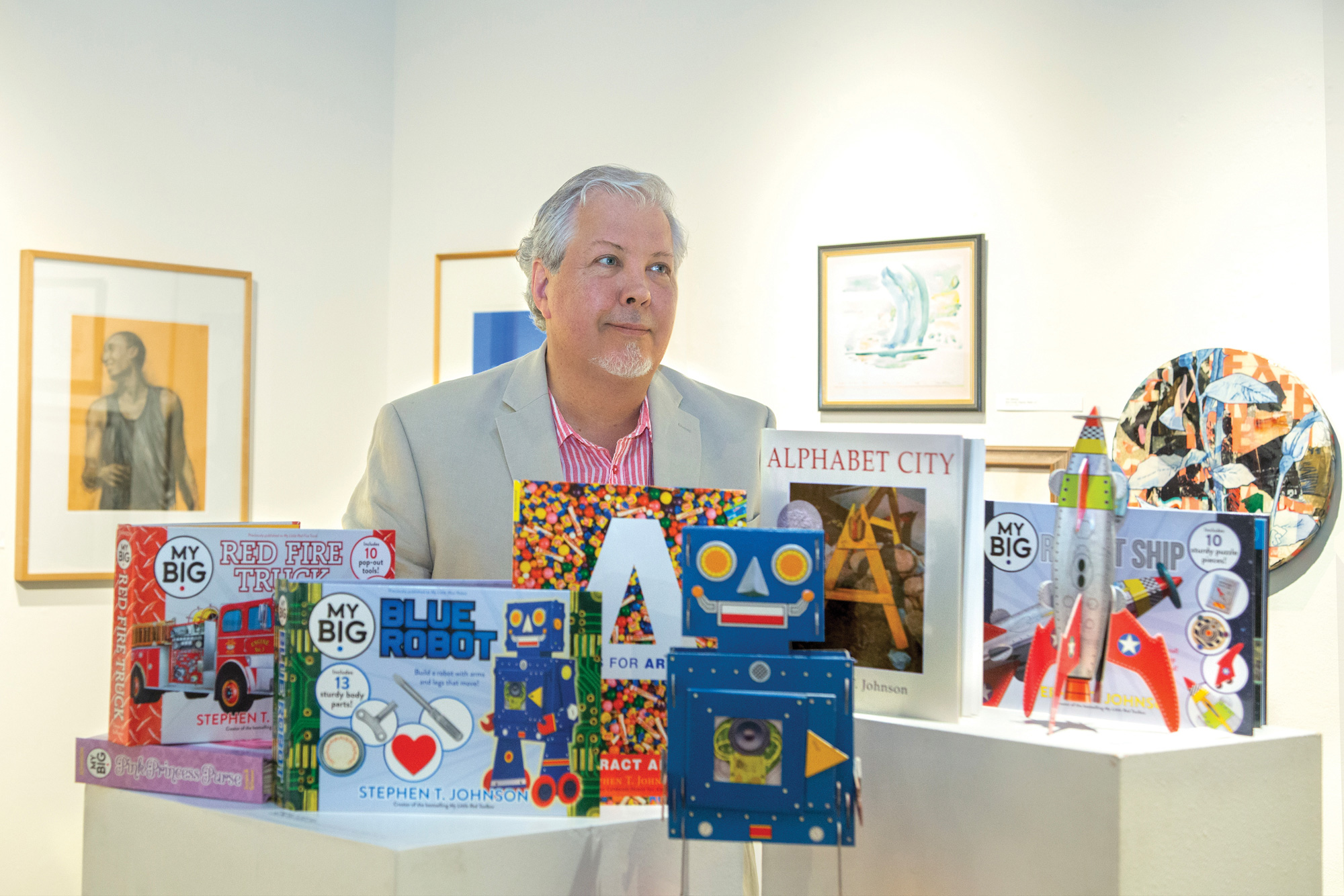
Stephen Johnson standing with copies of his children’s books at his recent Three Generation exhibition at KU; Johnson is the recipient of a Caldecott Honor, two New York Times Best Illustrated book of the Year awards, three ALA Notables, two Gold and two Silver medals from the Society of Illustrators in New York City, and the 2004 Governor’s Art Award for Individual Artist by former Kansas Governor, Kathleen Sebelius.
Art Transforms and Endures
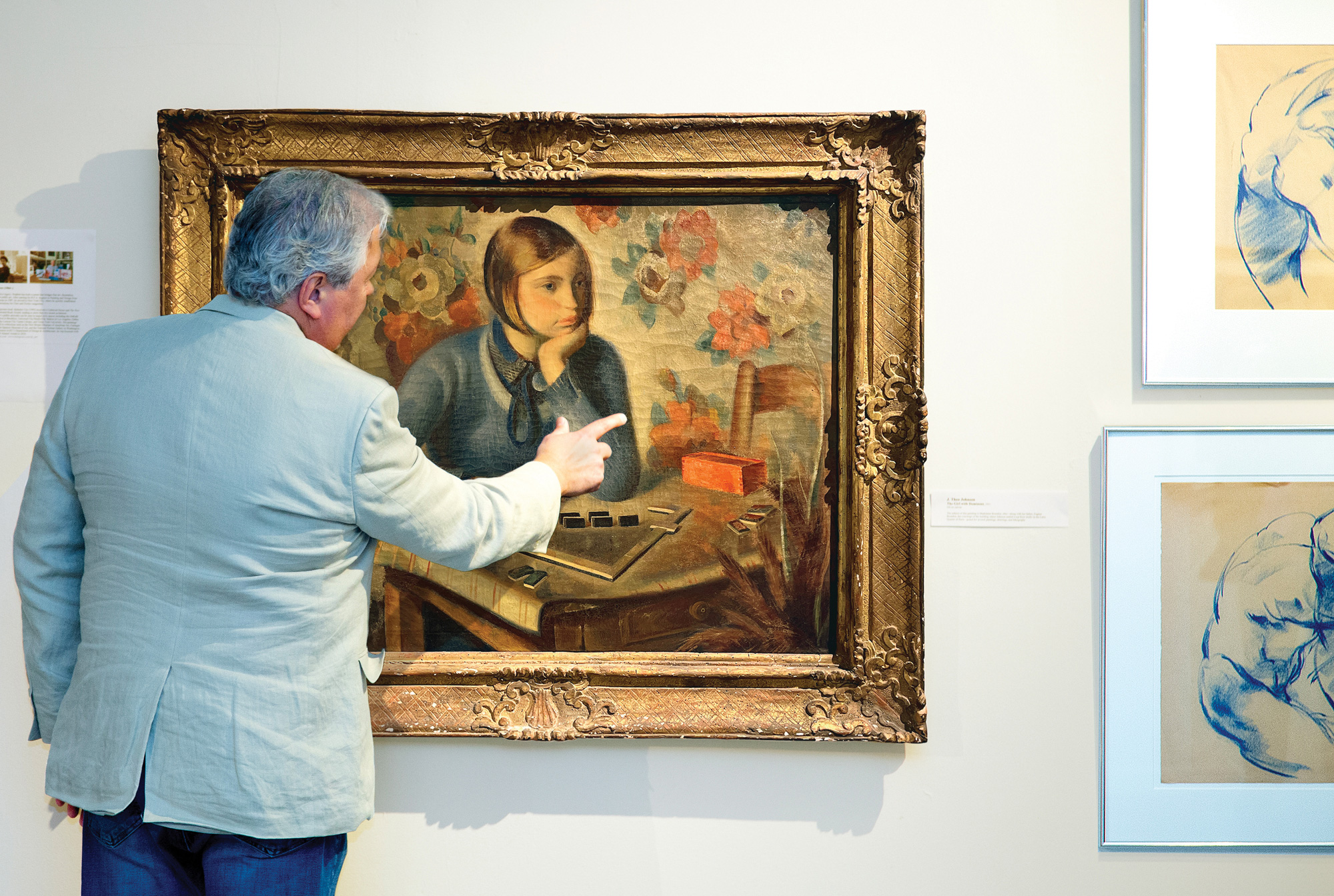
During a Q&A at his Three Generations Show, Stephen references “The Girl with Dominoes” a painting by his grandfather J. Theodore Johnson.
Stephen Johnson’s grandfather passed away while Stephen still was in his mother’s womb, depriving him an opportunity to personally know one of the renown painters of the early 20th century. J. Theodore Johnson studied at the Art Institute of Chicago during the first half of the 1920s, later studied in Paris at Academie de la Grande Chaumière and finished the decade with the prestigious distinction of being named a Guggenheim Fellow for distinguished accomplishment in his field. He directed the painting department at the Minneapolis School of Arts from 1938 to 1945 and served as a professor of art at San Jose State College from 1945 to 1963, where esteemed artists like Wayne Thiebaud and Edward Navone credited him as a transformative mentor.
He completed three murals for large metropolitan post offices and produced numerous commissioned portraits, and his work is represented in permanent collections at The Art Institute of Chicago, the Minneapolis Institute of Art, San Jose State University and the Smithsonian American Art Museum.
Yet his most important work—at least to young Stephen—was a portrait of an old man drawn in charcoal that Stephen had always displayed on a wall in his bedroom. He would later print the portrait in the foreword of his book, “A is for Art: An Abstract Alphabet.”
“It was a brilliant drawing of a human face,” Johnson says. “Our home was filled with my grandfather’s paintings, their quiet yet intellectual power becoming part of our family’s aesthetic.”
Johnson’s father, John Theodore Johnson Jr., known to all as “Ted,” inherited his father’s talent and was a gifted drawer in his younger years. But witnessing the realities of an artist’s life through his father, he later embraced the roles of intellectual and academic. A Fulbright Scholar in medieval studies with a Ph.D. in French literature from the University of Wisconsin-Madison, Ted, who passed away in September 2024, taught for decades at KU, earning the HOPE Award and the Chancellor’s Award for Excellence in Teaching. He also was a member of Mensa, and his “Theodore Talks,” an online Mensa lecture series named in his honor, has been viewed in 49 states and 10 countries.
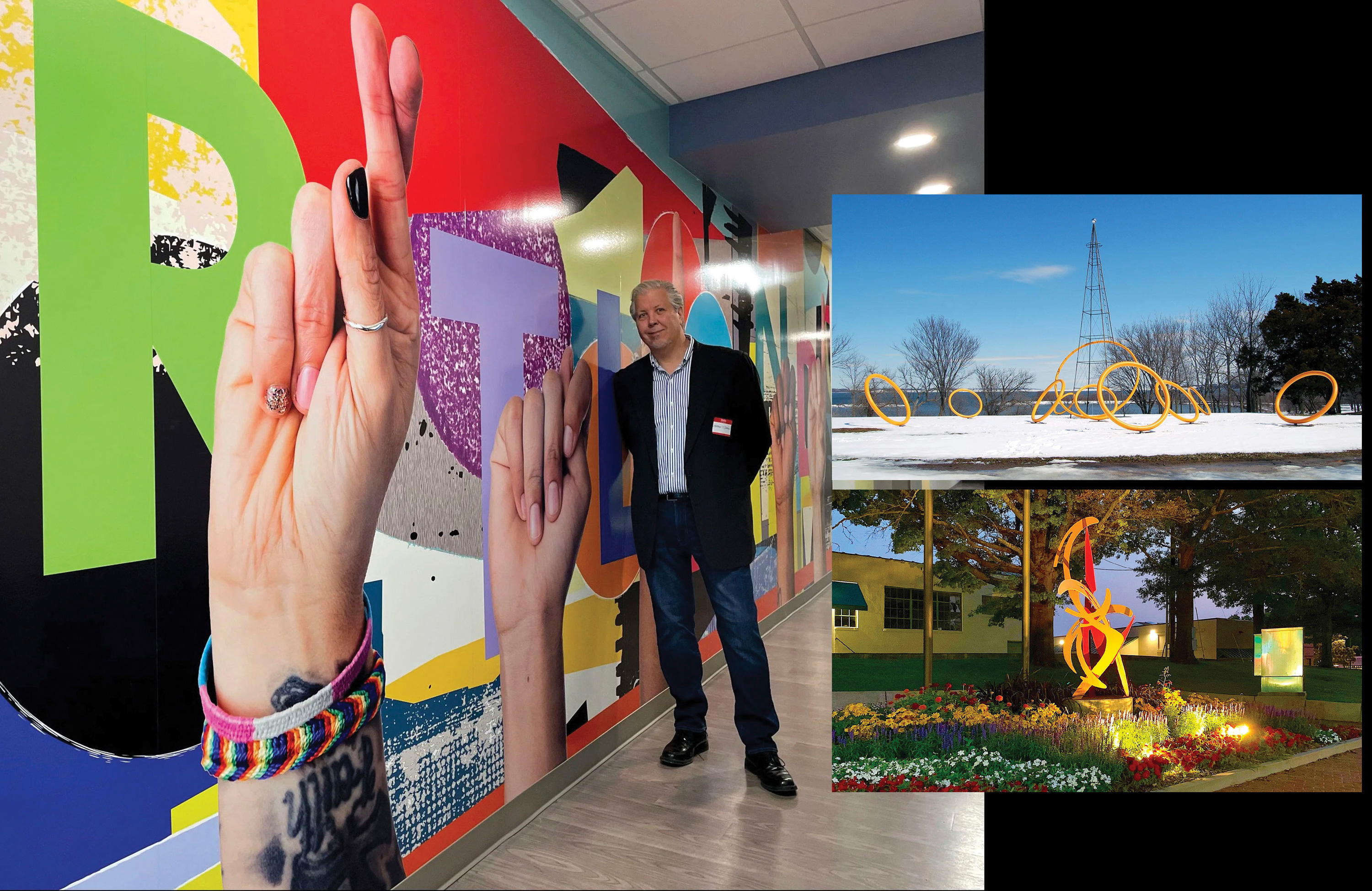
Stephen Johnson beside his mural “The Language of Care” at the Heartland Community Health Center; Freedom Rings by Stephen Johnson; Freeform by Stephen Johnson.
And still, his drawing never left him. In the 1980s, Ted cofounded a local life drawing group and sketched nearly every weekend for 40 years. His figure drawings and watercolors are held in private collections and in the Albrecht-Kemper Museum of Art, in St. Joseph, Missouri.
Stephen says for as long as he can remember, he’s drawn well. And yet, after graduating from high school, all he wanted to do was play in a rock band. That changed during his sophomore year at KU, when he was walking back to his dorm one afternoon with a classmate who told him about an illustration class.
“As a kid, you just want to find something you can do well,” he says. “Drawing came naturally, but I didn’t yet have a voice. Illustration changed that … each assignment gave me a spark, an idea to interpret visually. It made me think, imagine and invent.
“And honestly, it’s fun to be published,” he adds.
Spending time in France with his parents—his mother, Mary, is also a French professor—helped shape young Stephen. The family lived there periodically, and he found the culture historically rich, linguistically playful and endlessly inspiring, which deeply influenced his artistic vision.
“My dad’s greatest gift was his unwavering belief in me and my art,” Stephen says. “There was no competition, no ego, just pure support.”
Continuing his family’s legacy, Stephen graduated from KU with degrees in both painting and design, and has built a career that bridges fine art, illustration, children’s books and public art. Not only has he commissioned works for such prestigious publications as Time and Forbes magazines, but his public works can be seen in major civic spaces, including the DeKalb Avenue subway station in Brooklyn, N.Y., Universal City/Studio City Station in Los Angeles, Dallas Love Field Airport and Texas Tech University. Perhaps his best-known work is a picture book, “Alphabet City,” published in 1995, which earned him a Caldecott Honor, a gold medal from the Society of Illustrators, and The New York Times Best Illustrated book award.
LOCAL MATTERS
Our Local Advertisers – Making a Positive Impact
He also has followed in his parents’ footsteps in academia and teaches several illustration and drawing classes at KU. In 2024, he was honored with the KU Distinguished Alumni Award.
Stephen connected all three generations of Johnsons’ artwork together in an expansive exhibition titled “Transformations: From Art School to Art World—Stephen, Ted and J. Theo Johnson,” at KU’s Edgar Heap of Birds Family Gallery, Department of Visual Art and Chalmers Hall, which ran through early November. While the name Theodore unites all three men (yes, it’s Stephen’s middle name as well), their passion and work has created a creative lineage that tells a story of enduring curiosity, craftsmanship and care for the human spirit.
“I think all parents want their children to be who they are, without parentheses,” he says. “When you’re young and discover a passion to build around, it becomes a kind of muscle memory, a rhythm of skill and drive that carries through everything you do in life.”