| story by |  |
| photos by | Steven Hertzog |
| OPEN A PDF OF THE ARTI-CLE |
A trend toward getting to know where food comes from has taken hold, with several farm op-tions for locals to choose from in the Douglas County area.
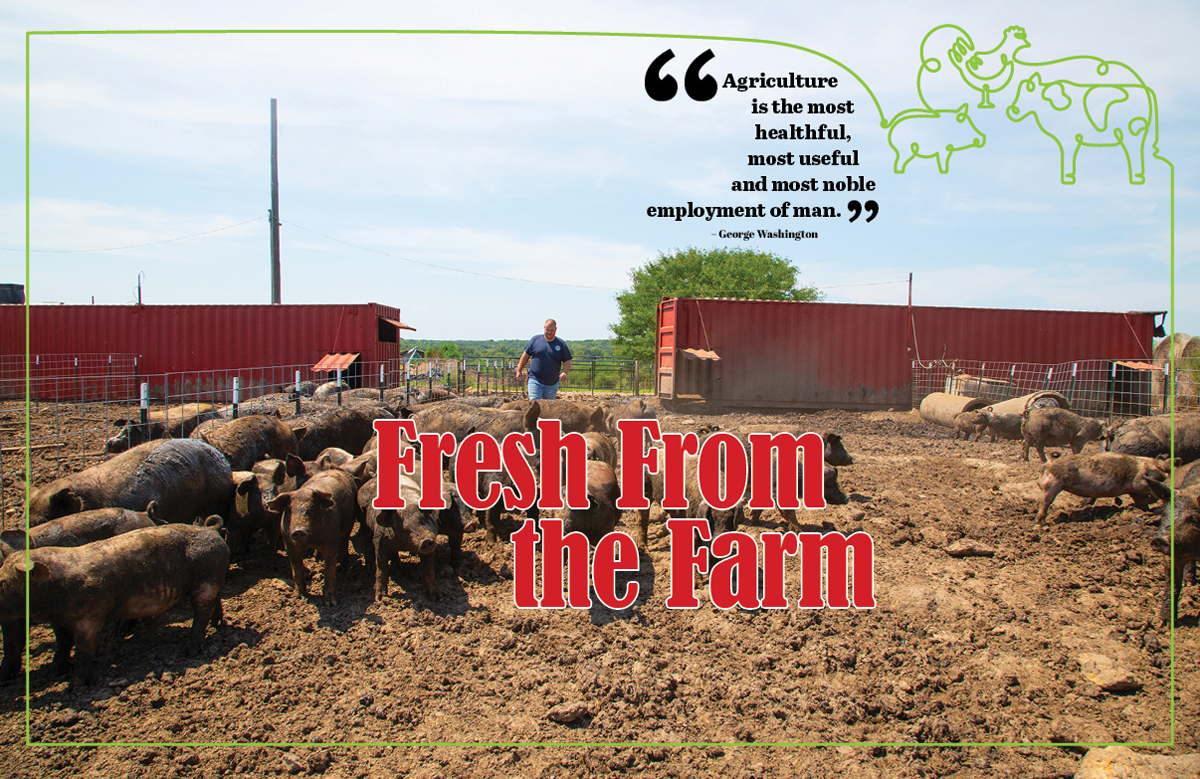
Jason Wulfkuhle herds his swine
Most people make weekly trips to a grocery store and purchase meat, poultry and eggs without a single thought given to where it came from. There never is a thought about how it was harvested, processed, packaged and shipped, or how the animals that provided the products were raised. That’s a normal process most of us have been raised on and, most probably, take for grant-ed.
But in these times where words like sustainability, community and organic have become burgeon-ing concepts that appear to be evermore omnipresent and popular, there’s a growing number of folks who have gained an appreciation for knowing and even having personal relationships with the farm-ers who grow and raise their food.
 Agriculture is the most health-ful, most useful and most noble employment of man.
– George Washing-ton
Lucky for them, there are a handful of options available in the Lawrence area to purchase any-thing from farm-fresh eggs to rib-eye steaks to summer sausage and jerky. All are raised and sold by farmers on family-owned farms, some of which have been around for generations, others newer, all within a short drive from town.
- Lone Pine Farms, just west of Stull, has been around for six genera-tions of the Wulfkuhle family but didn’t delve into livestock until Lloyd A. Wulfkuhle began raising hogs in the 1960s. After a 25-year break from the late 1990s to the 2020s, Lloyd’s grandson, Ja-son, restarted the hog business. Today, Lone Pine sells everything from pork shoulders to pork chops to brats, even ice cream (that comes from an outside vendor) through its retail storefront located on the 125-acre family farm.
- Amy’s Meats raises beef cows, dairy cows, heritage pigs, meat birds and egg-laying birds, and sells all the harvested product through what owner Amy Saunders calls her “member farm,” in which people purchase monthly subscriptions where they can drive out to the farm about eight miles north of Lawrence and pick up bags of meat, eggs and milk.
- Bauman’s Cedar Valley Farm takes a little more effort to get to, as it’s lo-cated just outside Garnett, but owner Rosanna Bauman undoubtedly believes the drive is worth it for the homegrown chicken, eggs, turkey and pork she sells mostly through direct marketing. The three-generation, 120-acre farm claims it “works to produce quality food, meaningful work and a better world.”
Though some might not recognize a difference after shopping at the local grocery store their en-tire lives, these community farmers argue that locally grown livestock, sold at the farm, tastes appre-ciably better than beef or pork from mega farm-factory feedlots or industrial hatcheries.
LOCAL MATTERS
Our Local Advertisers – Making a Positive Impact
“Our typical customer ranges from young families, dads … ” Bauman says. “Fifteen percent of our business comes from single-household natives who remember how good food used to taste. They come for flavor, nutritional impact. And some come just because they know us and know how we raise and harvest our animals.”
Whether better taste or greater nutritional value can be had from shopping for meat, poultry and eggs from local farmers might be subjective, it might be worth a short drive if, for nothing else, to check out the experience of being on the farm, getting to know farmers and learning the story of how the businesses started.
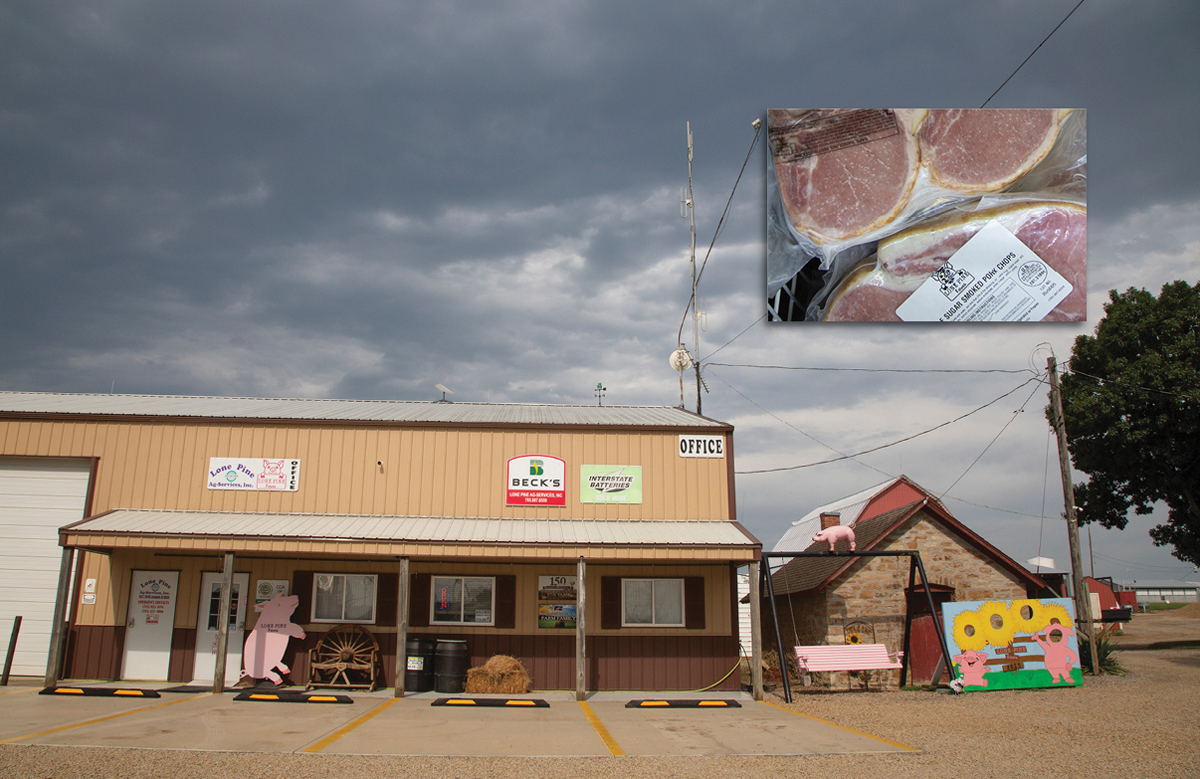
The Lone Pine Store sells their pork di-rect to their customers
Going Hog Wild at Lone Pine
The first thing you’ll notice before even stepping foot into the retail space at Lone Pine is La-dy.
Lady is a 2-year-old, 600-pound gilt that resides in a pen sitting just adjacent to the south of the store and is the official mascot of Lone Pine Farms. Hand-fed by Jason Wulfkuhle or one of his em-ployees each and every morning, when Lady doesn’t have her snout sticking through the wire fence entertaining visitors, she’s lying in a bed of mud under a shaded overhang to escape the summer heat.
“We don’t breed her because we want to make sure she sticks around for a long time,” Wulfkuhle says.
At one point back in the day, Lloyd Wulfkuhle had up to 600 sows on the farm, and his wife sold processed pork out of freezers in her dining room. Today, Jason Wulfkuhle raises a more modest 30 sows, along with six boars, and operates out of the much more convenient farm store. He says a pig can “farrow”—or, give birth—2½ times a year. A typical litter for a sow is eight to 12 piglets, which can grow from 2 pounds at birth to 300 pounds in six to seven months.
Wulfkuhle says he sends his hogs to a U.S. Department of Agriculture-certified processing plant in Smithville, Missouri, and the pork returns packaged and ready to sell.
“We supply a restaurant in Lawrence,” he says. “Everything else is sold here in our store. We go through 300 to 350 hogs (per year) through our freezers in here. We cut everything but the organs. We have pigs feet, hocs, everything you can imagine.”
Lone Pine also has two chicken pens—an outdoor pen and indoor nesting pen—and has around 70 chickens. Wulfkuhle says the farm sold 1,200 dozen eggs last year.
People come from far and wide to Lone Pine Farms for an opportunity to purchase top-grade pork, eggs and more.
“People come all the way from Alma (Kansas), Topeka, Lawrence, Kansas City,” he says. “We av-erage 30 to 40 customers a day.”
Wulfkuhle says Lone Pine strives to keep prices competitive with local grocery stores.
“Our prices may compare to the grocery store,” he says, “but our quality is not comparable.”
Outside vendors sell other goods at the farm store, including beef, milk, cheese, honey, hand-made goods and, one of the most popular offerings, ice cream from Flint Hill Pints, out of Alma.
Wulfkuhle also farms crops and sells seed in Douglas County and seven surrounding counties. Lone Pine is part of the Kaw Valley Farm Tour, which takes place Oct. 4 and 5, and the farm will offer hayrides, pig-viewing and grilling pork.
“We’re just going to keep doing what we’re doing,” Wulfkuhle says. “Riding the wave.”
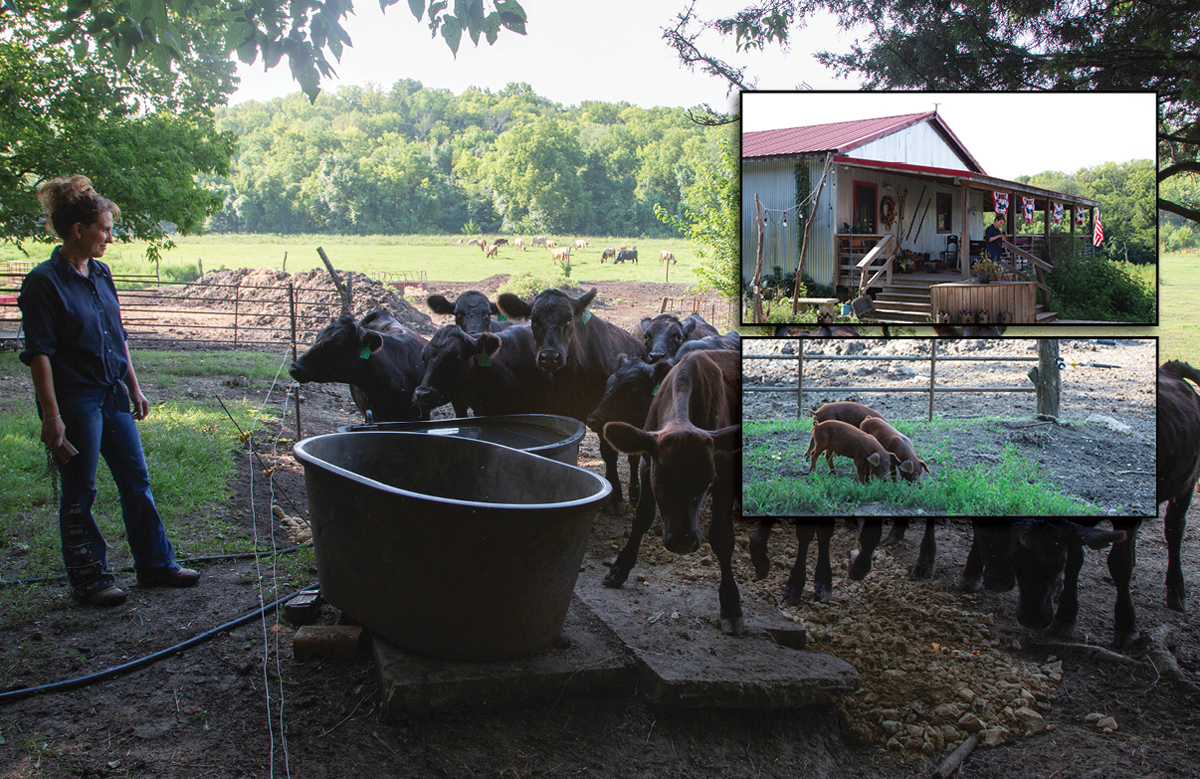
Amy Saunders on her Homestead Farm
Amy’s Member Farm
Amy Saunders can’t help but laugh at herself sometimes.
“If there’s a hard way to do something, that’s what I do,” she says with a chuckle inside the small still-under-construction building that houses several coolers of all sizes along with hundreds of cloth bags that hold meat for members of her food subscription service, Amy’s Meats at the Home-stead.
In addition to running the farm, Saunders is mother of six, five of whom she homeschools (her oldest is grown, has his own farm and raises lamb offered by Amy’s Meats). All meals for the family of eight—her husband is a pipefitter for a local union—are cooked at home. So she understands busy and knows how to budget.
In addition to the cows, pigs, birds and two horses roaming the pastures and hillsides of her 53-plus acres, she rents more land to supplement needs—she has two hives of bees on the proper-ty.
“They’re the pollinators,” Saunders says. “They keep everything growing and going.”
She takes great pride in raising her livestock humanely. She says it can have a positive impact on the flavor of meat postharvest.
“We’ve always raised our livestock differently,” she says. “We focus on quality of life. They graze on grass. They’ve got fresh water and hay. We’ve always done it this way.”
Buying feed also gives Saunders an opportunity to support fellow neighbors, she says.
She also has three hoop houses where she grows heirloom vegetables.
“They’re beautiful and extremely hard to grow,” Saunders explains. “We have tomatoes that are purple and jet black inside that have a whole different flavor. And we have lettuces that aren’t green but red and purple.”
The beauty of her member farm model, she says, is that every customer owns his or her buying power. They simply pick a bundle size and pay that corresponding amount monthly. And they can pick and choose what kind of product they want in the bag.
“It’s just like a grocery cart,” Saunders says. “It’s a year membership, so people can buy $1,000 worth of meat but not have to pay it all up front.”
There are three levels of membership, she explains, all paid monthly on an annual basis: $50, $150 and $250. She says most families join at the $150 level, which is not enough to feed a family of four for a month, but it’s a start.
She says she currently has 75 members, feeding 300 people.
“My customers are my bank,” Saunders says. “Everything’s on a cash basis. I know I have X amount of money every month. I know I can meet expenses. The consistent thing is, those who think food is important, they’re in.
“Doing this 19 years ago was a leap of faith, but I’m really glad I did it,” she adds.
The farm also has hosted weekly “farm-to-fork pizza nights” on Friday nights during mild-weather months, but that was put on hold temporarily after the weight of snow from January’s blizzard col-lapsed the roof over the pizza oven.
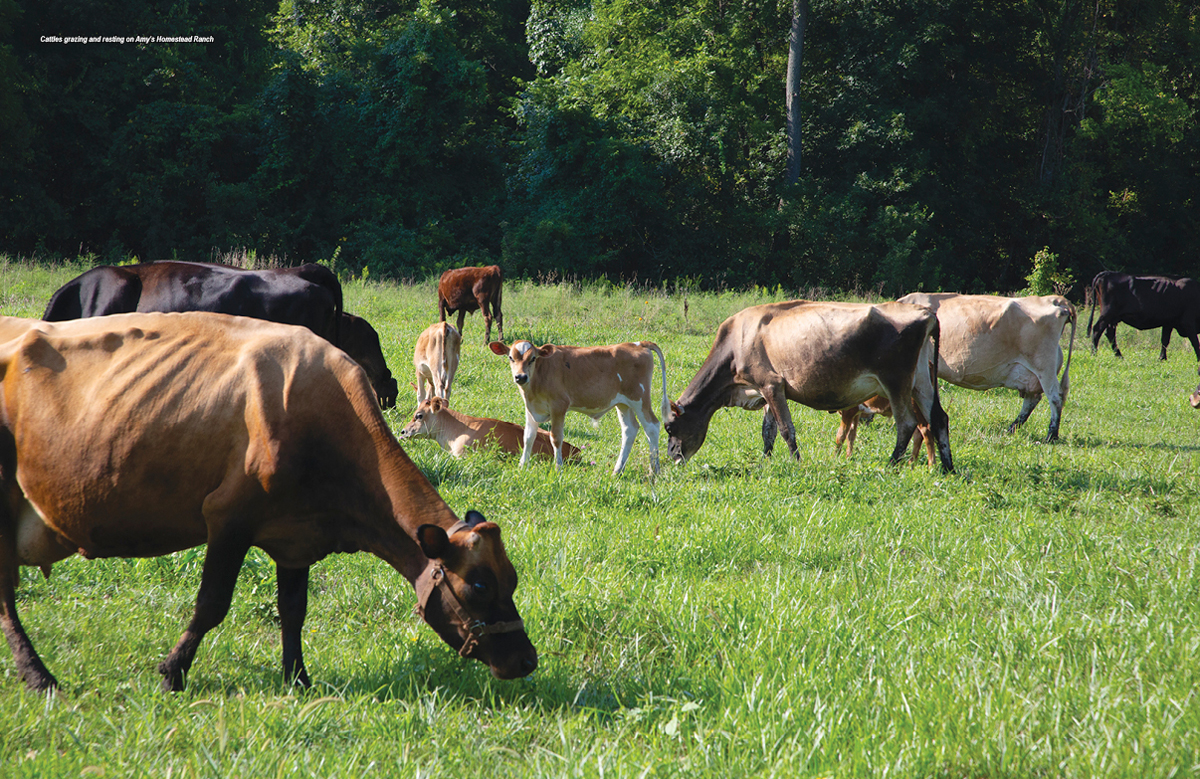
Cattles grazing and resting on Amy’s Homestead Ranch
Just Don’t Give Up
The Bauman family has been on its farm, seven miles west of Garnett, near Cedar Valley Reser-voir, for 25 years, having replaced a family of displaced farmers at the turn of the century. In addition to raising chicken and duck eggs, turkey, beef and pork, they operate two processing plants, one in Ottawa and one in Garnett.
Absolute numbers are a challenge to determine, but Bauman reckons she has somewhere be-tween 500 to 1,000 “layers” (chickens relied on for egg production) and around 5,000 “broilers” (those harvested for poultry products). She says she also has around 60 pigs and 40 head of cattle.
Bauman’s Cedar Valley Farms also is a sustainable enterprise, but Bauman is first to admit the reasons for that are entirely practical.
“We couldn’t farm that many acres, and the only option we had really was sustainable farming,” she says. “We couldn’t afford any of the fertilizers or chemicals a lot of farmers around here use when we started.”
All Bauman’s livestock grazes on pastureland, she explains. Most of their acreage also is tillable, meaning it’s ready to be worked and planted without any removal of trees or rocks.
“Organic farming was the way to go,” she says. “We have all non-GMO (genetically modified or-ganism) crops and plants. It’s all natural.”
Bauman says she sold her products mainly through wholesale during the first 10 to 15 years on the farm but grew frustrated with the corporatization of pasture-based products. So she switched to direct marketing, which seems to be going well, at least for now.
“One thing we’ve learned after so many years is that we just don’t give up,” Bauman says. “It never gets any easier, but we don’t quit.
“Nature is diverse, people are diverse, and we’ve been fortunate to capitalize on those strengths. We believe this farm has been a work of God. That keeps us pushing forward,” she adds.
During the regular market season, people can shop the Bauman’s Mobile Meat Market at the Overland Park Farmers’ Market on Wednesday and Saturday mornings, as well as The Olathe Farm-ers Market on Saturday. There is also a preorder shop where customers can reserve meats, dairy and baked goods, which sometimes do sell out.