| story by | |
| photo by | Steven Hertzog |
| OPEN A PDF OF THE ARTICLE |
Agriculture is key to a healthy economy, and its constant transformation has a big impact on local farms and communities.
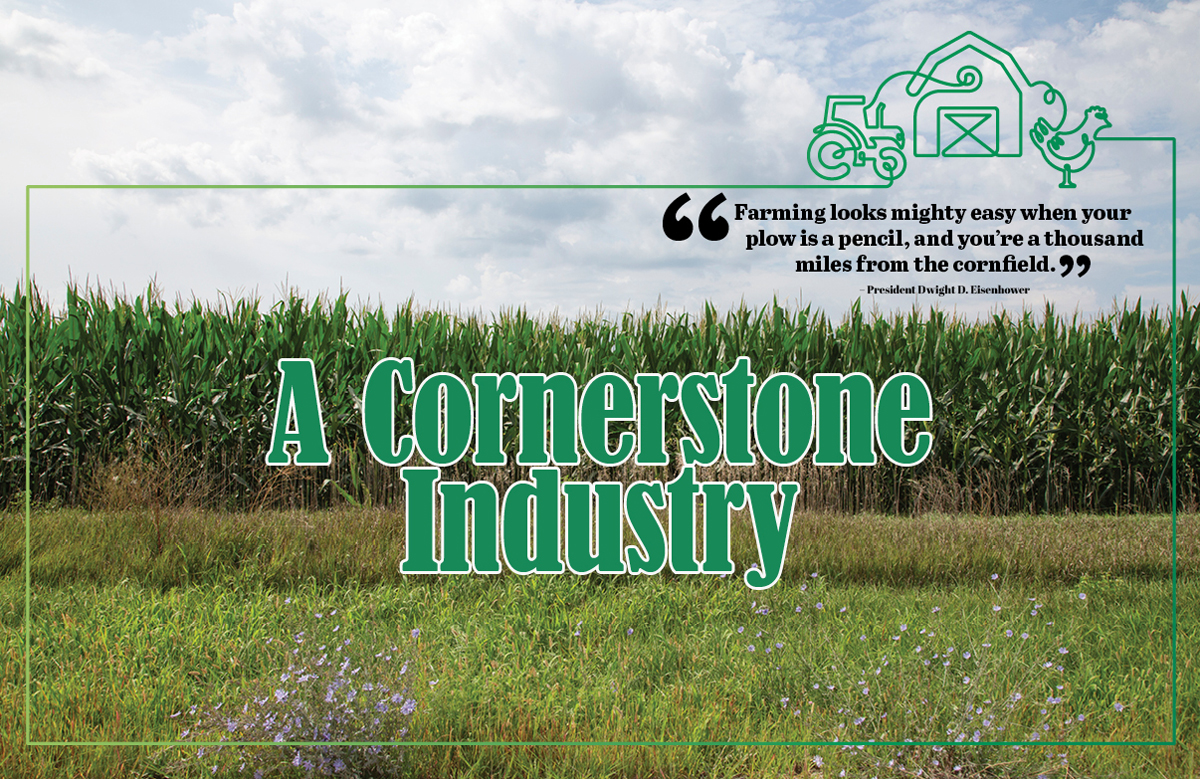
Cornfields of Douglas County
Agriculture is fundamental to the American economy, permeating communities well beyond just fields and farms. It nourishes local and worldwide populations while supporting jobs across all sectors. The agriculture industry fuels the nation daily while substantially contributing to its economy. Throughout generations, farming has been a story of community, innovation and resilience.
 Farming looks mighty easy when your plow is a pencil, and you’re a thousand miles from the cornfield.
– President Dwight D. Eisenhower
American novelist, poet and essayist Wendell Berry, also an environmental activist, cultural critic and farmer, once said in an essay that “eating is an agricultural act.” Margit Kaltenekker, agriculture agent with Kansas Agricultural Experiment Station and Cooperative Extension Service (Douglas County Extension), wholeheartedly agrees. “Fundamentally, we all eat. And if you eat, healthy, robust, sustainable and regenerative agriculture is the sine qua non and the foundation of our economy. This has been true for millennia and was a key vision of our founding fathers, foreseeing a healthy, robust economy based upon agrarian smallholders reaping abundant harvests across this continent.”
The United States is one of the world’s largest agricultural exporters, according to the U.S. Chamber of Commerce, with food and agriculture supporting more than 34 million jobs. People working directly in the agriculture and food sectors contribute nearly $3.8 trillion in economic output and earn wages amounting to nearly $1 trillion. Those working indirectly with the agriculture and food sectors comprise more than 12 million additional jobs, contribute nearly $3.1 trillion in economic output and earn wages amounting to $915 billion.
In 2023, the U.S. Dept of Commerce Bureau of Economic Analysis indicated agriculture, food and related industries contributed $1.537 trillion to the U.S. Gross Domestic Product (GDP), or 5.5 percent. Direct farm output ($222.3 billion) represented only a fraction of that total since value-added manufacturing, forestry and fishing are part of this economic sector. They also provided 10.4 percent of U.S. employment. Expenditures on food accounted for 12.9 percent of U.S. households’ spending, on average.
In Kansas, agriculture is the largest industry and economic driver, according to the Kansas Department of Agriculture, with 73 agriculture, food and food-processing sectors combining for $61.89 billion in direct output in the Kansas economy and supporting over 260,000 jobs.
Locally, Douglas County has more than 210,000 acres of land use devoted to agriculture, according to Douglas County Extension website. Acres dedicated to crops include 60.4 percent, while 26.6 percent is pastureland, 6.7 percent is woodland, and 6.2 percent is in other uses.
Douglas County figures reported in the 2022 USDA Census of Agriculture and the 2024 Kansas Department of Agriculture Economic Analysis indicate agriculture and agriculture-related sectors contributed a total estimated impact of $663 million in output, or 4 percent of the GDP to the local economy. They also support a total of 2,758 jobs, or 4 percent of the county’s entire workforce.
The good news for Kansas farmers, according to Douglas County Extension, is that economists and others project a $2.6-billion increase in total farm income in 2025, spurred by one-time government payments meant to blunt the effects of recent economic- and disaster-related losses.
However, according to the Kansas City Federal Reserve Bank, even if input prices are softening or yields are in the average to normal range in 2025, commodity prices remain low. Without drought disaster relief expected in 2026, concerns of declining farm income do exist.
Exclusively Douglas County
Tom Buller, executive director of the Kansas Rural Center, says agriculture is a key innovation for the economy of not only Douglas County but every Kansas community, and doing what they can to make sure it is not only a solid foundation but one that is responsible is extremely important. He says the Center aims to build communities around agriculture, and in turn, agriculture serves the communities it surrounds.
“We really try and support some of those farmers doing things a little differently, trying to sell their food locally rather than the large-scale … folks selling to export markets or moving into more of the commodity streams.” He believes Douglas County is a good example of local innovation: “Douglas County is a leader, so we are trying to share that model across the state.”
LOCAL MATTERS
Our Local Advertisers – Making a Positive Impact
Buller says agriculture is the largest industry in the state and “has impacts in every county across the state. And in many rural communities, it is the key driver of the economy. Compared to many other parts of the state, Douglas County has a larger number of smaller farms, and especially those growing fruits and vegetables, and diversified homestead operations. We also have a smaller average farm size than many areas of the state, especially further west, where substantially larger operations tend to dominate.”
He says agriculture can mean different things to different people. “The impacts on the community will be very different if we are talking about small, diversified farms growing and selling products through a local farmers market, or a 40,000-animal confined hog-production facility that pollutes the air and groundwater of a region. The impacts and benefits depend on the localized mixture of what is going on,” he adds.
“The county has somewhat of a mixed production,” Buller continues. He says down in the river valley and in the south are row crops such as corn and soybeans. In the hillier transition areas, there’s more hay ground grazing and livestock. “It just kind of depends on exactly where you’re at, but I think compared to a lot of other counties in Kansas, Douglas County has a more balanced economy. It isn’t dominated by agriculture; there’s a lot of other things going on.”
Douglas County Extension’s Kaltenekker says agriculture, representing 4 percent of the GDP in the county, may seem like small peanuts compared to other economic sectors, but we have to consider that a majority of the production includes grains like corn and soy, which are raw materials that contribute to larger agricultural markets, such as ethanol and feedstuffs for poultry farms or dairies out West.
“When considering the overall importance or ‘value’ of agriculture in Douglas County, we must consider the greater positive impacts that go beyond the economic impact alone, since the value of a healthy agriculture is rooted in the community of relationships across all sectors of the local economy,” she explains. When looking at the entire economy as an ecosystem, with producers being a cornerstone or “keystone species,” within that economy, there are many more metrics that aren’t being factored into the related sectors—marketing, software, banking and finance, trucking or technology industries—that are needed to sustain family farms, she continues.
Passing It Down
Kaltenekker says the intergenerational traditions and contributions being sustained through agriculture in Douglas County are invaluable, with many farm families being fourth, fifth or sixth generation and counting. “There’s been a resurgence of interest amongst the next generation of youth to step into agriculture, even more ‘first-generation’ beginning farmers across the country, and it’s up to our community to ensure there is room for them—literally and figuratively.”
Farmland preservation policies and succession planning are essential to keeping agricultural land in production for future generations, she continues. The value of agriculture goes beyond the “homegrown” human, family relationships that are sustained by the land. “It truly begets the culture. That provides depth to our community that’s priceless.”
Traditionally in the past, agriculture fed local communities. “I think we’re seeing a return to that … ” Kaltenekker explains. “There are some aspects of people demanding more local produce and wanting a connection to their land and to the community that’s feeding them. I think we’re seeing a return to those roles in our own community. There’s an increasing awareness in Douglas County and demand for locally grown produce.”
Another important aspect of agriculture in Douglas County is the employment it brings into the community. Buller says agriculture can be a driver of job creation, especially smaller scale, diversified farm operations. “Farms are employers. They’re community members. I think a lot of them do a good job in that area,” he says.
Kaltenekker agrees. She says most of the local farms are operating as family farms. “It might be one family farm, but they’re going to be employing other farm workers that are local people … local residents, local citizens, that will be employed by some of the bigger family farms or larger operations.”
Some local specialty crop farms also pull in H2A workers, a program that allows U.S. agricultural employers to bring foreign nationals to the United States to fill temporary or seasonal agricultural jobs when there are not enough qualified domestic workers.
Taking Care of the Land
Buller believes one of the key responsibilities for any farmer is stewardship of the land. “And the way they handle that, of course, is different from the kinds of products they’re producing. It not only impacts their own farm productivity over time but also has a lot of impacts on the community in terms of water quality or what kind of runoff is happening from their fields.” He says most farmers strive to be good stewards but warns that paying attention to the best techniques out there is important, as well.
Kaltenekker agrees, adding that soil, air and water quality are of great importance. “We have to look at the fact that our social responsibility in agriculture is to take care of the environment and to take care of each other. It’s all interrelated,” she explains. Agriculture provides other net value, such as pastureland that provides carbon sequestration for our air quality and soil health, which leads to better water quality, while water infiltration requires good soil health and good functioning agricultural systems. “It’s all tied together,” she adds.
Technological Advancements
The World Economic Forum (WAF) explains that the global agrifood system needs to adapt to the impacts of climate change and figure out a way to feed a growing population of over 8.2 billion people. With the agriculture sector being the second largest global emitter of greenhouse gas emissions and responsible for 70 percent of all freshwater withdrawals globally with more than half of agricultural land being degraded, it’s no wonder global productivity losses have gone up to $400 billion per year.
So how are those in agriculture trying to reshape the way it works to make it more profitable? Technology. The wide range of technologies—sensors, drones, robotics and data analytics that optimize resource use, enhance crop yields and improve worker safety—can make ag more efficient, sustainable and profitable, according to WAF. Integration of some or all of these technologies can boost productivity and minimize environmental impact, creating new economic opportunities.
“A key advantage of precision agriculture [technology and data analysis to optimize resource management and improve crop production efficiency]is that it allows farmers to target very precisely applications of things like pesticides and fertilizers,” Buller explains. “It allows farmers to do things like grid-sampling of the soil, loading the results into their equipment and applying more or less fertilizer or pesticides, depending on the needs of each area of the field. That information can by synced with harvest data to figure out additional information for tailoring the following years’ applications.”
While precision ag equipment can be expensive, he adds, it can save farmers money by preventing them from overapplying inputs, which are also expensive. “This has a positive downstream (literally) impact in that there is less pollution in runoff that would impact waterways.”
Kaltenekker believes on-farm trials and the use of data in agriculture are key to moving the dial and transitioning more of the production into full regenerative production, allowing for a net benefit on the environment as well as farmers’ pocketbooks. Gabe Brown, South Dakota farmer and author of “Dirt to Soil,” defines the term “regenerative agriculture” as “farming in synchrony with nature to repair, rebuild, revitalize and restore ecosystem function, beginning with all life in the soil and moving to all life above the soil.”
“Part of my vision of what I’m trying to work on,” she says, “is building a peer-to-peer network with on-farm research so that we have more trials in the fields here in Douglas County, where farmers can come and see and meet and talk to each other about what they’re doing with these practices.
“It’s a win-win, it’s just a matter of getting that flywheel going, whether it’s mindset or the biology in the soil, and the rest will take care of itself, because the markets are there.” She believes education and getting the information out there, offering support to those farmers who are listening, are vital. “Farmer-to-farmer education, a support network—behavior change happens best when there’s support.”
However, when asking farmers to make any kind of a change, there are always questions, she explains. What might they need to adjust? What’s the payoff? Is it either going to save them money or help them make money? Is it going to cost money or require new equipment? Therefore, cost-share payments for cover crops help a lot.
Kaltenekker is working with agronomists at Kansas State University and others to create a network and make these on-farm trials happen locally, “because farmers are putting crops in anyway.” She says it’s just a matter of coming up with a trial that doesn’t cost a lot to put on and then cooperating with farmers to help collect the data. There’s a lot of potential to learn about simple agronomic practices that can have a positive environmental and economic impact,” she says.
“I’m trying to build that network and then collaborate, pull together the farmers who are willing to participate—give up maybe 10 or 20 acres, then deciding, ‘Where can we take this? Listening to farmers and asking, ‘What else could we do to improve soil biological function?’ “
Once producers understand how their agroecological systems function and the principles of soil nutrient cycling revealed by new scientific insights to plant nutrition, she explains, they can tweak their existing cropping systems, integrate more livestock and run with it. “It takes a little more ‘whole farm’ planning, but farming becomes more fun with potential for significant payback through reduced input costs alone.” Just as it’s always been, “Farmers are continually going to have to reinvest in new technology to stay ahead of the curve,” Kaltenekker adds.
Douglas County Extension has worked diligently to build relationships with local producers and private ag businesses, while collaborating with local organizations, community leaders and individuals to understand local priorities and build support for Extension programs. Some of Douglas County Extension’s close partners include Douglas County Conservation District, Natural Resources Conservation Service, the Kansas Alliance for Wetlands and Streams (KAWS), Wetlands Restoration and Protection Strategy (WRAPS) and Kansas Forest Service, among others. These agencies help provide technical and cost-share assistance to farmers and ranchers.
In Douglas County, Kaltenekker works closely with the Douglas County Sustainability Office, Douglas County Food Policy Council, Lawrence Farmers Market, Growing Lawrence and the newly formed Kaw Valley Prescribed Burn Association. She says, “We all have a close working relationship promoting soil and water conservation, and building a constituency amongst farmers and ranchers, since preserving water quality in the Clinton Lake Reservoir is essential for our municipal water supply.”
Follow the Dollar
Despite all the challenges in agriculture, Kaltenekker believes the recent renaissance, or recognition, of the value of farmers resurfacing is refreshing. “We have to recognize how hard farmers work to provide these goods, services, food, inputs … and we need to value that,” she says. We in the United States have some of the lowest food prices in the world, even though we are feeling it in the pocketbook right now because of inflation, she adds, “but when it gets back to who’s getting that money, why not pay the farmer direct as much as possible?”
So where is the money going if not to the farmer? According to the U.S. Chamber of Commerce, when a consumer spends $1 on food produced in the U.S., just 7 cents of that dollar goes back to the farmers. The rest supports the wrap-around industries that deliver, sell and market food products to consumers. This ripple effect of the food dollar stems from agricultural activities and directly benefits local restaurants, supermarkets and other Main Street businesses.
Kaltenekker believes the intergenerational traditions and contributions being sustained through agriculture in Douglas County are invaluable. “There’s been a resurgence of interest amongst the next generation of youth to step into agriculture, and it’s up to our community to ensure there is room for them both—literally and figuratively. The value of agriculture goes beyond the homegrown human relationships that are sustained by the land.”
And there’s so much that can be gleaned from other people and other communities, she continues. “When we recognize agriculture is global and that we’re all trying to take good care of our families, to feed our communities, we all have the same goal. That builds unity, not only in our community but in the whole world.”
Kaltenekker says building networks not only in the state of Kansas but nationally and internationally is extremely important on the local level and something she strives to do every day. “Just participating in those conversations as much as possible is key.”
What does she foresee for the future of agriculture? Increased use of AI (artificial intelligence) and trends away from costly, input-heavy production, opting for “cleaner” biological solutions. “Quality matters from the seed to the table,” she explains. “We need a greater understanding that the future of agriculture production depends on functioning soil biology to produce nutrient-dense, mineral-rich food.”
Kaltenekker says more technological and nutritional research in “food as medicine” is needed to prove the saying “We are what we eat.” “A return to the profitable, well-managed, diversified family farms that support multiple generations will create a prosperous, diverse, robust agrarian economy that benefits a healthy, prosperous populace.”